Article
citation information:
Krajňák, J., Tomašková,
M. Engine
compartments of passenger cars: main sources of fire risk and modern prevention
strategies. Scientific Journal of
Silesian University of Technology. Series Transport. 2026, 131, 89-101. ISSN: 0209-3324. DOI: https://doi.org/10.20858/sjsutst.2026.131.5
Jozef KRAJŇÁK[1],
Marianna TOMAŠKOVÁ[2]
ENGINE
COMPARTMENTS OF PASSENGER CARS: MAIN SOURCES OF FIRE RISK AND MODERN PREVENTION
STRATEGIES
Summary. Motor vehicles
constitute a key component of transport infrastructure and play an
indispensable role in the movement of goods and the provision of services
within logistics and distribution systems. Their reliable and safe operation is
therefore essential not only from an economic perspective but also from a
safety standpoint. The engine compartment represents one of the most critical
zones in terms of fire safety. The elevated risk of fire initiation is
determined by multiple technical and operational factors. Among the most
significant are electrical failures, particularly short-circuit phenomena
within the vehicle’s electrical system, as well as the gradual degradation and
wear of internal combustion engine components. An important role is also
played by high operating temperatures and the presence of hot surfaces, which
can act as ignition sources for flammable substances. The risk is further
exacerbated by the reduced thermal and mechanical resistance of certain
construction materials, especially polymer-based components, which are
increasingly used in modern vehicles. Heat accumulation and restricted natural
heat dissipation occur due to the structural enclosure of the engine
compartment. At the same time, operating fluids (e.g., engine oil, fuel,
coolant) and contaminants tend to accumulate in this space, representing a
potential source of combustible material and contributing to the initiation and
dynamic development of fire.
Keywords: fire, risk, prevention, transport vehicle
1. INTRODUCTION
The
automotive industry has played a leading role in global economic development as
well as in the advancement of new technologies [2]. The use of vehicles to
achieve rapid and safe transportation to distant destinations represents a key
factor contributing to national economic growth and the efficiency of logistics
and service systems [3].
The engine compartments of passenger vehicles
represent one of the most critical areas in terms of fire initiation, due to
several factors, including electrical short circuits, engine wear and
degradation, high temperatures of hot surfaces, reduced resistance of
materials, extensive use of polymer components, engine compartment enclosure,
and the accumulation of operating fluids and contaminants. Statistical data
indicate that a significant proportion of vehicle fires originate in the engine
compartment. For this reason, fire protection of engine compartments is a
crucial aspect of overall vehicle safety.
Particularly
challenging and severe are fires involving large vehicles. In such cases, the importance
of careful and proactive planning of response resources is emphasized, as these
incidents often require substantial towing capacity and extended intervention
times, which consequently prolong incident clearance durations [1]. It is also
essential to prevent vehicle fires in confined environments such as tunnels and
enclosed spaces, where fire development can have significantly more severe
consequences.
Research
results indicate that both internal combustion engine vehicles and electric
vehicles exhibit similar fire dynamics. Studies suggest that electric vehicles
can produce a comparable heat release rate to vehicles powered by fossil fuels,
although differences have been observed in smoke dispersion and visibility
conditions [3]. During vehicle fires, special attention must be given to
batteries. Lithium-ion batteries are frequently associated with fire incidents
due to the phenomenon of “thermal runaway,” which may occur during operation as
a result of internal manufacturing defects or operational issues [4].
Conventional lead-acid batteries also present certain disadvantages and risks
[5].
Several
studies systematically address experimental research on passenger vehicle
fires, particularly in the context of parking facility safety design [6]. A
growing body of experts in fire safety engineering focuses on issues such as
parking garage fire safety [7], protective measures and suppression systems
[8,9], and effective smoke control strategies [7]. At the same time, there is
an increasing need for high-quality, comprehensive data sources related to
vehicle fire incidents.
This article
provides a systematic analysis of the main risk factors, identifies critical
ignition points, and proposes modern preventive measures that can significantly
reduce the risk of fire occurrence and enhance the operational safety of
passenger vehicles.
2. RISK PLACES FROM THE ASPECT OF FIRE
Engine compartments (e.g., in
passenger cars and trucks) are among the riskiest places in terms of fire,
because several initiating and supporting factors are concentrated here at the
same time.
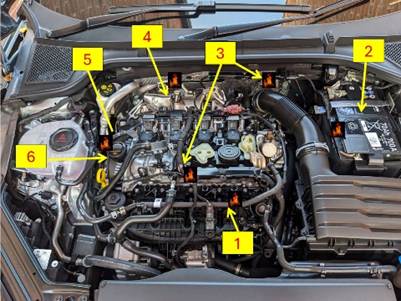
Fig. 1. Engine compartment of a Skoda Octavia
passenger car with marking of fire risk points
(1 - fuel pipe, 2 - battery, 3 - electrical wiring, 4 - catalyst (turbo), 5 -
exhaust pipe, 6 - engine oil filler cap)
Figure 1 shows the engine of a Skoda
Octavia passenger car with the plastic covers removed. The important engine
compartments of the passenger car are marked there along with the
identification of the main fire risk areas. The image presents the engine compartment
after the covers have been removed, which allows for a more detailed
localization of critical components from the point of view of fire initiation.
Position 1 represents the fuel line.
From a fire safety perspective, this system is highly hazardous, as leakage
failures or mechanical damage may lead to fuel leakage (gasoline or diesel). In
combination with the presence of ignition sources (e.g., hot surfaces or
sparks), there is a high risk of fire initiation.
Position 2 shows the battery
(accumulator), which represents a significant source of electrical hazard.
Short circuits, overheating, conductor burnout, or sparking may occur,
potentially leading to fire initiation, especially in cases of insufficient insulation
or mechanical damage.
Position 3 indicates the vehicle’s
electrical wiring. The electrical system is prone to insulation degradation,
mechanical damage, or loose connections, which may result in sparking or short
circuits. These phenomena represent significant ignition mechanisms for fire
development in the engine compartment.
Position 4 identifies components
with high surface temperatures, such as the catalytic converter or
turbocharger. These parts reach extreme temperatures during operation and may
cause ignition of flammable liquids (e.g., leaking oil or fuel) upon contact.
Position 5 refers to the exhaust
system, located in the lower part of the engine compartment. The exhaust system
is characterized by high exhaust gas and surface temperatures, making it a potential
ignition source for accumulated flammable substances or contaminants.
Position 6 represents the internal
combustion engine itself, specifically the area of the engine oil filler cap.
Leakage of engine oil, its degradation, or engine overheating may lead to the formation
of a flammable environment [11]. Oil, in combination with high temperatures, poses a significant risk
for both fire initiation and propagation.
The above-mentioned components
represent the most critical areas from the perspective of fire safety in the
engine compartment. Their technical condition, regular maintenance, and timely
diagnostics are essential for minimizing the risk of fire occurrence in
passenger vehicles.
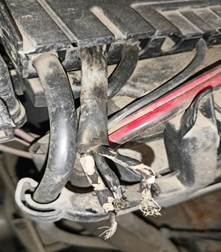
Critical
source of fire initiation within the engine compartment is represented by
electrical faults, particularly short-circuit phenomena. These may arise due to
thermal degradation or mechanical damage of electrical conductors, as
illustrated in Figure 2. Damaged insulation or conductor exposure can lead to
unintended current flow and localized overheating.
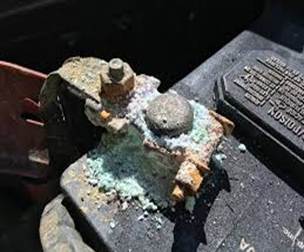
Additionally,
as shown in Figure 3, the oxidation and corrosion of electrical contacts and
connectors can significantly increase contact resistance. This condition may
result in localized thermal loading, electrical arcing, or intermittent
sparking. Such processes represent a significant ignition mechanism and
may act as a primary trigger for fire initiation within the vehicle’s
electrical system.
|
|
|
|
Fig. 2. Damaged - burnt electrical insulation |
Fig. 3. Oxidized electrical connections |
The most
common causes of fires due to electrical wiring are:
• damaged wire insulation,
• vibrations causing loose connections,
• corrosion of contacts,
• aftermarket devices (audio, lights).
The occurrence of a fire in the engine
compartment may also be caused by various mechanical failures. Among the most
common mechanical faults that may act as initiating factors of a fire are the
following:
• engine oil leak,
• damaged fuel hoses,
• engine overheating,
• friction of moving parts.
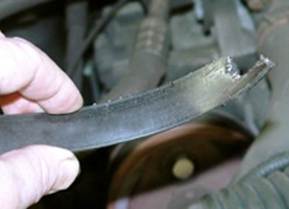
Figure 4
illustrates damage to the drive belt (e.g., rupture or excessive wear) [13]. Such a failure
may lead to secondary effects, including the formation of an electrical arc,
localized overheating of components, or increased friction. As a result, fire
initiation may occur, particularly in the presence of flammable materials such
as plastic components or operating fluids.
Figure 5
shows engine overheating. The mechanism of fire initiation in this case is
based on the contact of a flammable liquid (e.g., engine oil or fuel) with
high-temperature surfaces. This contact may lead to ignition and the subsequent
development of a fire within the engine compartment.
|
|
|
|
Fig. 4. Broken drive belt |
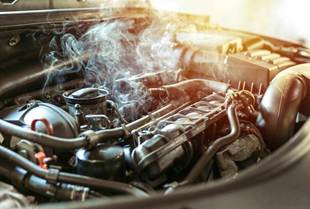
Fig. 5. Overheating of a hot engine resulting
in ignition of flammable liquids |
From a
fire safety perspective, hot surfaces of various engine compartment components
represent a significant risk factor. These include parts such as the
turbocharger, catalytic converter, and exhaust system, whose surface
temperatures may reach approximately 300 to 800°C depending on operating
conditions [10].
These
components act as potential ignition sources, particularly in the event of
contact with flammable liquids (e.g., engine oil, fuel, or other operating
fluids). The impingement or leakage of such liquids onto heated surfaces can
lead to rapid evaporation, formation of flammable vapors, and subsequent
ignition. This mechanism represents a significant risk factor for fire
initiation within the engine compartment of a vehicle.
The use of plastic materials in
modern automobiles is essential and represents an integral part of contemporary
vehicle design. Polymeric materials are widely used for protective covers,
thermal insulation components, fuel system elements, and various structural
parts within the engine compartment.
From a fire safety perspective,
however, their application represents a significant risk factor. Operating
temperatures within the engine compartment may, under certain conditions,
exceed the ignition temperatures of some types of plastics. When exposed to
elevated thermal loads or in contact with hot surfaces, these materials may
undergo degradation, melting, and subsequent ignition, thereby creating a
potential source of fire initiation.
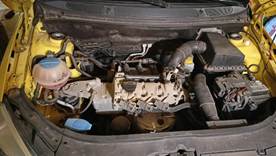
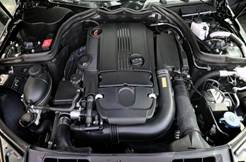
Modern vehicles contain a high
proportion of polymeric materials [12], which, in the event of fire, contributes to faster fire spread and
increased fire intensity. Figure 6 illustrates the extensive use of plastic
components in the engine compartments of Škoda Fabia and Figure 7 Mercedes-Benz
vehicles, clearly demonstrating that these materials constitute a substantial
part of the construction.
For this reason, from a fire
prevention standpoint, it is advisable to prioritize the use of materials with
higher thermal resistance, as well as non-combustible or self-extinguishing
polymers, which can significantly reduce the risk of fire initiation and
propagation within the engine compartment.
|
|
|
|
Fig. 6. Plastics in the engine compartment of
a Skoda Fabia passenger car |
Fig. 7. Plastics in the engine compartment of
a Mercedes-Benz passenger car |
Another
significant factor affecting the fire safety of the engine compartment is its
structural covering. Although enclosing the engine compartment brings certain
advantages in terms of aerodynamics, optimization of air flow and noise
reduction, it also presents several negative aspects. The main disadvantages
include limited ventilation of the engine compartment, which leads to heat
accumulation and increased thermal load on individual components. At the same
time, vapors of flammable liquids (e.g., fuel or oil) accumulate, creating a
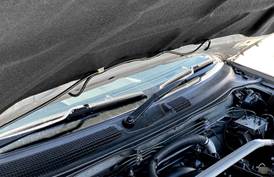
potentially explosive or highly flammable environment. In the event of a fire,
a sudden supply of oxygen may occur after opening the hood, which will cause
intensive development of combustion (the so-called flashover effect), and thus
a sharp deterioration in the course of the fire in the engine compartment. In
Figure 8 we see an example of such an engine cover.
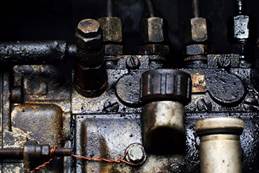
Another
significant risk factor in terms of engine compartment fire safety is the
accumulation of operating fluids and dirt. During vehicle operation, oil
deposits, fuel residues, dust particles, and lubricant deposits are formed,
which are deposited on the surfaces of individual components, as shown in
Figure 9. These contaminants represent a potentially flammable material that
can, under increased thermal load or contact with hot surfaces (e.g., exhaust
pipe, turbocharger), undergo thermal decomposition, evaporation and subsequent
ignition. The accumulation of these substances significantly increases the
risk of fire initiation, especially in conditions of engine overheating or
insufficient vehicle maintenance.
|
|
|
|
Fig. 8. Engine cover |
Fig. 9. Dirty parts and oil residue on |
2.1. Calculation of fire in the engine
compartment
The fire
risk R is often expressed by the formula:
 (1)
(1)
P – probability of fire,
C – consequences of fire (damage, danger to
people, technical loss).
For the engine
compartment, this formula is extended by specific factors:
 (2)
(2)
Factors
affecting the probability of fire (P). Before performing the fire calculation
in the engine compartment, it is necessary to design Table 1, Evaluation
of the engine compartment inspection. This table presents the value of the
factor.
1. Fuel
system
Fuel leakage (petrol,
diesel)
Hose tightness, fuel
pressure
Rating: 1 (low risk)
- 5 (high risk)
2.
Electrical installation
Condition of cables,
insulation
Connections and short
circuits
Rating: 1-5
3.
Engine temperature and operation
Operating temperature
(engine block, exhaust)
Oil and grease
accumulation
Rating: 1-5
4.
Maintenance
Frequency of cleaning
and inspection engine compartment
Rating: 1-5
Tab. 1
Engine compartment inspection evaluation
|
Factor |
Value 1–5 |
|
Fuel leak |
3 |
|
Electrical installation |
2 |
|
Engine temperature |
4 |
|
Maintenance |
2 |
The probability of a
fire occurring is often calculated as a weighted average:
 (3)
(3)
If all factors are
equally important (weight = 1):
 (4)
(4)
Calculation of total
risk:
 (5)
(5)
- Risk 1-5
→ low,
- Risk 5-10
→ medium,
- Risk >10
→ high.
In our case
R=8.25→ medium risk.
Table 2 shows the identification of fire
initiation sources for individual components located in the front of the
engine.
Tab. 2
Identification of fire initiation sources
|
Component |
Risk Type |
Probability (P) |
Consequence (C) |
Risk
|
Note |
|
Fuel Hoses & Injection |
Combustible Leak |
4 |
4 |
16 |
Critical element |
|
Alternator + Wiring Short |
Circuit / Sparking |
3 |
3 |
9 |
Common cause |
|
Battery |
Short Circuit / Overheating |
3 |
4 |
12 |
Damage risk |
|
Exhaust Pipe / Turbo |
High Temperature |
4 |
3 |
12 |
Oil contact |
|
Engine Oil Leak |
Flammable Film |
3 |
3 |
9 |
Secondary risk |
|
Control Unit (ECU) |
Electrical Failure |
2 |
3 |
6 |
Low frequency |
Calculation of the overall risk index:
Average
probability:
 (6)
(6)
Average
consequence:
 (7)
(7)
Overall
risk:
 (8)
(8)
Engine
compartment = Increased risk (10.56).
Most
critical element: fuel system (R=16).
3. RISKINESS OF ENGINE COMPARTMENT COMPONENTS
Based on the risk assessment of individual components, it is possible to
construct a risk distribution graph of engine compartment components. This
approach enables a comparative evaluation of key elements in terms of their
fire hazard potential, including fuel lines, the alternator, electrical
wiring, the battery, the exhaust system, engine oil, and other associated
components.
The analysis indicates that fuel lines represent the highest fire risk
due to the potential for leakage of flammable substances and their proximity to
ignition sources. The second highest risk category is associated with the
battery and turbocharger, primarily due to electrical failure mechanisms (e.g.,
short circuits, thermal runaway) and elevated operating temperatures. Other
components, such as the alternator, exhaust system, and additional engine
subsystems, exhibit comparatively lower, yet still significant, levels of fire
risk.
This comparative evaluation of component-level fire risk is graphically
illustrated in Figure 10, which provides a clear visualization of the
relative hazard ranking within the engine compartment.
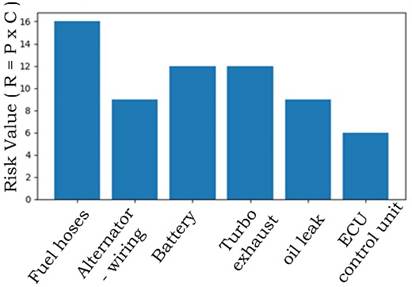
Fig.10.
Engine compartment component risk chart
Pareto analysis represents an effective tool for identifying the most
critical risk factors contributing to fire initiation. Based on the 80/20
principle, a limited number of components (e.g., the fuel system and electrical
wiring) are responsible for the majority of fire incidents. This method enables
the prioritization of preventive measures and the optimization of fire safety
strategies within the engine compartment.
The application of Pareto analysis in this study allows for a clear
identification of the most significant sources of fire risk and supports a more
efficient allocation of safety measures. The results of this analysis are
graphically illustrated in Figure 11, where the Pareto distribution of fire
risk factors is presented.
Practical conclusion (80/20 principle).
To reduce or minimize the risk of engine compartment fire, it is
necessary to focus on the following as a priority:
1. Fuel system tightness.
2. Battery and terminal
condition.
3. Exhaust heat shielding.
4. Power wiring inspection.
Intervention in these areas
will reduce the overall risk at the lowest cost.
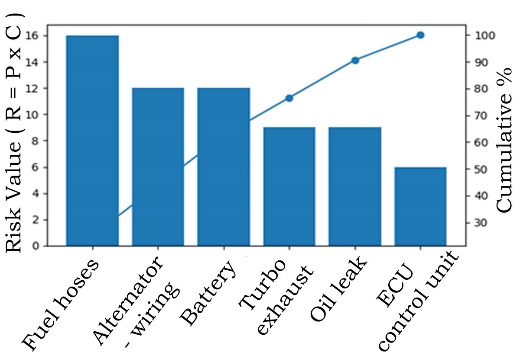
Fig.11.
Pereto engine compartment risk analysis
4. CONCLUSION
The analysis of engine compartments in passenger vehicles indicates that
up to 70% of fires originate as a result of mechanical failures, fuel leakage,
or electrical short circuits. These factors represent the primary initiating
mechanisms of fire within the engine compartment. Modern preventive strategies,
including regular maintenance, intelligent monitoring through sensor-based
systems, and predictive diagnostics, significantly contribute to the early
detection of potential failures and risk conditions. In addition, the
implementation of advanced safety technologies, such as automatic fire
suppression systems and thermal fuses, plays a crucial role in reducing the
probability of fire occurrence and mitigating potential damage.
This study provides a detailed examination of the passenger vehicle
engine compartment, with a focus on identifying and characterizing the main
fire risk sources. Individual components were systematically evaluated and
classified according to their level of fire hazard, distinguishing between
high-risk and moderate-risk elements. A quantitative assessment of fire
occurrence probability and overall fire risk was carried out, enabling an
objective evaluation of the hazard level. Based on these results, a risk
distribution graph of engine compartment components and a Pareto analysis of
fire risk factors were developed. The findings indicate that fuel lines
represent the most significant contributor to fire risk, followed by the
battery, turbocharger, exhaust system, and electrical wiring. Additional
influencing factors include electronic control units and parameters such as oil
pressure, which may indirectly contribute to hazardous conditions leading to
fire initiation.
Furthermore, the study proposes a set of technical measures aimed at
reducing fire risk, divided into design and operational approaches. From a
design perspective, the application of thermal shields between high-temperature
components and sensitive elements, the use of non-combustible or
flame-retardant insulation for electrical wiring, and the integration of
automatic fire suppression systems (e.g., aerosol-based modules) significantly
enhance fire safety. From an operational perspective, regular inspection of
fuel system integrity (e.g., every 10,000 km), monitoring of electrical wiring
condition, and systematic cleaning and degreasing of the engine compartment are
essential preventive measures.
Based on the results and conclusions obtained, a set of recommendations
and proposed risk reduction measures are presented in Tables 3 and 4, which
provide a practical framework for minimizing the risk of fire in the engine
compartments of passenger vehicles.
FMEA (Failure Mode and Effects Analysis) we can see this analysis in Table 3, the
method assesses risk according to the formula:
 (9)
(9)
·
S (Severity) – severity of the consequence (1-10),
·
O (Occurrence) – probability of occurrence (1-10),
·
D (Detection) – detection capability (1-10, 10 =
difficult to detect),
·
RPN – Risk Priority Number.
Tab. 3
Failure Mode and Effects
Analysis
|
Component |
Failure |
Consequence |
S |
O |
D |
RPN |
|
Fuel
Hoses & Injection |
Fuel
leak |
Rapid
fire |
9 |
6 |
6 |
324 |
|
Alternator
+ Wiring Short |
Short
circuit |
Cable
fire |
8 |
5 |
5 |
200 |
|
Battery |
Overheating |
Oil
ignition |
7 |
6 |
6 |
252 |
|
Exhaust
Pipe / Turbo |
Short
circuit |
Local
fire |
7 |
5 |
5 |
175 |
|
Engine
Oil Leak |
Exhaust
contact |
Smoldering
→ flame |
6 |
6 |
7 |
252 |
|
Control
Unit (ECU) |
Internal
fault |
Electrical
ignition |
5 |
3 |
6 |
90 |
Tab. 4
Recommended measures (reduction of RPN)
|
Component |
Measures |
Impact |
|
Fuel
Hoses |
Metal
braiding, regular pressure testing |
↓O, ↓D |
|
Exhaust |
Heat
shields, insulation |
↓S |
|
Battery |
Terminal
cover, fuses |
↓O |
|
Wiring |
Non-flammable
insulation |
↓S |
|
Oil |
Tightness
check |
↓O |
Acknowledgments
This research was
supported by VEGA 1/0573/25 and KEGA 037TUKE-4/2024.
References
1.
Overall Myles W., Justin Mukai, Rahul Suryakant Sakhare, Jairaj Desai,
Hillary Lowther, Darcy M. Bullock. 2025. „Measuring the Impact of Recovery Resource
Delay on Traffic Incident Management Clearance Times”. Future Transportation 4: 171. ISSN: 2673-7590. DOI: https://doi.org/10.3390/futuretransp5040171.
2.
Fayez
Alanazi. 2023. „Electric
Vehicles: Benefits, Challenges, and Potential Solutions for Widespread
Adaptation”. Applied Sciences 10. ISSN: 2076-3417. DOI: https://doi.org/10.3390/app13106016.
3.
Dessì
Roberto, Daniel Fruhwirt, Davide Papurello. 2025. „A Study on Large Electric Vehicle Fires in a
Tunnel: Use of a Fire Dynamics Simulator (FDS)”. Processes 8: 2435. ISSN:
2227-9717. DOI: https://doi.org/10.3390/pr13082435.
4.
Xuning
Feng, Zhang Fangshu, Feng Jing, Jin Changyong, Wang Huaibin, Xu Chengshan,
Ouyang Minggao. 2024. „Propagation dynamics of the thermal runaway front in
large-scale lithium-ion batteries: Theoretical and experiment validation”. International
Journal of Heat and Mass Transfer 225: 125393. ISSN:
0017-9310. DOI: https://doi.org/10.1016/j.ijheatmasstransfer.2024.125393.
5.
Zinveli
Ankidim, Mihai Dragomir, Diana Dragomir. 2025. „What’s Hot and What’s Not – A Simulation-Based Methodology for Fire Risk Assessment
in Lead-Acid Battery Manufacturing”. Processes 3: 837. ISSN: 2227-9717. DOI: https://doi.org/10.3390/pr13030837.
6.
Miechówka
Bartosz, Wojciech Węgrzyński. 2025. „Systematic Literature Review on Passenger Car Fire
Experiments for Car Park Safety Design”. Fire Technology 61: 2651-2688. ISSN: 2651-2688. DOI: https://doi.org/10.1007/s10694-025-01701-5.
7.
NFPA. „Building
and Life Safety”. Available at: https://www.nfpa.org/foundation.
8.
CFIS 2023. „Lash
FIRE”. Available at: https://lashfire.eu/.
9.
DBI. „Research
and Development”. Available at: https://brandogsikring.dk/en/research-and-development/maritime/elbas/.
10.
Mangs
Johan, Olavi Keski-Rahkonen. 1994. „Characterization of the fire behaviour of a burning passenger car. Part I: Car fire experiments”. Fire
Safety Journal 23(1): 17-35. ISSN:
0379-7112. DOI: https://doi.org/10.1016/0379-7112(94)90059-0.
11.
Badida
Miroslav, Lýdia Sobotová, Tibor Dzuro, Marek Moravec, Pavol Liptai, Anna Badidová. 2017. „The analysis of reflector options evaluation from cars
after their lifetime under the conditions of the Slovak Republic”. Waste
Forum 2017(5): 362-371. ISSN: 1804-0195.
12.
Laciak Marek, Karol Kostúr, Milan Durdán,
Ján Kačur, Patrik Flegner. 2016. „The analysis of the underground coal
gasification in experimental equipment”. Energy 114: 332-343.
ISSN: 0360-5442. DOI: https://doi.org/10.1016/j.energy.2016.08.004.
13.
Maláková Silvia. Samuel Sivák, Anna
Guzanová, Robert Grega. 2021. „Strength
Calculation of Fixed Joints Applied in Passenger Cars”. AD ALTA: Journal of Interdisciplinary
Research: 11(1):
423-427. ISSN: 1804-7890.
Received 08.03.2026; accepted in revised form 17.05.2026

Scientific Journal of Silesian
University of Technology. Series Transport is licensed under a Creative
Commons Attribution 4.0 International License