Article
citation information:
Zieliński,
T. AI-enabled
defense-in-depth: a multi-layered framework for countering UAS threats in smart
airports. Scientific Journal of Silesian
University of Technology. Series Transport. 2026, 130, 299-323. ISSN: 0209-3324. DOI: https://doi.org/10.20858/sjsutst.2026.130.17
Tadeusz
ZIELIŃSKI[1]
AI-ENABLED
DEFENSE-IN-DEPTH: A MULTI-LAYERED FRAMEWORK FOR COUNTERING UAS THREATS IN SMART
AIRPORTS
Summary. Smart airports
increasingly rely on interconnected cyber‑physical systems, data-driven
operations, and automation, which expands the attack surface for incidents
involving unmanned aircraft systems (UAS). This article develops an
AI‑enabled defense‑in‑depth (DiD) conceptual framework for countering UAS threats in
smart airports, addressing both kinetic and cyber‑physical vectors while
respecting the constraints of safety‑critical aviation operations. The
AI-based Intrusion Risk Intervention (AIRI) framework is central to the
proposed approach. AIRI specifies a five-stage decision loop
(detect–classify–assess–intervene–learn) integrating multimodal sensing,
AI‑assisted risk scoring, and human‑in‑the‑loop
decision support. The framework is positioned against representative
airport‑oriented UAS incident-management guidance and counter‑UAS
frameworks, and a compact validation is provided through (a) a cross‑walk
between AIRI stages and established incident-management steps and (b) a
scenario exercise illustrating decision thresholds and intervention options.
The paper further discusses regulatory, ethical, and operational requirements
for deploying AI‑enabled counter‑UAS capabilities in European
aviation, emphasizing traceability, logging, robustness, information-security
management, and accountability. Claims are therefore limited to conceptual and
design contributions supported by the compact validation; the paper concludes
by outlining the data, metrics, and governance artifacts required for future
empirical evaluation in operational airport environments.
Keywords: smart airports, unmanned aircraft systems (UAS), artificial
intelligence (AI) in aviation, counter-UAS (C-UAS), airport security frameworks
1. INTRODUCTION
The
emergence of smart airports signifies a transformative moment in the evolution
of global civil aviation. Situated at the crossroads of advanced
digitalization, artificial intelligence (AI), and interconnected sensor
technologies, smart airports reflect a paradigm shift from static transport
nodes to intelligent, self-regulating ecosystems. These airports are crafted
not only as gateways for air traffic but as dynamic operational environments
that seamlessly integrate data from passengers, aircraft, logistics systems,
and infrastructure components into real-time workflows. From biometric boarding
and AI-enabled queue management to predictive maintenance and autonomous ground
vehicles, the modern smart airport harnesses a wide range of cyber-physical technologies
to enhance efficiency, sustainability, and user experience. However, this
convergence of digital and physical layers also creates a broader, increasingly
vulnerable threat landscape, especially given the emerging aerial threats posed
by unmanned aircraft systems (UAS).
The
rise of UAS – commonly called drones – has introduced new asymmetries and
uncertainties into airport security. Originally developed for military
reconnaissance and later adapted for commercial and recreational use, drones
have transformed into modular, affordable, and highly maneuverable
platforms capable of carrying sensors, payloads, or cyberattack vectors. The
exponential growth in drone ownership, combined with the increasing autonomy of
these systems, has made traditional perimeter-based security architectures
irrelevant. Recent high-profile incidents – especially the extended disruption
at London Gatwick Airport in 2018, which grounded over 1,000 flights –
highlight how easily a single unauthorized drone can disrupt airport
operations. These events have exposed critical vulnerabilities in current
detection and mitigation capabilities and have raised concerns about the
readiness of even technologically advanced airports to address low-cost,
high-impact aerial incursions.
In
this paper, unmanned aircraft system (UAS) is used as the primary term because
airport protection and counter-UAS measures concern not only the aerial
platform but the entire system (aircraft, command-and-control link, control
station, payload, and supporting elements). The term unmanned aerial vehicle
(UAV) denotes the aerial vehicle alone and is therefore avoided in the main
narrative except when reproducing terminology used in cited sources or
publication titles. The word drone is treated as a common, non-technical
synonym used for readability at first mention and in selected illustrative
passages; otherwise, the paper uses UAS consistently. Accordingly, counter-UAS
(C-UAS) refers to the set of detection, tracking, identification,
decision-support, and mitigation measures against unauthorized UAS activity in
safety-critical airport environments.
Smart
airports, because of their digital interdependence, are particularly vulnerable
to these risks. Their reliance on Internet of Things (IoT) devices, wireless
communication protocols, cloud-based data integration, and AI-driven decision
systems has created a new operational paradigm that is highly efficient yet
potentially fragile when faced with coordinated or intelligent threats. Today,
a rogue drone is no longer just a nuisance in physical airspace; it can operate
autonomously, capable of jamming radar signals, intercepting data packets,
interfering with navigation systems, or triggering false responses from AI
surveillance tools. The complexity of managing such multi-domain threats,
especially under real-time constraints, has far exceeded the capabilities of
conventional counter-UAS (C-UAS) systems, which are typically reactive, siloed,
and technologically outdated.
In
this context, there is an urgent need for an integrated, adaptive, and
intelligent framework capable of securing smart airports against UAS threats
that reflects the complexity of their technological architecture. This paper
addresses this need by introducing a defense-in-depth
strategy tailored to smart airport environments, underpinned by a novel
AI-based methodology called the AIRI model (AI-based Intrusion Risk
Intervention). The defense-in-depth approach
conceptualizes airport security as a multi-layered construct comprising
physical detection and mitigation tools, digital safeguards against
cyber-physical manipulation, and cognitive AI systems capable of interpreting
threat behavior and supporting decision-making.
Rather than relying on static defenses or isolated
mitigation technologies, the framework envisions a resilient security ecosystem
that perceives, reasons, and learns.
Central
to this approach is the AIRI model, which operationalizes the defense-in-depth paradigm by integrating sensor fusion,
AI-based classification, dynamic risk assessment, and escalation protocols into
a coherent, continuously learning cycle. By incorporating explainable AI,
federated learning, and human-in-the-loop governance, AIRI ensures that its
interventions are timely, effective, and legally and ethically sound. This is
especially crucial in the regulated domain of civil aviation, where the margin
for error is minimal and where disproportionate responses can pose systemic
risks.
This
research also situates its proposed solution within the broader regulatory and
policy context of European and international aviation security. As highlighted
by recent frameworks such as the EU Drone Strategy 2.0, EASA’s AI Roadmap, and
ICAO’s Annex 17, the governance of drone threats and the certification of AI in
safety-critical infrastructure have become top-tier priorities for aviation
authorities. These documents collectively call for a new generation of AI
systems that are technically robust, ethically grounded, auditable, and aligned
with human oversight. The AIRI model is developed in accordance with these
expectations, offering a practical contribution to the evolving landscape of AI
assurance in aviation.
This
paper makes three principal contributions. First, it redefines the smart
airport's security architecture to account for contemporary UAS threat
dynamics. Second, it proposes a technologically and ethically viable model for
integrating AI into real-time risk mitigation. Third, it provides a foundation
for harmonizing AI-enabled security tools with emerging regulatory regimes and
operational norms in civil aviation.
The
study adopts a design-oriented conceptual research approach combining (a) a
targeted review of peer-reviewed literature on counter‑UAS and
smart-airport security, (b) analysis of official and quasi-official aviation
security guidance (e.g., EASA, ICAO, FAA, IATA) to extract operational and
governance requirements, and (iii) design of the AIRI artefact (process model)
followed by a compact validation via a framework cross‑walk and scenario
exercise. This positioning clarifies that the contribution is an integrative,
prescriptive framework rather than an empirical performance evaluation.
The
remainder of the paper is organized as follows: Section 2 presents a literature
review. Section 3 analyzes the evolving threat
landscape of drones concerning smart airport vulnerabilities. Section 4
develops the defense-in-depth concept, integrating
physical, digital, and cognitive layers. Section 5 presents the AIRI
methodology as a practical AI-enabled drone intrusion response model. Section 6
explores the regulatory, ethical, and operational implications of implementing
such a system. Finally, Section 7 offers concluding reflections and strategic
recommendations for future research, policy design, and airport-level
implementation.
2. LITERATURE REVIEW
Smart airports represent a paradigm
shift in aviation, leveraging advanced technologies to enhance operational
efficiency, passenger experiences, and security [1]. These airports integrate
numerous systems, including sophisticated surveillance, data analytics, and
automation, to optimize baggage handling and air traffic control processes [2].
The foundation of a smart airport lies in its ability to collect and process
vast amounts of data from various sources, such as sensors, cameras, and
passenger information systems [3]. This data-driven approach facilitates
real-time decision-making, predictive maintenance, and personalized services,
thus improving airport performance. Artificial intelligence plays a pivotal
role in smart airports, enabling advanced functionalities such as automated
security screening, predictive maintenance of airport infrastructure, and
intelligent resource allocation [2]. AI algorithms can analyze
passenger flow patterns to optimize gate assignments, reduce congestion, and
enhance the overall passenger experience while providing proactive security
measures by predicting and preventing potential threats [4]. Moreover,
AI-powered systems can monitor and manage energy consumption, contributing to
the airport's sustainability goals [5]. The integration of AI in air traffic
control, for instance, can enhance safety and efficiency by predicting
potential collisions and optimizing flight paths [6]. The complexity of smart
airports necessitates robust cybersecurity measures to protect sensitive data
and critical infrastructure from possible threats. The evolution of smart
airports is closely linked to the development and deployment of advanced
technologies such as the Internet of Things, cloud computing, and big data
analytics, which collectively provide the infrastructure for intelligent
airport operations. Engineering professionals and aviation construction experts
acknowledge the transformative potential of AI to revolutionize project
management processes in the aviation sector, thereby improving decision-making
capabilities and overall efficiency [7].
The increasing prevalence of
unmanned aircraft systems, or drones, poses a significant threat to airport
operations and security [8]. UAS can be employed for various malicious
purposes, including surveillance, smuggling, and even terrorist attacks. The potential
for UAS to disrupt air traffic, damage aircraft, or harm individuals on the
ground is a serious concern for airport authorities and security agencies [5].
The relatively low cost and easy access to drones make them an attractive tool
for malicious actors. The growing sophistication of drone technology, including
advanced navigation systems, extended flight ranges, and payload capacities,
further amplifies the risk. The integration of AI in military applications
underscores the potential for autonomous drones to conduct coordinated attacks,
thereby making detection and interception even more challenging [5]. Airports
must develop comprehensive counter-UAS strategies to mitigate these risks and
safeguard their airspace and infrastructure. The susceptibility of drone
technology to cyberattacks introduces another layer of complexity, as malicious
actors can take control of drones and exploit them for nefarious purposes [9].
The use of commercial drones for illicit activities such as drug trafficking or
unauthorized surveillance near airports has become an increasing concern for
law enforcement agencies [5]. AI systems are vulnerable to manipulation through
“deep fakes,” which could lead to misinformation and increased global
instability [5]. The convergence of AI and drone technology necessitates
ongoing monitoring and adaptation of security measures to counter potential
threats.
Effective drone detection and risk
mitigation are critical components of a comprehensive counter-UAS framework for
smart airports. These countermeasures typically involve a multi-layered
approach that integrates various technologies and strategies to detect, track,
identify, and neutralize unauthorized drones. Radar systems, acoustic sensors,
and optical cameras are commonly used to detect drones in airport airspace.
These technologies can provide early warning of potential threats, allowing
security personnel to act appropriately [10]. Radio frequency scanners can
detect and analyze the communication signals between
drones and their operators, aiding in identifying and tracking unauthorized UAS
[11]. AI-powered video analytics can automatically detect and classify drones
in real time, reducing the workload on human operators and improving
threat-detection accuracy. Moreover, machine learning algorithms can be trained
to identify anomalous drone behavior, such as unusual
flight patterns or proximity to restricted areas, further enhancing situational
awareness. Integrating these detection systems with risk assessment models can
help prioritize threats and allocate resources effectively. Predictive
analytics, driven by AI, can forecast potential drone incursions based on
historical data, weather patterns, and other relevant factors, enabling
proactive security measures. Real-time data analytics and integration of AI
techniques can enhance automated incident management and overall transportation
efficiency [12].
Neutralization techniques are used
to disable or remove unauthorized drones from airport airspace, preventing them
from causing harm or disruption. These methods range from non-kinetic measures,
such as jamming and spoofing, to kinetic options, such as drone interceptors.
Jamming disrupts communication between the drone and its operator, causing it
to lose control or crash. Conversely, spoofing sends false GPS signals to the
drone, redirecting it away from the airport or prompting it to land in a safe area.
Drone interceptors, usually other drones equipped with nets or capture devices,
can physically remove unauthorized drones from the airspace. These defensive
systems aim to address challenges and reduce risks posed by hostile UAS
incursions. Deploying such systems requires careful consideration of legal and
regulatory implications and potential safety risks. Utilizing AI in autonomous
weapon systems raises ethical concerns and questions about accountability. It's
important to recognize that some neutralization techniques may interfere with
legitimate drone operations or other airport systems. Careful planning and
coordination are vital to minimize collateral effects.
AI-enabled defense-in-depth
strategies are increasingly discussed as a way to counter UAS threats in smart
airports by improving detection, classification, and risk-informed response. In
safety‑critical civil aviation, the role of AI is primarily decision
support: fusing multi‑modal sensor data (e.g., radar, RF, acoustic,
EO/IR) and prioritizing events for human review, rather than replacing
operational decision‑makers. Machine learning can improve classification
under cluttered conditions and support anomaly detection for
cyber‑physical interference and spoofing attempts [14-16].
Important ethical and legal issues
arise when using AI systems in smart airports. The operational context of AI
systems is crucial, as the risk of miscalculation increases when the context
deviates from the training data [17]. It is crucial to remember that AI-driven
systems are vulnerable to adversarial attacks, wherein malicious actors
strategically manipulate input data to cause the AI to make incorrect
decisions.
To identify the specific features of
AIRI, Table 1 compares it with representative airport-oriented UAS
incident-management guidance and critical-infrastructure counter‑UAS
frameworks. Existing guidance typically specifies governance and operational
steps (detection–assessment–response–recovery) but remains intentionally
technology-agnostic, with limited treatment of AI‑enabled sensor fusion,
real-time risk scoring, and post‑incident learning loops. AIRI
contributes an explicit, auditable AI‑enabled decision loop that
integrates these process requirements with human oversight and continuous
learning, making it suitable for safety‑critical smart-airport
environments.
Tab. 1
Positioning of AIRI against
representative airport-oriented
UAS incident-management guidance and counter‑UAS frameworks
|
Framework (source) |
Primary
scope |
Core process / phases |
AI-specific content |
Learning / feedback |
Gap addressed by AIRI |
|
EASA Drone Incident
Management at Aerodromes [34] |
Aerodrome
ops & ANSP response |
Report-assess-decide-respond-recover |
Limited (tech‑agnostic) |
After‑action lessons (procedural) |
Adds AI‑enabled risk
scoring + auditable thresholds |
|
ICAO infrastructure protection guidance |
Civil aviation infrastructure security |
Preparedness-detection-response-recovery |
Limited (tech‑agnostic) |
Post‑event reporting
(high level) |
Adds learning loop linked to
model/SOP updates |
|
JRC five‑phase approach |
Critical infrastructure protection |
Prepare-prevent-detect-respond-recover |
Mentions
tech options |
Continuous
improvement emphasized |
Operationalizes phases as AI
decision loop + playbooks |
|
FAA airport UAS
detection/response work |
US airport UAS governance |
Detection-coordination-response
planning |
Focus on legal/operational
constraints |
Iterative
trials recommended |
Integrates safety/legal
constraints into interventions |
|
IATA guidance on
unauthorized UAS |
Airport/ANSP/operator
coordination |
Detection-response-recovery
taxonomy |
None (process focus) |
Reporting & improvement |
Provides AI‑enabled
prioritization + decision support |
|
Standardized evaluation
approaches (e.g., CWA 18150) |
Testing
& evaluation |
Scenario-based tests and
metrics |
Metrics for multi-sensor
performance |
Validation
& comparability |
Links evaluation metrics to
AIRI outputs |
|
AIRI |
Smart airports (cyber‑physical) |
Detect-classify-assess-intervene-learn |
Explicit (fusion, risk
scoring, Human-in-the-Loop) |
Explicit (model + SOP update
loop) |
– |
3. UAS THREAT LANDSCAPE IN THE ERA OF SMART
AIRPORTS
Compartmentalized operations,
paper-based procedures, and limited communication between systems have long
characterized traditional airports. While functional, these infrastructures are
increasingly strained by rising passenger volumes, growing security demands,
and the necessity for environmental responsibility. In contrast, smart airports
emerge as integrated digital environments that adapt to operational and
passenger-related variables in real time. The shift is not purely technological
but systemic, involving the convergence of data-driven decision-making with
automated and autonomous processes that optimize every aspect of airport
functioning [18].
At the heart of the smart airport is
a network of interconnected technologies that work together to enhance
efficiency, safety, and user experience. Infrastructure equipped with IoT
devices allows for continuous monitoring of baggage, vehicles, environmental
conditions, and passenger flow. Artificial intelligence enables predictive
management of traffic patterns, resource allocation, and maintenance needs.
Biometric identity verification speeds up passenger processing while enhancing
security and minimizing physical contact. These components are supported by
cloud-based platforms that facilitate real-time coordination among airport
authorities, airlines, and service providers, ensuring a comprehensive and
synchronized approach to operations [19].
One of the most striking differences
between smart and traditional airports is the transformation of the passenger
experience. In a conventional airport, travelers face
manual check-in processes, physical document verification, and limited
real-time information. In contrast, a smart airport enables passengers to
navigate their journey using mobile applications, biometric authentication, and
AI-guided assistance, often without interacting with airport staff. Baggage is
tracked using RFID tags and routed by predictive logistics systems, minimizing
delays and mishandling. On the airside, aircraft movements are directed by
algorithms that calculate optimal taxiing routes, reducing fuel consumption and
turnaround time. Once reliant on scheduled inspections, facility maintenance is
now guided by sensor data that indicates when intervention is needed, enhancing
safety and reducing operational downtime [20].
The operational transformation
introduced by smart airports also extends to strategic areas. Enhanced
automation and predictive analytics lower operational costs and reduce the
likelihood of human error, while boosting service speed and reliability. Security
is fortified through real-time surveillance, behavior
analysis, and integrated threat detection systems. Environmental performance
benefits from smart grids, optimized energy use, and waste monitoring, aligning
with global sustainability goals [21]. However, this reliance on interconnected
systems poses challenges in data protection and cybersecurity as the airport's
digital footprint expands.
Smart airports are also redefining
the role of aviation hubs in the broader transport ecosystem. As digital
platforms enable harmonization of schedules, services, and passenger data
across modes of transport, airports become nodes of intermodal mobility –
connecting air, rail, and road systems in a seamless continuum [22]. This
creates new opportunities for urban development, economic growth, and
public-private innovation, but it also necessitates robust regulatory
frameworks to ensure the ethical and secure use of emerging technologies.
The emergence and rapid
proliferation of unmanned aircraft systems (UAS), more commonly referred to as
drones, have introduced a new and complex dimension to the security environment
of civil aviation. While initially developed and deployed for military applications,
drones have since evolved into versatile platforms widely accessible to
consumers, commercial actors, and public institutions. Their utility in aerial
photography, infrastructure inspection, logistics, and agriculture has
positioned them as a cornerstone of modern airspace innovation [23].
However, the ubiquity of these systems has simultaneously generated a range of
unanticipated risks, often inadequately mitigated, particularly for airport
infrastructure, which now stands at the intersection of digital transformation
and increased operational vulnerability. The evolution toward smart airports,
characterized by the extensive integration of artificial intelligence,
interconnected sensors, IoT networks, and data-driven automation, further
amplifies critical aviation nodes' exposure to kinetic and non-kinetic drone
threats. The result is a security ecosystem in which technological
sophistication is paralleled, if not outpaced, by the growing complexity of
threat vectors originating from or enabled by rogue drone activities [24].
The accelerating pace of drone
adoption across Europe and beyond has dramatically altered the structure of
low-altitude airspace. Forecasts by aviation regulators such as EASA suggest
that by the early 2030s, millions of drones will operate across European skies,
many of them in or near urban centers and airport
control zones [25]. This trend has been catalyzed by
a range of enabling factors, including declining hardware costs, the widespread
availability of commercial off-the-shelf systems, and the relative ease with
which basic piloting skills can be acquired. Simultaneously, the capabilities
of these platforms have advanced significantly. Contemporary drones are often
equipped with high-resolution optical systems, GPS navigation, autonomous
flight software, swarming algorithms, and in some cases, the capacity to carry
and deploy physical payloads. Notably, these systems are often modular and
dual-use, which means that platforms initially intended for benign civilian
purposes can be readily repurposed for malicious activities [23]. The
implications of this dual-use character are profound, as it complicates both
regulatory classification and detection protocols. The same drone used for
real-time infrastructure monitoring may be reconfigured for signal jamming,
illicit surveillance, or even physical sabotage of critical airport assets.
Empirical evidence of drones'
disruptive capacity in airport environments has steadily accumulated over the
past decade, with several high-profile incidents underscoring both the severity
of the threat and the institutional unpreparedness to address it effectively.
Perhaps the most emblematic case occurred in December 2018 at London Gatwick
Airport, where repeated sightings of unauthorized drones led to the
cancellation or diversion of over one thousand flights, directly impacting more
than 140,000 passengers and resulting in an estimated financial loss exceeding
£50 million [26]. Despite deploying advanced military-grade detection
systems and extensive coordination between law enforcement and aviation
authorities, no individual or group was conclusively identified or apprehended
in connection with the incident. The episode revealed critical weaknesses in
the capacity to neutralize a drone once detected and in the fundamental
processes of attribution, forensic reconstruction, and incident response. More
importantly, it demonstrated that the operational disruption caused by drones
does not necessarily depend on direct physical collisions with aircraft or
infrastructure [27]. A drone's confirmed presence or credible suspicion within
controlled airspace is sufficient to activate emergency protocols that can
paralyze airport operations.
This vulnerability is not unique to
Gatwick. Comparable incidents have been recorded in Frankfurt, Dubai, Madrid,
and Warsaw, among others, where unauthorized drone activity near runways and
approach paths has resulted in temporary airspace closures, delays, and
emergency procedural adaptations. These cases collectively illustrate that the
threat posed by drones is geographically diffuse and functionally diverse.
Drones can be deployed to harass aircraft, film secure areas, smuggle
contraband into airport perimeters, or test the response latency of security
systems – all without the need for advanced military capabilities [28].
Furthermore, as smart airports increasingly rely on complex, interoperable
digital ecosystems to manage everything from airside logistics to passenger
flow, they become vulnerable to a new class of drone-enabled attacks that
exploit both the physical and cyber domains. Drones can carry payloads capable
of intercepting wireless signals, GPS spoofing, or conducting denial-of-service
attacks targeting Wi-Fi infrastructure and sensor networks. They can hover
within the electromagnetic perimeter of an airport terminal and collect data
passively, or they can actively disrupt operations by flooding network ports,
jamming control channels, or delivering malicious code to connected devices
[29]. The convergence of cyber and physical capabilities within a single aerial
platform creates an asymmetric threat environment in which traditional
perimeter defense models are mainly rendered
obsolete.
The evolving architecture of smart
airports further compounds these challenges. By design, smart airports are
constructed as layered ecosystems of interdependent subsystems, each relying on
continuous data exchange, real-time analytics, and adaptive AI decision-making.
These systems include automated baggage handling, intelligent lighting, HVAC
control (Heating, Ventilation, and Air Conditioning), facial recognition for
access and boarding, predictive maintenance for ground equipment, and even
AI-optimized air traffic flow management [30]. While these innovations yield
considerable efficiencies and sustainability benefits, they also create
numerous potential points of failure and exploitation. A compromised drone
could, for instance, manipulate the camera feeds used in perimeter security,
interfere with RFID signals used for baggage tracking, or feed false data into
AI systems tasked with queue management, thereby triggering incorrect
responses. In the worst-case scenario, a coordinated drone attack could synchronize
kinetic distraction (e.g., visual interference or low-altitude loitering) with
a cyber intrusion, effectively overwhelming human operators and automated
systems [31].
Moreover, the situational ambiguity
surrounding many drone incidents complicates the decision-making environment
for airport authorities and air traffic controllers. Drones are often difficult
to detect using conventional radar due to their small size, low radar
cross-section, and non-metallic construction. Acoustic and optical sensors may
offer enhanced detection capabilities but are limited by environmental noise
and line-of-sight constraints. Additionally, many counter-drone technologies,
such as RF jamming or kinetic interception, are legally restricted in civilian
contexts or operationally risky within dense passenger areas [11]. As a result,
even when drones are identified, response options are constrained, and the
default institutional reaction is often to ground flights as a precautionary
measure. This reactive posture, while prudent, is inherently unsustainable in
the face of increasing drone density and sophistication.
Adding to this complexity is the
emerging phenomenon of drone swarms, which poses a qualitatively different
threat profile. Swarms may consist of dozens or even hundreds of
semi-autonomous drones capable of decentralized coordination and adaptive behavior. Such systems can saturate detection networks,
exploit blind spots, and simultaneously mount distributed denial-of-service
attacks against both physical and digital targets. The implications for airport
security are particularly grave, as current C-UAS systems are primarily
designed to neutralize single or low-multiplicity threats, not coordinated mass
incursions [32]. Furthermore, as drone software becomes increasingly
open-source and modular, the barrier to entry for developing swarm capabilities
continues to diminish, raising the specter of
asymmetric actors – including organized criminal groups or terrorist cells –
employing coordinated aerial campaigns against airport infrastructure.
Beyond swarms, recent threat
evolution includes higher levels of autonomy and deception. Low-cost platforms
increasingly combine autonomous navigation (pre‑programmed routes,
terrain following, GPS/INS redundancy) with adaptive behaviors
that can complicate attribution and intent assessment. At the same time,
adversaries can exploit cyber‑physical seams through GNSS spoofing, RF
protocol manipulation, or coordinated cyberattacks targeting airport networks
and surveillance feeds. These trends reinforce the need for behavioral
classification and risk‑informed escalation logic (rather than purely
signature-based detection), and they justify AIRI’s explicit separation of
classification, risk assessment, and intervention selection under human
oversight [31,34,42].
Finally, the regulatory landscape
surrounding drone use remains fragmented and reactive, especially near critical
infrastructure. While the European Union has made significant progress in
harmonizing drone regulations, particularly through the EASA framework and the
Drone Strategy 2.0, enforcement mechanisms and technological implementation
remain uneven across Member States [33]. National variations in airspace
classification, remote ID requirements, and C-UAS deployment authorizations
create a patchwork environment where both compliant and malicious drone
operators may exploit legal ambiguities. This regulatory gap is particularly
consequential for airports near national borders or high-density urban regions
with limited jurisdictional coordination.
In sum, the threat landscape posed
by UAS in the context of smart airports is characterized by multiplicity,
ambiguity, and acceleration. The convergence of advanced drone technologies,
expanding operational domains, and digital airport infrastructure has produced
a security paradigm in which traditional risk-mitigation approaches are
increasingly insufficient. Airports must contend with the kinetic risks of
mid-air collisions and the strategic vulnerabilities of interconnected systems
exposed to surveillance, interference, and cyber-physical exploitation.
Addressing this challenge requires fundamentally rethinking defense
postures, operational protocols, and technological architectures – shifting
from linear, reactive systems to adaptive, AI-driven frameworks that can
respond to an evolving, intelligent adversary.
4. DEFENSE-IN-DEPTH STRATEGY: INTEGRATING
PHYSICAL, DIGITAL, AND COGNITIVE SECURITY LAYERS
In response to the accelerating
threat posed by UAS to the integrity, safety, and continuity of civil aviation
operations – especially in the context of digitally augmented, smart airport
ecosystems – there is a growing consensus among scholars, regulators, and
practitioners that traditional airport security models are no longer
sufficient. The increasing frequency, complexity, and unpredictability of
drone-related incidents have revealed the inadequacy of perimeter-based,
single-layered defense systems that were designed
primarily to address human intrusions or conventional criminal threats. This
emergent security context demands a paradigmatic shift toward a layered,
integrated, and adaptive approach that can dynamically detect, assess, and
respond to aerial intrusions across multiple domains of airport operation [34].
The defense-in-depth (DiD)
concept, long familiar in military and cybersecurity doctrine, offers a
compelling architectural logic for this purpose (Figure 1). By deploying
mutually reinforcing layers of defense across the
physical, digital, and cognitive spectra, the DiD
strategy aims not to guarantee perfect impermeability – an impossible goal in
modern threat environments – but rather to create an anticipatory, responsive,
and resilient security posture.
At its most basic level, a DiD framework begins with the
physical layer, which comprises the sensory and kinetic components designed to
detect and, where necessary, physically neutralize intruding drones. In the
airport environment, this entails deploying a wide array of sensor types –
radars, RF detectors, electro-optical and infrared cameras, acoustic arrays,
and LIDAR systems – all positioned to maximize coverage of vulnerable zones
such as runway approaches, terminal roofs, perimeters, and airside logistics
corridors [22]. These sensors vary in range, resolution, and detection
principles. Still, when integrated through sensor fusion platforms – especially
those enhanced by AI – they provide a high-resolution, real-time common
operational picture. For instance, while radar systems excel at long-range
detection of larger UAS, they often struggle with the low radar cross-sections
of commercial drones. Acoustic arrays, conversely, can detect the distinctive
harmonic signatures of drone propellers at close range but are vulnerable to
environmental noise and directional ambiguity. EO/IR cameras offer visual
confirmation but suffer weather-related degradation [11]. It is precisely in
this multidimensionality that the DiD approach finds
its strength: by aggregating and cross-validating inputs across sensor
modalities, false positives can be minimized, detection certainty increased,
and the risk of sensor saturation distributed.
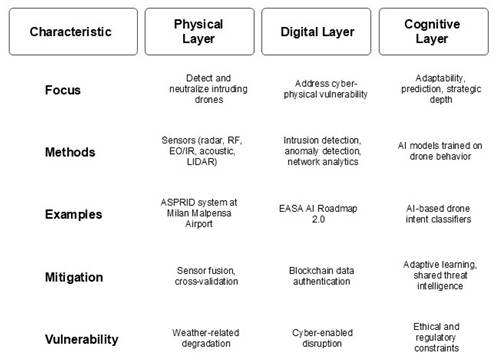
Fig. 1. Defense-in-Depth
Layers for UAS Protection
The operationalization of this
multi-sensor architecture has already been demonstrated in modular experimental
platforms such as the ASPRID (Airport System Protection against Intruding
Drones) system, which was piloted at Milan Malpensa Airport. ASPRID is a
multi-layered drone detection and response system integrating radar, EO/IR, and
RF-based sensing with a centralized AI-enabled decision-support module [35].
Notably, the system is designed for full interoperability with existing airport
security platforms and flight management systems, allowing alerts to be
cross-checked with scheduled UAS operations or geofenced airspace corridors.
ASPRID’s modular design also enables seamless integration of new components as
technologies evolve. For instance, detection modules can be recalibrated with
updated AI algorithms based on incident feedback. At the same time, mitigation
tools, such as RF jammers or net capture drones, can be added or substituted
depending on legal and environmental constraints. This adaptability is critical
in civilian airport contexts, where legal frameworks may prohibit specific
countermeasures, and where the safety of uninvolved passengers and
infrastructure must be weighed against the urgency of response [35].
In parallel to physical detection
and interception capabilities, the digital layer of the DiD
framework addresses the less visible but equally consequential domain of
cyber-physical vulnerability. As smart airports increasingly rely on
interconnected systems to manage core functions – from baggage routing and
biometric boarding to airside fleet management and predictive maintenance –
their exposure to cyber-enabled disruption grows proportionally. Drones may act
as mobile cyber weapons by deploying signal jammers, intercepting unencrypted
Wi-Fi or Bluetooth communications, launching man-in-the-middle attacks, or
injecting malicious code into IoT infrastructure [36]. The convergence of these
threats with physical incursion risk creates a compounded attack surface, in
which the drone serves as both sensor and saboteur. Within the digital layer,
mitigation is achieved through AI-enabled intrusion detection systems, anomaly
detection engines, and network behavior analytics
that can flag irregular access patterns, unauthorized drone command
frequencies, or synthetic GPS signals indicative of spoofing attempts [37].
One example of proactive digital
security integration is the EASA AI Roadmap 2.0, which outlines a framework for
AI trustworthiness, assurance, and lifecycle monitoring in aviation
environments. According to the roadmap, AI components in safety-critical applications
must undergo continuous validation through human-in-the-loop monitoring,
explainable decision-making modules, and secure learning environments [38].
Applying these principles to drone mitigation, an airport’s digital DiD layer would include an AI analytics engine that
monitors digital infrastructure for anomalies and correlates these with
external drone-related sensor feeds. For instance, a sudden loss of signal in a
baggage system, coinciding with an unidentified drone hovering over the baggage
handling area, would trigger an AI-generated alert flagging a likely
coordinated intrusion. EASA's focus on human-centered
AI also ensures that such alerts are interpretable and actionable by human
operators, thus enhancing autonomous systems' legitimacy and operational
coherence within high-stakes environments such as civil aviation hubs.
A further refinement of the digital
layer involves implementing blockchain-based data authentication protocols to
ensure the integrity of real-time communications among sensors, control towers,
and AI analytics platforms. Such measures prevent adversaries from executing
spoofing attacks that could manipulate sensor input or alter automated response
thresholds. Moreover, digital twins of airport systems – virtual replicas that
mirror the operational state of physical infrastructure – can be employed to simulate
the impact of drone incursions and test mitigation responses under various
threat scenarios [39]. These simulations, powered by real-time data feeds and
AI-driven forecast models, allow for preemptive
optimization of security protocols before an incident occurs.
While the physical and digital
layers provide the structural foundation of the DiD
architecture, the cognitive layer, enabled primarily through artificial
intelligence, imbues the system with adaptability, predictive capability, and
strategic depth. This layer's core is a suite of AI models trained on vast
datasets of drone behavior, intrusion incidents,
environmental variables, and airport operational patterns. These models, often
built using deep learning techniques such as convolutional neural networks, long
short-term memory networks, and reinforcement learning agents, can identify not
just the presence of a UAS but its probable trajectory, intent, and operational
risk level [40].
For instance, if an unidentified
drone is detected entering restricted airspace, the cognitive layer does not
merely log its presence – it analyzes its speed,
altitude, maneuverability, deviation from commercial
flight corridors, and proximity to sensitive infrastructure. If the drone’s behavior aligns with patterns associated with
reconnaissance missions or previous hostile incursions, the AI may assign a
higher threat score and trigger a priority response. The cognitive layer
is also designed to function within an ethical and regulatory envelope:
mitigation suggestions (e.g., jamming, interception, or passive tracking) are
filtered through risk evaluation matrices that account for air traffic density,
civilian proximity, and applicable legal constraints [41]. Thus, AI does not
replace human decision-makers but augments their judgment with data-rich
insights and predictive foresight.
Real-world implementations of
cognitive-layer defense capabilities are still
emerging, but testbeds such as ASPRID and components developed under the EU
Horizon 2020 research framework have demonstrated promising outcomes. In
particular, experimental deployments of AI-based drone intent classifiers –
systems capable of inferring likely objectives from observed behaviors and context – have demonstrated utility in
reducing false alarms and enabling proportionate responses. These classifiers
are especially valuable in dense airspace environments where hobbyist drones,
delivery UAS, and autonomous inspection drones coexist, and indiscriminate
countermeasures could disrupt legitimate operations or lead to regulatory
violations [7].
Moreover, the cognitive layer
facilitates adaptive learning, enabling AI systems to be continuously retrained
using data from past incidents, incident reports, and red-teaming exercises.
This dynamic updating process ensures that the DiD
framework evolves alongside the threat landscape, maintaining its relevance and
efficacy. It also supports the development of shared threat intelligence across
airports and aviation authorities through federated learning architectures. AI
models trained at different sites can share insights without compromising
sensitive data – a critical consideration for transnational aviation operations
governed by heterogeneous privacy laws [42].
In its entirety, the defense-in-depth architecture for smart airport UAS
protection is not merely a sum of its technical components but a systemic logic
for managing uncertainty, complexity, and asymmetry in a rapidly evolving
security environment. It recognizes that drones do not operate in isolation but
as part of socio-technical systems shaped by global supply chains, evolving
legislation, adversarial innovation, and technological convergence. Integrating
physical, digital, and cognitive defense layers –
each empowered by artificial intelligence and reinforced by modular,
interoperable platforms – the DiD framework offers a
scalable, ethically grounded, and operationally resilient approach to the next
decade's most pressing aviation security challenge.
5. METHODOLOGICAL FRAMEWORK: THE AIRI MODEL
(AI-BASED INTRUSION RISK INTERVENTION)
Building on the conceptual
foundation established by the defense-in-depth
architecture, the AIRI model – AI-based Intrusion Risk Intervention – proposes
a structured, scalable methodology for detecting, classifying, and mitigating
drone incursions in smart airport environments (Figure 2). Conceived as both an
operational and analytical framework, AIRI integrates artificial intelligence
at every stage of the UAS threat response cycle: from early detection and behavioral inference to escalation protocols, real-time
intervention, and post-event learning. Unlike reactive models that rely on
isolated detection technologies or human judgment subject to cognitive fatigue,
AIRI is designed to function as a continuous, closed-loop system, linking
sensor fusion, predictive analytics, human-in-the-loop oversight, and adaptive
post-incident correction into a cohesive cycle of decision-making and action.
The first stage of AIRI is centered on pre‑intrusion detection, where the
emphasis is on identifying a drone’s presence with sufficient lead time to
enable downstream interventions. This is achieved through multi‑modal
sensor integration (e.g., radar, RF detection, acoustic sensors, EO/IR cameras,
and, where available, LIDAR). AIRI further assumes AI‑assisted sensor
fusion, wherein inputs from disparate modalities are aggregated and analyzed using probabilistic models (e.g., Bayesian
networks or ensemble classifiers) to reduce uncertainty and improve
discrimination between drones, birds, and benign objects [43]. Project evidence
such as ASPRID supports the qualitative value of multi‑sensor fusion and
centralized processing for situational awareness, although performance outcomes
are highly context‑dependent and must be validated per airport
environment [35]. Fusion algorithms also allow AIRI to operate under suboptimal
conditions (poor weather, RF interference, or urban clutter) by dynamically
recalibrating sensor weights based on environmental context.
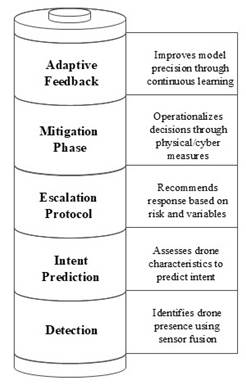
Fig. 2. AIRI Stages
The second stage of the AIRI
methodology involves classification and intent prediction, a domain in which AI
offers transformative potential. Once a drone is detected, the system must
rapidly assess its characteristics – flight pattern, trajectory, speed,
altitude, and loitering behavior – and compare them
to known profiles stored in a threat behavior
library. Using supervised and unsupervised machine learning techniques,
including convolutional and recurrent neural networks, the system generates a
risk score that estimates the drone’s likely function: recreational,
commercial, negligent, or hostile [44]. A drone that maintains a steady
altitude and trajectory within a known geofenced delivery corridor may be
classified as benign, while a UAS exhibiting erratic patterns, hovering near
critical infrastructure, or exhibiting command-and-control signal anomalies may
be flagged for elevated response. This form of intent inference, still in its
infancy, is a growing area of research; projects under the EU’s H2020 program
and the EASA AI Roadmap emphasize the need for reliable models that can
distinguish intent not merely on the basis of origin or proximity, but on
nuanced temporal and behavioral patterns [38].
Opposing arguments exist – critics point to the challenge of ensuring accuracy
without infringing on operational autonomy or making incorrect assumptions
based on incomplete data – but the field is moving toward hybrid models
combining machine reasoning with operator validation to offset these risks.
The third stage, escalation protocol
and decision-loop execution, activates once a drone is classified as suspicious
or hostile. AIRI connects real-time classification data with a pre-defined
decision tree encoded in an AI decision support system. The decision tree
weighs multiple variables: risk score, proximity to flight operations, current
air traffic density, applicable legal restrictions, availability of mitigation
tools, and situational awareness inputs from human operators. Based on these
variables, AIRI recommends an appropriate response – monitoring, alerting,
jamming, physical interception, or coordination with external agencies – and
presents these recommendations in an interpretable format to a
human-in-the-loop decision-maker [45]. The goal is not to fully automate
kinetic response (which remains legally and ethically contentious in most
jurisdictions), but to support human authority with rapid, explainable
analytics. Such frameworks have already been explored in ICAO’s Universal
Security Audit Program (USAP-CMA), where risk-informed escalation mechanisms
are essential for real-time UAS threat response planning.
Critics of this semi-autonomous
escalation logic warn against excessive reliance on algorithmic outputs,
particularly when legal responsibility for action (e.g., jamming or
intercepting a drone) remains with human actors. There is also concern that AI
decision-support systems might be gamed through adversarial tactics, in which a
drone mimics benign behavior until the last possible
moment to delay the activation of a response. AIRI includes a redundant
validation layer to mitigate these vulnerabilities, requiring alerts with a
threat score above a specified threshold to be confirmed by at least 2
independent AI classifiers and approved by human control personnel before
active mitigation is deployed. This reduces the probability of false escalation
while preserving response integrity.
The fourth stage of the AIRI model
is the intervention and mitigation phase, where the system operationalizes its
decisions through graded operational, physical, or cyber measures. In airport
environments, most guidance emphasizes coordination among aerodrome operations,
ATC/ANSP, law enforcement, and (where applicable) national security
authorities, and it prioritizes safety and legality over rapid neutralization
[34]. Accordingly, AIRI treats intervention as a constrained decision problem:
response options are selected from pre-approved playbooks (e.g., communication
warnings, temporary runway restrictions, security perimeter actions, or
controlled escalation to specialist counter‑UAS units) and require
explicit human authorization for any active mitigation near aircraft or people.
This design aligns with airport UAS response planning principles and supports
auditable accountability [46].
The final stage of the AIRI cycle is
post-event learning and adaptive feedback integration. Regardless of whether
escalation occurs, every drone detection event is logged and subjected to
retrospective analysis. AI systems extract features from event sensor
performance, classification accuracy, decision latency, and false-positive
rates, and feed them back into the training datasets. Over time, this
continuous learning process improves model precision, updates threat
classification profiles, and refines escalation criteria. Moreover, aggregated
data from multiple AIRI-equipped airports can be shared (in compliance with
privacy regulations) through federated learning protocols, enabling
decentralized knowledge accumulation without compromising sensitive data. This
feature is significant in transnational EU contexts, where shared learning on
emerging threats, such as drone swarms or AI-enabled UAS, can significantly
enhance collective resilience. The Joint Research Centre (JRC) and
EUROCONTROL’s FLY AI action plan stress the importance of such real-time,
evidence-based governance systems for drone risk management across critical
infrastructure sectors [47].
Despite its promise, AIRI is not
without limitations. First, its successful deployment depends on substantial
infrastructure investment in sensor hardware and high-performance computing
resources required for real-time AI inference. Second, its operational
effectiveness hinges on cross-sector collaboration: airport authorities, air
navigation service providers, law enforcement, cybersecurity experts, and AI
vendors must work together, often across jurisdictional and organizational
boundaries. Finally, AI model validation remains an open challenge. EASA
rightly notes that developing certification standards for AI in aviation is
still underway, particularly for safety-critical and real-time decision-making
systems. Without a shared regulatory standard for AI behavior
in counter-UAS applications, there is a risk of inconsistent implementation and
uneven stakeholder trust.
Nonetheless, AIRI represents a vital
step toward operationalizing artificial intelligence as a core component of
airport security in the drone era. It embodies a technical solution and a shift
in institutional thinking – from reactive defense to
anticipatory risk governance; from human-centric bottlenecks to human-machine
synergy; and from isolated interventions to integrated, learning-enabled
ecosystems. As smart airports evolve into intelligent infrastructures capable
of perceiving, reasoning, and responding in real time, the AIRI model offers a
framework that is not only technologically sophisticated but normatively
grounded, ethically aware, and strategically aligned with the emerging
challenges of 21st-century airspace security.
Although this study is conceptual, a
minimal validation is provided to justify the framework’s scope and to
constrain claims. First, Table 2 maps the AIRI stages to
incident‑management phases in established airport and
critical‑infrastructure guidance, demonstrating functional coverage and
compatibility. Second, Table 3 illustrates AIRI decision logic in three
representative airport scenarios, specifying observable cues, human decision
points, and auditable outputs. This validation is not a substitute for field
trials; rather, it establishes internal coherence and an evaluation blueprint
for future empirical work.
Tab. 2
Cross‑walk between AIRI
stages and incident‑management phases in
selected guidance (illustrative mapping)
|
AIRI stage |
EASA DIM (aerodromes) [34] |
ICAO infrastructure protection [42] |
JRC five‑phase [31] |
FAA airport UAS guidance [46] |
Implementation note (smart airports) |
|
Detect |
Detection
& reporting triggers |
Detection
/ awareness |
Detect |
Detection
capability & reporting |
Multi‑sensor fusion;
logging of sensor context |
|
Classify |
Assessment
(identify type/intent) |
Assessment |
Detect/Respond boundary |
Identification & coordination |
AI‑assisted
classification with human review |
|
Assess |
Risk evaluation & decision criteria |
Risk-based
response selection |
Respond
(decision) |
Response
planning |
Risk score + uncertainty;
safety constraints |
|
Intervene |
Response
actions & coordination |
Response
/ mitigation |
Respond |
Coordination and authorized mitigation |
Playbooks; human
authorization; deconfliction with ATC |
|
Learn |
Post‑incident review |
Recovery
& improvement |
Recover |
After‑action improvement |
Model update governance; SOP
refinement; audit trail |
Tab. 3
Scenario exercise illustrating
AIRI decision logic
and human decision points (compact validation)
|
Scenario
(airport context) |
Observable
cues (multi‑sensor) |
AIRI classification output |
AIRI assessment (risk + uncertainty) |
Intervention playbook (examples) |
Human decision points /
audit artifacts |
|
S1: Recreational drone near
final approach |
RF signature; EO/IR visual;
track crossing approach corridor |
Recreational / negligent
(low intent confidence) |
Medium risk due to
proximity; high uncertainty tolerated |
Alert ATC + ops; temporary
runway restriction; locate operator |
Authorize airside measures;
log thresholds, comms timeline, and operator ID |
|
S2: Suspicious drone near
cargo perimeter at night |
Thermal hotspot; low RF;
hovering near fence; repeated passes |
Suspicious / surveillance
(moderate intent confidence) |
High risk to perimeter;
moderate uncertainty; escalation trigger |
Security response; perimeter
lockdown; coordinate law enforcement |
Authorize escalation;
preserve evidence; record rationale and chain-of-custody |
|
S3: Multi‑UAS
coordinated incursion + cyber anomaly |
Multiple tracks; RF
diversity; GNSS anomalies; CCTV feed disruptions |
Coordinated hostile (high
intent confidence) |
Very high risk; rapid
escalation; require multi‑agency coordination |
Activate major incident
plan; airspace restrictions; specialist C‑UAS unit |
Incident commander decision;
document deconfliction with ATC; post‑incident model review |
6. REGULATORY, ETHICAL, AND OPERATIONAL
CONSIDERATIONS
Implementing artificial
intelligence-driven counter-UAS within the complex operational environment of
smart airports presents technical and logistical challenges, as well as a
constellation of regulatory, ethical, and operational dilemmas. These challenges
are particularly salient in contexts where civil aviation intersects with
evolving norms of data governance, personal privacy, and the legitimate use of
force or coercive technologies in non-military domains. As systems such as the
AIRI model gain traction as viable frameworks for threat mitigation, their
deployment cannot occur in a normative vacuum. Instead, they must be embedded
within a transparent, harmonized, and forward-looking regulatory ecosystem that
balances technological innovation with the foundational principles of civil
liberty, proportionality, and public trust [41].
From a regulatory standpoint,
deploying AI-enhanced C-UAS systems at airports raises fundamental questions
regarding compliance with national airspace sovereignty, international aviation
law, and data protection legislation. At the European level, efforts to address
these concerns have been spearheaded by institutions such as EASA and the
European Commission by adopting the U-Space Regulatory Package, the Drone
Strategy 2.0, and most recently, the EASA AI Roadmap 2.0. These documents
outline a risk-based, layered governance model for manned and unmanned
aviation, stressing the need for trustworthy, human-centric, and certified AI
applications in critical airspace management [48]. The AI Roadmap highlights
the imperative to align AI functionality with regulatory oversight mechanisms,
emphasizing human-in-the-loop control, auditability, traceability, and
robustness against adversarial exploitation.
In the European context,
AI‑enabled counter‑UAS components used to support security
decisions in safety‑critical airport environments may fall within the
scope of the EU Artificial Intelligence Act, especially when deployed as part
of critical‑infrastructure protection or safety‑related decision
support. This implies documented risk management, data governance, logging,
transparency, human oversight, and post‑deployment monitoring
obligations. Complementarily, EASA’s information‑security framework
(Part‑IS) requires organizations to manage information‑security
risks with potential impact on aviation safety through a structured management
system, incident reporting, and continuous improvement. For operationalization,
AIRI governance can be aligned with recognized AI and security management
frameworks (e.g., NIST AI RMF and ISO/IEC 42001) so that assurance artifacts
are auditable and comparable across airports [50,53,55,56].
In practical terms, every decision
an AI system makes – especially involving kinetic intervention against a drone
or initiating an airport lockdown – must be explainable, reversible, and
reviewable. The AIRI model complies with this mandate by incorporating human
authorization protocols at every escalation stage, ensuring that AI-generated
threat assessments are presented in transparent formats with sufficient
contextual metadata for human review. Furthermore, the model incorporates
regulatory guardrails through embedded legal rulesets that vary according to
national constraints – for instance, automatic disabling of jamming functions
in jurisdictions where electronic countermeasures are restricted or prohibited.
This modular approach facilitates regulatory interoperability across European
airports while maintaining compliance with local laws [39].
At the international level, the
International Civil Aviation Organization (ICAO) has also contributed
significantly to the normative architecture underpinning C-UAS implementation
through Annex 17 of the Chicago Convention, which obligates member states to
safeguard civil aviation against acts of unlawful interference and to ensure
rapid, proportionate responses to elevated threat levels. Annex 17’s emphasis
on security risk assessment, stakeholder information sharing, and rapid threat
mitigation is operationalized through its Universal Security Audit Programme,
which encourages national authorities to establish and regularly update
policies on UAS threat response [49]. The AIRI model aligns with this logic by
structuring its intervention thresholds around dynamic risk scoring and
ensuring interoperability with airport-level incident response plans.
Nonetheless, ICAO standards remain general by design and leave significant
discretion to national regulators, leading to a patchwork of implementation
practices that could compromise cross-border coordination in the event of
transnational UAS threats.
The ethical considerations
surrounding AI‑enabled counter‑UAS systems are complex. Key
concerns include potential surveillance overreach, opacity of algorithmic
decision‑making, and the risk of biased logic in machine‑learning
classifiers [12]. In airport environments, security analytics that incorporate
personal or behavioral data can create
disproportionate impacts if not strictly governed. AIRI therefore constrains
classification and assessment to operational and aeronautical variables (e.g.,
trajectory, altitude, velocity, RF signature, geofencing status) and requires
explicit data‑governance controls, audit logging, and human oversight for
any data sources that could be linked to individuals, consistent with EU
governance expectations for high‑risk AI systems [50].
Another ethical dilemma arises from
the possibility of false positives and disproportionate responses. An
overzealous AI system that misclassifies a hobby drone as a hostile incursion
could trigger costly operational disruptions, erode passenger confidence, or
even cause physical harm if kinetic mitigation is misapplied. The principle of
proportionality, well established in both EU fundamental rights law and
international humanitarian law, requires that security interventions be
necessary, targeted, and minimally harmful. This principle is embedded in the
AIRI framework through a tiered escalation protocol that restricts kinetic or
electromagnetic responses to only those scenarios where all non-invasive
measures (e.g., tracking, warning, geofencing override) have been exhausted or
deemed ineffective [51]. Additionally, AI decision rationales are logged and
reviewed post-incident to ensure accountability and continuous improvement,
thus aligning with the ethics of responsibility and transparency advocated by the
European Commission’s High-Level Expert Group on AI.
Opposing views emphasize the dangers
of normalizing automated security apparatuses in civilian contexts, arguing
that such systems, once deployed, may become entrenched and expanded beyond
their original mandate. Critics fear a gradual erosion of civil liberties under
the guise of safety, especially if AI capabilities such as facial recognition
or behavioral analytics are integrated without strict
safeguards [52]. These concerns are valid and underscore the importance of
legislative sunset clauses, independent oversight bodies, and civil society
engagement in the deployment of any AI-enabled security infrastructure.
Moreover, the governance of such systems should not be left solely to
technocrats or private vendors. Still, it should involve participatory mechanisms
allowing airport users, labor unions, and local
communities to shape the contours of legitimate and proportionate security.
From an operational standpoint,
successfully implementing systems like AIRI requires significant coordination
across diverse institutional domains. Airport operators, national aviation
authorities, air navigation service providers, local police forces, and
counter-terrorism units must develop joint standard operating procedures that
define roles, responsibilities, escalation thresholds, and post-incident
communication protocols. The Joint Research Centre addresses this complexity in
its five-phase C-UAS methodology, emphasizing stakeholder alignment across
solution design, implementation, and long-term operation. In their 2023
handbook, the JRC emphasizes that a viable C-UAS system must be “less a
technology and more a process” – a modular architecture that evolves through
institutional learning, technical iteration, and social feedback [31].
Implementing AIRI requires
coordination across airport operators, ANSP/ATC, law enforcement, and relevant
national authorities. Established guidance for drone incidents at aerodromes
emphasizes predefined roles, communication protocols, and joint exercises to
ensure that detection alerts translate into timely, proportionate actions
without compromising flight safety [34,54]. AIRI complements this guidance by
structuring information flows (classification outputs, risk scores, uncertainty
estimates) and by linking them to response playbooks and audit artifacts that
can be reviewed during training and after-action processes [46].
Finally, the economic dimension of
C-UAS deployment cannot be overlooked. Systems like AIRI require substantial
capital expenditure for sensor arrays, computing infrastructure, cybersecurity
hardening, and personnel training. For smaller airports with limited traffic
volumes, these costs may appear prohibitive. However, the economic costs of a
significant drone-related disruption, as seen at Gatwick in 2018 or Dubai
International Airport in 2016, can far exceed the investment required for
preventive infrastructure. Therefore, public-private partnership models,
supported by EU grants under programs such as the Connecting Europe Facility or
Horizon Europe, should be explored to ensure financial sustainability and
equitable access to high-grade security technologies.
In conclusion, deploying AI-based
counter-UAS systems, such as AIRI, in smart airports must be guided by a
multifaceted normative architecture. This architecture must harmonize
regulatory compliance with operational flexibility, uphold ethical principles
while enabling technological innovation, and support institutional coordination
without compromising individual rights. If these imperatives are respected, AI
can serve not as a threat to civil liberties or human oversight, but as a
catalyst for more responsive, transparent, and accountable security in the age
of aerial autonomy.
7. CONCLUSION
Smart airports increasingly rely on
interconnected cyber‑physical systems and automation, which improves
efficiency but also introduces new security dependencies. In parallel, UAS
activity in the vicinity of aerodromes poses safety and security risks,
including airspace disruption, perimeter intrusion, and potential
cyber‑physical interference.
This paper contributes an
AI‑enabled defense‑in‑depth
conceptual framework for countering UAS threats in smart airports and
introduces the AIRI process model (detect-classify-assess-intervene-learn) as
an auditable decision loop integrating multimodal sensing, risk scoring, and
human oversight.
The proposed framework aligns with
established practices for airport incident management and for countering
threats to critical infrastructure. It incorporates recognized incident
response steps, outlines clear decision-making criteria, and defines procedures
for intervention and assurance that support effective and accountable
operations.
The analysis also highlights
constraints that shape real-world deployment: heterogeneous national rules on
active mitigation, requirements for explainability and accountability, and the
need to manage information‑security risks and model updates in a
safety‑critical setting. Accordingly, empirical evaluation and
operational trials remain necessary future work; the paper outlines the
metrics, data, and governance artifacts required to move from conceptual design
to validated capability.
References
1. Gohar
Usman, Michael C. Hunter, Agnieszka Marczak-Czajka, Robyn R. Lutz, Myra B.
Cohen, Jane Cleland-Huang. 2024. “Towards Engineering Fair and Equitable
Software Systems for Managing Low-Altitude Airspace Authorizations”. In: Proceedings
of the 46th International Conference on Software Engineering: Software
Engineering in Society, 177-188. Lisbon Portugal: ACM. DOI: https://doi.org/10.1145/3639475.3640103.
2. Sadou
Abderrahmane Moubarek, Eric Tchouamou Njoya. 2023. “Applications
of Artificial Intelligence in the Air Transport Industry: A Bibliometric and
Systematic Literature Review”. Journal of Aerospace Technology and
Management 15: e2223. DOI: https://doi.org/10.1590/jatm.v15.1312.
3. Mayer
Michael. 2023. “Trusting machine intelligence: artificial intelligence and
human-autonomy teaming in military operations”. Defense
and Security Analysis 39: 521-538. DOI: https://doi.org/10.1080/14751798.2023.2264070.
4. Roshanaei Maryam, Mahir R. Khan, Natalie N. Sylvester.
2024. “Enhancing Cybersecurity through AI and ML: Strategies, Challenges, and
Future Directions”. Journal of Information Security 15: 320-339. DOI: https://doi.org/10.4236/jis.2024.153019.
5. Rashid Adib
Bin, Ashfakul Karim Kausik, Ahamed Al Hassan Sunny, Mehedy Hassan Bappy. 2023. “Artificial Intelligence in the
Military: An Overview of the Capabilities, Applications, and Challenges”.
Edited by Yu-an Tan. International Journal of Intelligent Systems
8676366. DOI: https://doi.org/10.1155/2023/8676366.
6. Gosling,
Geoffrey D. 1987. “Identification of artificial intelligence applications in
air traffic control”. Transportation Research Part A: General 21: 27-38.
DOI: https://doi.org/10.1016/0191-2607(87)90021-5.
7. Alketbi Mariam Abdalla, Fikri Dweiri, and Doraid Dalalah. 2024. “The Role of Artificial Intelligence
in Aviation Construction Projects in the United Arab Emirates: Insights from
Construction Professionals”. Applied Sciences 15: 110. DOI: https://doi.org/10.3390/app15010110.
8. Yigitcanlar Tan, Federico Cugurullo. 2020. “The
Sustainability of Artificial Intelligence: An Urbanistic Viewpoint from the
Lens of Smart and Sustainable Cities”. Sustainability 12: 8548. DOI: https://doi.org/10.3390/su12208548.
9. Tychola Kyriaki A., Konstantinos Rantos. 2025. “Cyberthreats
and Security Measures in Drone-Assisted Agriculture”. Electronics 14:
149. DOI: https://doi.org/10.3390/electronics14010149.
10. Mekdad
Yassine, Ahmet Aris, Leonardo Babun, Abdeslam El Fergougui, Mauro Conti,
Riccardo Lazzeretti, A. Selcuk Uluagac. 2023. “A
survey on security and privacy issues of UAVs”. Computer Networks 224:
109626. DOI: https://doi.org/10.1016/j.comnet.2023.109626.
11. Jin
Hengkang. 2019. “Design of UAV Detection Scheme Based on Passive Acoustic
Detection”. IOP Conference Series: Materials Science and Engineering
563: 042085. DOI: https://doi.org/10.1088/1757-899X/563/4/042085.
12. Mirindi
Derrick. 2024. “A Review of the Advances in Artificial Intelligence in
Transportation System Development”. Journal of Civil, Construction and
Environmental Engineering 9: 72-83. DOI: https://doi.org/10.11648/j.jccee.20240903.13.
13. Johnson
James. 2022. “Delegating strategic decision-making to machines: Dr. Strangelove
Redux?” Journal of Strategic Studies 45: 439-477. DOI: https://doi.org/10.1080/01402390.2020.1759038.
14. Velasco
Cristos. 2022. “Cybercrime and Artificial Intelligence. An overview of the work
of international organizations on criminal justice and the international
applicable instruments”. ERA Forum 23: 109-126. DOI: https://doi.org/10.1007/s12027-022-00702-z.
15. Ajaz Aleena,
Ayesha Salar, Tauseef Jamal, Asif Ullah Khan. 2022. “Small Object Detection
using Deep Learning (version 1)”. arXiv. DOI:
https://doi.org/10.48550/ARXIV.2201.03243.
16. Roshanaei Maryam, Mahir R. Khan, Natalie N. Sylvester.
2024. “Navigating AI Cybersecurity: Evolving Landscape and Challenges”. Journal
of Intelligent Learning Systems and Applications 16: 155-174. DOI: https://doi.org/10.4236/jilsa.2024.163010.
17. Goldfarb
Avi, Jon R. Lindsay. 2022. “Prediction and Judgment: Why Artificial
Intelligence Increases the Importance of Humans in War”. International
Security 46: 7-50. DOI: https://doi.org/10.1162/isec_a_00425.
18. Smart
Airports, the digital transformation of airports. 2022. Nexus Integra EN.
19. Gürsel
Serap, Rafet Demir, Hakan Rodoplu. 2023. “The effect of digitalisation on
sustainability and smart airport”. International Journal of Sustainable
Aviation 9: 26. DOI: https://doi.org/10.1504/IJSA.2023.127488.
20. Dias Clara,
Jorge Silva. 2024. “Unveiling the future: Smart airports - applications,
advantages, strategies and technological challenges”. Journal of Airline and
Airport Management 14: 38. DOI: https://doi.org/10.3926/jairm.419.
21. Cho
Sung-Hwan, Sang Yong Park. 2023. “Reviewing the Utilization of Smart Airport
Security - Case Study of Different Technology Utilization”. Journal of the
Korean Society for Aviation and Aeronautics 31: 172-177. DOI: https://doi.org/10.12985/ksaa.2023.31.3.172.
22. Huang
Hailong, Jinfu Zhu. 2021. “A Short Review of the
Application of Machine Learning Methods in Smart Airports”. Journal of
Physics: Conference Series 1769: 012010. DOI: https://doi.org/10.1088/1742-6596/1769/1/012010.
23. Pyrgies John. 2019. “The UAVs threat to airport security:
risk analysis and mitigation”. Journal of Airline and Airport Management
9: 63. DOI: https://doi.org/10.3926/jairm.127.
24. Haji Amiri Misagh, Ali Osman Kuşakcı. 2024. “A
Scoping Review of Artificial Intelligence Applications in Airports”. Transactions
of Industrial Engineering 10: 1-12. DOI: https://doi.org/10.61186/crpase.10.2.2900.
25. A Drone
Strategy 2.0 for a Smart and Sustainable Unmanned Aircraft Eco-System in
Europe. 2022. European Commission.
26. Kotkova Barbora. 2022. “Airport defense
systems against drones attacks”. In: 2022 26th International Conference on
Circuits, Systems, Communications and Computers (CSCC), 85-90. Crete,
Greece: IEEE. DOI: https://doi.org/10.1109/cscc55931.2022.00025.
27. Krlos Vasilis, Martin Larcher. 2023. Protection Against
Unmanned Aircraf Systems: Handbook on UAS Risk
Assessment and Principles for Physical Hardening of Buildings and Sites.
JRC Technical Report. Luxembourg: Publications Office of the European Union.
28. Lykou
Georgia, Dimitrios Moustakas, Dimitris Gritzalis.
2020. “Defending Airports from UAS: A Survey on Cyber-Attacks and Counter-Drone
Sensing Technologies”. Sensors 20: 3537. DOI: https://doi.org/10.3390/s20123537.
29. Kabashkin Igor, Boriss Misnevs,
Olga Zervina. 2023. “Artificial Intelligence in Aviation: New Professionals for
New Technologies”. Applied Sciences 13: 11660. DOI: https://doi.org/10.3390/app132111660.
30. Rane Nitin,
Saurabh Choudhary, Jayesh Rane. 2024. “Artificial intelligence for enhancing
resilience”. Journal of Applied Artificial Intelligence 5: 1-33. DOI: https://doi.org/10.48185/jaai.v5i2.1053.
31. Hansen Paul,
Faria R. Pinto. 2023. Protection Against Unmanned Aircraft Systems: Handbook
on UAS Protection of Critical Infrastructure and Public Space : a Five
Phase Approach for C-UAS Stakeholders. JRC Technical Report. Luxembourg:
Publications Office of the European Union.
32. González-Jorge
Higinio, Luis Miguel González-deSantos, Enrique
Aldao, Gabriel Fontenla-Carrera. 2024. “C-UAS in the Protection of
Critical Infrastructures”. In Applying Drones to Current Societal and
Industrial Challenges, ed. Diego Carou, Antonio Sartal, J. Paulo Davim, 131-153.
Management and Industrial Engineering. Cham: Springer Nature Switzerland. DOI: https://doi.org/10.1007/978-3-031-55571-8_5.
33. Scott
Benjamyn I., Konstantinos Andritsos. 2023. “A Drone Strategy 2.0 for a Smart
and Sustainable Unmanned Aircraft Eco-System in Europe”. Air and Space Law
48: 273-296. DOI: https://doi.org/10.54648/AILA2023041.
34. Drone
Incident Management at Aerodromes. Part 1: The Challenge of Unauthorised Drones
in the Surroundings of Aerodromes. 2021. European Union Aviation Safety Agency.
35. Pascarella D.,
P. Bieber, M. Cioffi, T. Dubot, M. Ippolito, F.J.
Jiménez Roncero, E. Martinavarro Armengol, et
al. 2024. “Drone intrusion management systems in airports: assessment of ASPRID
solution”. Journal of Physics: Conference Series 2716: 012070. DOI: https://doi.org/10.1088/1742-6596/2716/1/012070.
36. Anghuwo John Shivute, Peter Imanuel, Sam Shimakeleni
Nangolo. 2024. “Anti-unmanned aerial vehicle detection system for airports:
aviation and national security perspective”. Journal of Transportation
Security 17: 12. DOI: https://doi.org/10.1007/s12198-024-00280-w.
37. Vozella
Angela, Francisco Muñoz Sanz, Mario Antonio Solazzo, Edgar Martinavarro Armengol, Pierre Bieber, Giancarlo Ferrara.
2020. “Solution Set-up for Airport Protection from Intruder Drones”. In: Proceedings
of the 30th European Safety and Reliability Conference and 15th Probabilistic
Safety Assessment and Management Conference, 4469-4476. Research Publishing
Services. DOI: https://doi.org/10.3850/978-981-14-8593-0_4189-cd.
38. Artificial
Intelligence Roadmap 2.0: Human-Centric Approach to AI in Aviation. 2023.
European Union Aviation Safety Agency.
39. Tafur
Cristian Lozano, Rosa Gabriela Camero, Didier Aldana Rodríguez, Juan Carlos
Daza Rincón, Edwin Rativa Saenz. 2025. “Applications of artificial intelligence
in air operations: A systematic review”. Results in Engineering 25:
103742. DOI: https://doi.org/10.1016/j.rineng.2024.103742.
40. Jiang Yirui,
Trung Hieu Tran, Leon Williams. 2023. “Machine learning and mixed reality for
smart aviation: Applications and challenges”. Journal of Air Transport
Management 111: 102437. DOI: https://doi.org/10.1016/j.jairtraman.2023.102437.
41. Kashyap
Ramgopal. 2019. “Artificial Intelligence Systems in Aviation”. In: Advances
in Computer and Electrical Engineering, ed. Tetiana Shmelova, Yuliya
Sikirda, Nina Rizun, Dmytro Kucherov, 1-26. IGI Global. DOI: https://doi.org/10.4018/978-1-5225-7588-7.ch001.
42. Protection
of Civil Aviation Infrastructure Against Unmanned Aircraft. 2023.
International Civil Aviation Organization.
43. Kovács Béla,
Fanni Vörös, Tímea Vas, Krisztián Károly, Máté Gajdos, Zsófia Varga. 2024. “Safety
and Security-Specific Application of Multiple Drone Sensors at Movement Areas
of an Aerodrome”. Drones 8: 231. DOI: https://doi.org/10.3390/drones8060231.
44. Wu Jie, Jiaquan Ye, Jie Zou, Jing Gao, Kaitao
Cui. 2023. “Research on the Influence of Drone Countermeasure Equipment on the
Surveillance System Used in Civil Aviation”. IEEE Access 11: 134191-134198.
DOI: https://doi.org/10.1109/ACCESS.2023.3337089.
45. Nalin
Alessandro, Paolo Tripodi. 2023. “Future Warfare and Responsibility Management
in the AI-based Military Decision-making Process”. Journal of Advanced
Military Studies 14: 83-97. DOI: https://doi.org/10.21140/mcuj.20231401003.
46. Federal
Aviation Administration (FAA). 2021. CertAlert 21-05:
On-Airport Small Unmanned Aircraft Systems (sUAS) and UAS Response Planning
(Office of Airports). Available at:
https://www.faa.gov/airports/airport_safety/suas.
47. The FLY AI
Report Demystifying and Accelerating AI in Aviation/ATM. 2020. European
Organisation for the Safety of Air Navigation.
48. Jepsen Jes
Hundevadt, Kristian Husum Laursen, Kjeld Jensen. 2024. “A survey of
state-of-the-art U-space research”. In: 2024 10th International Conference
on Automation, Robotics and Applications (ICARA), 265-272. Athens, Greece:
IEEE. DOI: https://doi.org/10.1109/icara60736.2024.10552989.
49. International
Civil Aviation Organization (ICAO). Universal Security Audit Programme –
Continuous Monitoring Approach (USAP‑CMA): objective and overview.
Available at: https://www.icao.int/USAP.
50. European
Union. Regulation (EU) 2024/1689 of the European Parliament and of the Council
of 13 June 2024 laying down harmonised rules on artificial intelligence
(Artificial Intelligence Act). Official Journal of the European Union.
Available at:
https://eur-lex.europa.eu/legal-content/EN/TXT/PDF/?uri=CELEX:32024R1689.
51. Chen Yingzi,
Zhiqing Li, Longchuan Li, Shugen Ma, Fuchun Zhang, Chao Fan. 2022. “An anti-drone
device based on capture technology”. Biomimetic Intelligence and Robotics
2: 100060. DOI: https://doi.org/10.1016/j.birob.2022.100060.
52. Bieber
Pierre, and Thomas Dubot. 2024. “Drone Intrusions in U-Space: Risk Analysis and
Modeling of Cyber-Physical Attacks”. In: 2024 IEEE
International Workshop on Technologies for Defense
and Security (TechDefense), 334-339. Naples,
Italy: IEEE. DOI: https://doi.org/10.1109/TechDefense63521.2024.10863471.
53. European
Union Aviation Safety Agency (EASA). Easy Access Rules for Information Security
(Part‑IS). Available at:
https://www.easa.europa.eu/en/newsroom-and-events/news/easa-publishes-new-revision-easy-access-rules-information-security.
54. International
Air Transport Association (IATA). 2022. Unauthorised Unmanned Aircraft in the
Vicinity of Airports: Guidance. Available at:
https://www.iata.org/contentassets/fb1df0e634454acc9207418a5d1d636b/unauthorized-ua-guidance-material.pdf.
55. National
Institute of Standards and Technology (NIST). 2023. Artificial Intelligence
Risk Management Framework (AI RMF 1.0). NIST AI 100-1. Available at:
https://nvlpubs.nist.gov/nistpubs/ai/NIST.AI.100-1.pdf.
56. International
Organization for Standardization (ISO) and International Electrotechnical
Commission (IEC). 2023. ISO/IEC 42001:2023 Information technology – Artificial
intelligence – Management system. Available at:
https://www.iso.org/standard/81230.html.
57. Cubber De Geert, Daniela Doroftei, Paraskevi Petsioti,
Alexios Koniaris, Konrad Brewczyński, Marek Życzkowski, Razvan Roman,
Silviu Sima, Ali Mohamoud, Johan van de Pol, Ivan Maza, Anibal Ollero,
Christopher Church, Cristina Popa. 2025. “Standardized Evaluation of
Counter-Drone Systems: Methods, Technologies, and Performance Metrics”. Drones
9: 354. DOI: https://doi.org/10.3390/drones9050354.
Received 24.09.2025; accepted in revised form 23.02.2026

Scientific Journal of Silesian
University of Technology. Series Transport is licensed under a Creative
Commons Attribution 4.0 International License