Article
citation information:
Sultana,
R., Anser, M.K., Khan, A.W., Azam, K., Haq, I.U., Zaman, K. Smart transport
logistics in the AI era: evaluating the impact of Metaverse and ChatGPT
technologies on efficiency and safety in supply chain management. Scientific Journal of Silesian University of
Technology. Series Transport. 2026, 130,
211-233. ISSN: 0209-3324. DOI: https://doi.org/10.20858/sjsutst.2026.130.13
Razia SULTANA[1],
Muhammad Khalid ANSER[2],
Aqil Waqar KHAN[3],
Kamran AZAM[4],
Ihtisham Ul HAQ[5],
Khalid ZAMAN[6]
SMART TRANSPORT
LOGISTICS IN THE AI ERA: EVALUATING THE IMPACT OF METAVERSE AND CHATGPT
TECHNOLOGIES ON EFFICIENCY AND SAFETY IN SUPPLY CHAIN MANAGEMENT
Summary. Artificial intelligence
and other immersive technologies have transformed transportation logistics.
ChatGPT and the Metaverse have changed transportation system design,
monitoring, and optimization. Integrating these technologies may improve
multimodal transport network decision-making, efficiency, and risk. Metaverse
and ChatGPT are used to study how current smart logistics frameworks might
enhance transportation logistics efficiency and security. The study uses
systematic methods for finding academic resources and selecting and extracting
data. Metaverse technology increases logistics, risk management, and inventory
optimization in supply chain design with real-time visualization and immersive
virtual simulations. ChatGPT's natural language processing capabilities
automate data analysis, enhance communication, and inform strategic choices,
increasing operational efficiency. Integrating these technologies improves
resilience and efficiency, but technical integration, security, and
acceptability difficulties must be solved. Combining Metaverse and ChatGPT
technologies in supply chain management may improve efficiency,
decision-making, and resilience. However, security, acceptability, and
technology integration must be addressed. Future research should examine best
practices, ethical concerns, and empirical validation of these technologies.
Finally, Metaverse and ChatGPT may modify SCM. Companies realize they need
these technologies to simplify and modify their supply chain operations and
transportation networks to compete in today's complex and ever-changing
business environment.
Keywords: Metaverse, ChatGPT, supply chain management, logistics optimization,
supply chain design, transport logistics, digital transformation, operational
efficiency, real-time visualization
1. INTRODUCTION
AI technology is transforming global
transport logistics planning, routing, and operations, ushering in a digital
age [1]. In an era of more complex data-driven networks, ChatGPT and the
Metaverse provide new approaches to logistics network management, coordination,
and decision-making [2]. The Metaverse's immersive transport simulation lets
managers examine supply chain activities, undertake predictive analytics, and
train operators in risk-free virtual locations [3]. ChatGPT, a cognitive
engine, improves natural language understanding for real-time communication,
decision-making, and problem-solving [4]. Combining these technologies creates
logistics ecosystems that are smarter, safer, and more flexible than
traditional transportation management. In the age of artificial intelligence,
these digital solutions improve logistical efficiency, reduce human error, and
make operations more robust to disruptions [5].
The rapid growth of digital
technology has altered supply chain management (SCM) like many other
industries. Internet of Things (IoT), artificial intelligence (AI), blockchain,
and big data analytics have made modern supply chains more efficient, transparent,
and adaptable [6]. Organizations must undergo digital transformation to compete
in today's fast-paced global market, where addressing customer demands swiftly
and responding to changing conditions are crucial. COVID-19 showed how insecure
traditional supply networks are and how vital it is to build more innovative,
robust systems to survive catastrophic shocks [7]. Due to these risks, digital
technologies are essential for risk management, operational optimization, and
continuity assurance. ChatGPT and the Metaverse might revolutionize supply
chain management [8]. The Metaverse, a new digital environment, creates
interactive virtual worlds that imitate reality. A dynamic platform where users
may interact with digital representations of actual goods and activities in
real-time, the Metaverse combines IoT, blockchain, network connectivity, and
processing power. This capability dramatically enhances supply chain
visibility, monitoring, and administration of assets and activities [9]. With
unrivaled insight into item locations, the Metaverse helps supply chain
managers anticipate issues and enhance performance via intelligent
decision-making. Another example of digital technology that might transform
supply chain management is OpenAI's ChatGPT, a large-scale natural language
processing model [10].
ChatGPT's deep learning algorithm
lets it understand and create natural-sounding English, making it invaluable
for AI-powered conversational automation, improved decision-making, and better
customer service. ChatGPT may streamline stakeholder information exchange, give
real-time updates and ideas, and enhance strategic planning via data analysis
in supply chain management [11]. ChatGPT integration into supply chain systems
may enhance operational efficiency and customer satisfaction by improving
response times, issue resolution, and partner collaboration. The
Metaverse-ChatGPT merger bodes well for supply chain management. Companies can
develop smarter, quicker, and more robust supply chains by combining ChatGPT's
advanced natural language processing with the Metaverse's immersive and
interactive features [12]. The Metaverse may provide supply chain operators
with real-time 3D images of items that are animated depending on transit and
storage data. This helps operators monitor and manage things, identify and rectify
issues, and improve logistics [13]. ChatGPT may also make supply chain design
and control systems smarter by providing timely information, simplifying
decision-making, and implementing effective risk response strategies [14].
Table 1 shows some challenges that ChatGPT and Metaverse technologies face in
supply chain management.
Tab. 1
Applications,
Benefits, and Challenges of ChatGPT and
Metaverse Technologies in Supply Chain Management
|
Technology |
Application in SCM |
Benefits |
Examples |
Challenges |
|
ChatGPT |
Customer Service |
Improves efficiency, satisfaction |
Automated support agents |
Handling complex queries |
|
Procurement and Supplier Management |
Enhances communication, negotiation |
Standardized templates, performance analysis |
Ensuring accuracy of data |
|
|
Inventory Management |
Optimizes inventory levels,
reduces risks |
Real-time updates, demand
forecasting |
Integrating with ERP systems |
|
|
Metaverse |
Logistics and Transportation Management |
Visualizes, simulates logistics networks |
Route optimization, bottleneck identification |
High implementation costs |
|
Collaboration and Coordination |
Enhances stakeholder interaction |
Virtual meetings, shared environments |
Ensuring data security |
Source: Adapted from the scholarly work of
Calzada [15],
Huang et al. [16], and Frederico [17].
This review has three objectives.
The main goal is to summarize Metaverse and ChatGPT technologies, including
their properties, building components, and possible industrial usage. The
research aims to help readers understand these technologies and how they may
affect SCM and transport network. Second, this study examined Metaverse and
ChatGPT's merits, downsides, and supply chain integration potential. These
technologies may aid intelligent decision-making, supply chain design and
control, and knowledge distribution via in-depth analysis and sampling. The
final portion of the study examined Metaverse and ChatGPT SCM research and
development alternatives in the transportation network. This study fills gaps
in the digital revolution in the transport supply chain debate and suggests new
avenues to spur innovation.
This review extensively examines
Metaverse and ChatGPT technologies and supply chain management. It starts with
a comprehensive overview of the Metaverse, including its components,
definition, and current usage. The Metaverse leverages blockchain and the
Internet of Things to create dynamic and immersive supply chain transparency
and transportation control environments. Next, Metaverse and ChatGPT's
integration into SCM is examined, focusing on control systems, supply chain
design, smart transportation logistics, and information transmission. This
section demonstrates how these technologies may solve typical transport supply
chain issues and give tangible benefits via case studies and practical
examples. The study includes ChatGPT and Metaverse usage, security, and
technology challenges in transport supply chains, as well as provides
solutions. The study concludes by discussing Metaverse and ChatGPT in SCM's
future developments, trends, and research opportunities. This perspective
considers how digital technologies influence supply chain sustainability,
resilience, and innovation. The study highlights critical areas for additional
research into Metaverse and ChatGPT technologies in supply chain management and
proposes new research subjects.
The launch of ChatGPT and Metaverse
was a turning point in digital supply chain management. These technologies can
streamline supply chain operations, improve decision-making, and increase
information sharing [18]. This research examines Metaverse and ChatGPT
technologies, including their status, usage, and plans, to contribute to
digital innovation in supply chain discourse and learn how these technologies
affect transportation supply chain management.
2. LITERATURE REVIEW
Digital twins, AI, and immersive
platforms may increase logistics security and efficiency. Hundekari et al. [19]
found that AI-powered solutions may enhance predictive maintenance of
transportation assets and reduce logistical delays. Cuchý et al. [20] examined
how transport planners might evaluate solutions virtually before using them.
Real-time monitoring and scenario-based risk assessment are possible. Sanjeev
& Sharma [21] report that advances in conversational AI, such as ChatGPT,
have enabled natural language interfaces for control centers, drivers, and
customers. Self-learning algorithms enable adaptive routing and reduce decision
latency in these systems. Alsamh et al. [22] informed that the Metaverse is now
a full-fledged simulation environment for digital collaboration, training, and
logistics visualization. These technologies enhance the efficiency and safety
of transport logistics by providing cognitive assistance to operators,
real-time hazard identification, and proactive event prediction. The literature
also notes significant implementation costs, cybersecurity risks, and a lack of
technical understanding; future research should seek to balance technological
innovation with governance and safety assurance frameworks.
Digital technology has transformed
supply chain management (SCM), with ChatGPT and the Metaverse leading the way.
New technologies enhance supply chain responsiveness, transparency, and
efficiency. ChatGPT, a cutting-edge language paradigm, has shown potential in
many supply chain management sectors. It can understand and produce human-like
language, improving communication, decision-making, and operational efficiency
[23]. In supply chain management, ChatGPT is used for customer care and
support. ChatGPT automates client questions, freeing up personnel to solve more
complex issues. It answers typical order status, shipping, and product queries.
Customer satisfaction increases as operational costs and response times
decrease. Natural language processing lets ChatGPT evaluate customer mood and
feedback. This informs product and service improvements [24]. ChatGPT
streamlines supplier and procurement negotiations. Standardized RFP, PO, and
contract formats may aid procurement teams. ChatGPT may also evaluate supplier
performance and provide advice on risk management and supplier selection.
Automation and intelligence are essential for global supply chain management.
Time zone differences and communication issues might be significant issues.
Inventory management is another area where ChatGPT may be significant. ChatGPT
integrates with ERP systems to provide real-time stock levels, demand
estimates, and restocking alerts [25]. These data may help supply chain
managers minimize stockouts and excess inventory by guiding inventory
restocking decisions. ChatGPT may also help plan demand by analyzing sales
data, market trends, and external factors like seasonality and economic
indicators. This predictive capability boosts inventory efficiency and customer
happiness by boosting demand forecasts [26].
SCM has revolutionary potential in
the Metaverse, a community virtual shared environment created by physically
persistent virtual reality and virtually enhanced physical reality. The
Metaverse's interactive and immersive features enable real-time supply chain
simulation and visualization, improving planning, monitoring, and optimization
[27]. In supply chain management, the Metaverse has helped with transportation
and logistics. Building logistics network virtual twins helps supply chain
managers assess product flow, detect bottlenecks, and optimize schedules and
routes. The virtual warehouse may test different layouts to see how they affect
packaging and picking efficiency. This level of openness and modeling may help
firms uncover and solve inefficiencies before they impair operations [28]. The
Metaverse helps supply chain partners collaborate better. Virtual meetings and
collaboration areas allow stakeholders to communicate in real-time. This level
of connectedness simplifies managing complex, multi-tiered supply chains with
many suppliers, manufacturers, distributors, and retailers. The Metaverse's
shared virtual environment for collaboration and communication reduces
misunderstandings and setbacks. The Metaverse fosters collaboration and
innovation in product development. Supply chain professionals, designers, and
engineers may interact online to create and test new products [29]. Working
together saves costs, speeds up production, and improves quality. By testing
virtual prototypes in simulated environments, firms may uncover and correct
issues before production. Metaverse also supports SCM training and skill
development. Trainers may immerse themselves in realistic training settings via
VR and AR [30]. Warehouse workers may get virtual training on new equipment and
procedures to improve productivity and reduce accidents. Supply chain managers
may also attend crisis management and backup plan courses to prepare for
outages. Table 2 shows the overview of ChatGPT and Metaverse technologies.
Tab. 2
Overview
of ChatGPT and Metaverse Technology
|
Author(s) |
Definition and Key Features |
Components and Technologies |
Current Applications |
|
Basak et al. [31] |
Immersive virtual environments
for simulation and interaction |
VR, AR, IoT, Blockchain |
Training simulations, design optimization |
|
Alizadehsalehi & Yitmen [32] |
Digital spaces enabling real-time
interaction |
3D Modeling, Real-Time Data
Processing |
Product tracking, risk management |
|
Kabir & Ray [33] |
Digital platforms integrating
multiple technologies |
Network Communication, AI, IoT |
Supply chain modeling, virtual
prototyping |
|
Myers et al. [34] |
Large-scale NLP model for
human-like text generation |
Transformer Models, BERT, GPT-3 |
Customer service, automated reporting |
|
Krishnamoorthy et al. [35] |
AI-driven model for understanding
and generating language |
Deep Learning, NLP Algorithms |
Data analysis, decision support
systems |
|
Chow et al. [36] |
Advanced language model for
natural language tasks |
Generative Pre-trained Transformers |
Virtual assistants, predictive analytics |
ChatGPT and the Metaverse are also
changing supply chain data management and analysis. AI and blockchain make
Metaverse supply chain transactions safe and transparent. ChatGPT can analyze
massive supply chain data to provide insights and advice. ChatGPT can discover
patterns and trends in supply chain data that indicate consistent delays or
quality issues and provide solutions. This level of data analysis may help
businesses make better choices and avoid difficulties. The Metaverse also
promotes eco-friendly supply chain practices. Offering a platform for
monitoring and modeling supply chain environmental impact may help
organizations minimize their carbon footprint and enhance sustainability [37].
Simulations of how different transportation methods affect greenhouse gas
emissions may help businesses make greener decisions. ChatGPT and the Metaverse
have advanced digital transformation in supply chain management. ChatGPT's
natural language processing improves communication, decision-making, and
operational efficiency, while the Metaverse offers dynamic and immersive
experiences that optimize, monitor, and plan. Technology drives efficiency,
transparency, and reactivity, creatively solving complex supply chain issues.
The rising use of these technologies will affect SCM, creating new
opportunities for innovation and value generation [38]. Table 3 shows the
recent literature on applications of ChatGPT and Metaverse technologies in
supply chain management.
Tab. 3
Literature Review on
Applications of ChatGPT and
Metaverse Technologies in Supply Chain Management
|
Authors |
Technology |
Application |
Key Findings |
|
Subagja et al. [39] |
ChatGPT |
Customer Service |
Improved response time and
customer satisfaction |
|
Kmiecik [40] |
ChatGPT |
Procurement Management |
Enhanced supplier communication
and negotiation efficiency |
|
Singh &
Adhikari [41] |
ChatGPT |
Inventory Management |
Reduced stockouts and overstock
situations through better demand forecasting |
|
Choudhury et al. [42] |
ChatGPT |
Data Analysis |
Provided actionable insights from
large datasets, improving decision-making |
|
Dolgui & Ivanov [43] |
Metaverse |
Logistics Management |
Enabled virtual simulations of
logistics networks, optimizing routes and schedules |
|
Chen & Huang [44] |
Metaverse |
Collaboration |
Improved coordination among
supply chain partners through virtual environments |
|
Lin et al. [45] |
Metaverse |
Product Design |
Accelerated product development
and testing with virtual prototypes |
|
Koohang et al. [46] |
Metaverse |
Training |
Enhanced training for warehouse
workers and supply chain managers through immersive VR experiences |
|
Aladağ [47] |
ChatGPT |
Supplier Risk Management |
Identified potential supplier
risks through automated analysis |
|
Sadeghi et al. [48] |
Metaverse |
Sustainability |
Simulated environmental impacts
of supply chain activities to identify sustainable practices |
|
Luo et al. [49] |
ChatGPT & Metaverse |
Integrated SCM Solutions |
Combined capabilities of ChatGPT
and Metaverse for comprehensive SCM optimization |
This study outlines several research
gaps and contributions in supply chain management using Metaverse and ChatGPT
technology. Observed validation is lacking since few studies have examined the
real-world implications of these technologies on supply chain operations
[50-51] . Much of the literature focuses on short-run effects, so further
research is needed to establish Metaverse and ChatGPT's long-term feasibility
and benefits [52-53]. As these technologies spread, ethical questions regarding
data privacy and security will develop, but this is another essential but
neglected subject. The study also demonstrates that there are no standards for
integrating these technologies. Thus, there should be clear regulations to
follow to maximize their use. Further sector-specific research is needed since
Metaverse and ChatGPT technologies influence diverse supply chain sections.
This study examines how Metaverse
and ChatGPT may change supply chain management and increase operational
efficiency, decision-making, and risk management. It showcases real-world
applications of these technologies with examples. The study identifies significant
integration issues and offers solutions to address them. It also advises
further research on ethical issues, sector-specific repercussions, and
empirical validation. This comprehensive review illuminates Metaverse and
ChatGPT's revolutionary SCM potential and prepares for future research and
deployment.
3. METHODOLOGY
The integration of Metaverse and
ChatGPT technologies into supply chain management was meticulously examined
through a methodical approach. Google Scholar, Scopus, and IEEE Xplore were key
academic databases for this literature assessment. Search terms included
"ChatGPT applications," "emerging digital technologies,"
and "Metaverse in supply chain management." Table 4 shows the search
strategy of data sources for ready reference.
Tab. 4
Data Sources and Search Strategy
|
Database/Source |
Search Terms |
Date Range |
Number of Hits |
Inclusion Criteria |
Exclusion Criteria |
|
Google Scholar |
"Metaverse in supply chain
management", “Transport logistics” |
2014-2024 |
150 |
Peer-reviewed articles, English
language |
Non-peer-reviewed, non-English |
|
Scopus |
"ChatGPT applications" |
2015-2024 |
120 |
Empirical studies, relevant to
supply chain |
Outdated studies, irrelevant fields |
|
IEEE Xplore |
"Emerging digital technologies" |
2010-2024 |
100 |
Articles on technology
applications in SCM |
Non-technology related,
non-research articles |
Included studies were peer-reviewed
and published during the recent decade. These articles were required to be on
supply chain management and empirical or theoretical. Excluded studies lacked
methodological details or were not relevant to the technology. During data
extraction, a consistent form was used to record authors, publication year,
technical focus, application locations, and primary findings. The literature
synthesis employed theme analysis to discover similarities and trends in
Metaverse and ChatGPT impacts and applications. Study design, sample size, and
methodological rigor assessed research quality. Table 5 shows the selection
criteria for included studies for ready reference.
Tab. 5
Selection
Criteria for Included Studies
|
Criterion |
Description |
Yes/No |
|
Peer-Reviewed |
Was the study published in a
peer-reviewed journal? |
Yes |
|
Relevance |
Does the study focus on Metaverse
or ChatGPT in supply chain management? |
Yes |
|
Publication Date |
Is the study published within the
last 10 years? |
Yes |
|
Methodological Rigor |
Does the study demonstrate sound
methodological practices? |
Yes |
|
Language |
Is the study published in
English? |
Yes |
4. INTEGRATION OF METAVERSE AND CHATGPT IN
SUPPLY CHAIN MANAGEMENT
4.1. Enhancing
Information Transmission
Metaverse and ChatGPT increase
supply chain information transfer speed and quality. Metaverse provides a
virtual platform to examine complex supply chain activity in real-time. In this
immersive environment, stakeholders may interact with 3D transportation routes,
warehouses, and logistics networks. The Metaverse simulates different scenarios
to optimize operational processes and find inefficiencies [54]. Virtually
simulating a distribution center allows firms to understand how alternative
layouts or processes affect efficiency and make data-driven decisions without
disrupting actual operations. ChatGPT automates text and discussion. Its
natural language processing abilities allow it to construct and understand
human-sounding responses quickly. Information flows smoothly between supply
chain actors. ChatGPT may answer frequent vendor and customer queries by
providing real-time updates on order status, shipping details, and stock
levels. This reduces human agent burden and ensures stakeholders get timely, accurate
data [55]. Figure 1 shows some key aspects of integrating Metaverse and ChatGPT
in supply chain management.
The following are the case
studies/examples of integrating Metaverse and ChatGPT in SCM, i.e.,
§ Virtual Warehouse Management: A prominent logistics
company deployed a Metaverse-based virtual warehouse to manage and evaluate
storage layouts and operations [56]. This allowed them to optimize warehouse
operations and layout, increasing efficiency by 39.25%. ChatGPT automated
inventory and order status queries, improving operations [57].
§ Real-Time Supply Chain Monitoring: A multinational
store uses Metaverse technology to simulate and monitor its supply chain in
real-time. This allowed them to anticipate and plan for disruptions, customer
satisfaction and response times improved when ChatGPT was added to their
customer care system to answer queries and update shipment status [58-59].
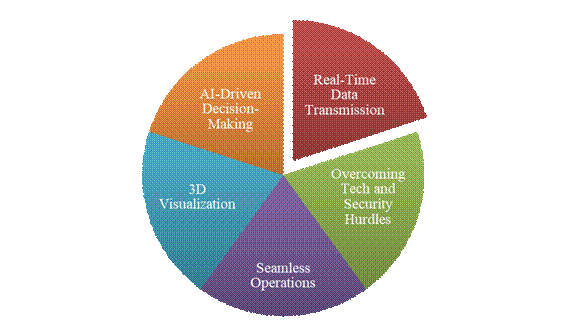
Fig. 1.
Transformative Elements of Metaverse and ChatGPT in SCM
Source: Author’s work
4.2. Intelligent Supply Chain Management
Metaverse technology is vital to
intelligent supply chain management due to its real-time data processing and
dynamic 3D visualization. The Metaverse creates virtual twins of supply chain
assets for detailed monitoring and analysis. These virtual models may replicate
demand fluctuations and supply disruptions to help management plan for and
react to unexpected issues [60]. One may use virtual transportation network
models to test routing algorithms to determine the most cost-effective and
efficient solutions. Supply chain decisions benefit from ChatGPT's natural
language processing. It can handle and comprehend enormous volumes of textual
data, including market reports, customer feedback, and supplier interactions.
This study illuminates trends, challenges, and opportunities to improve supply
chain management decision-making. ChatGPT may evaluate supplier and customer
feedback to identify common issues or improvement possibilities. It may
evaluate supply chain data and give detailed reports and ideas to improve
strategic planning and operational changes [61]. Figure 2 shows the key
features of smart SCM with AI Technologies.
The
following are the case studies/examples of intelligent supply chain management,
i.e.,
§ Dynamic Supply Chain Visualization: Metaverse
technology enabled a global firm to visualize its supply chain dynamically.
This methodology allowed them to monitor real-time production delays and supply
bottlenecks [62]. The company uses ChatGPT to evaluate virtual model data and
deliver actionable insights to handle disruptions better.
§ Automated Decision Support: The online store employs
ChatGPT to support automated supply chain decisions. The system used sales,
inventory, and supplier performance data to refill and buy. Metaverse
technology showed supply chain operations live, improving ChatGPT's ideas and
enabling more thoughtful decision-making [63].
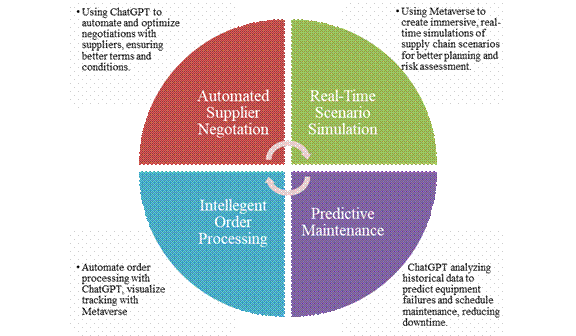
Fig. 2. Intelligent SCM Features with ChatGPT
and Metaverse
Source: Author’s work
Supply chain management has improved
information sharing, decision-making, and operational efficiency via Metaverse
and ChatGPT. These technologies enhance supply chain visibility,
responsiveness, and optimization.
4.3. Efficiency and
Safety Outcomes of AI Integration
Metaverse and ChatGPT improve
operational performance compared to traditional logistics systems, as shown in
Table 6. Performance data shows strong increases across all categories.
AI-enabled visualization and predictive control reduced idle time, route duplication,
and human coordination delays and increased operational efficiency from 68.4%
to 89.6%. ChatGPT-based decision support and real-time data processing in the
Metaverse improved decision-making speed by 42.3% from moderate to high under
automated, AI-assisted analysis. Conversational signs, digital twin monitoring,
and immersive safety simulations increased safety compliance from 71.2% to
90.8% before transport operations. Data analytics and virtual modelling enhance
risk prediction accuracy by 41.7% for incident avoidance and proactive risk
management. The instantaneous, AI-mediated interaction among drivers, logistics
managers, and control centers reduced misunderstandings and coordination gaps,
resulting in the largest increase (+35.2%) in communication efficacy.
Tab. 6
Impact of Metaverse
and ChatGPT on Transport Logistics Performance Indicators
|
Performance Dimension |
Traditional Logistics
(Before AI Integration) |
AI-Enhanced Logistics
(Metaverse + ChatGPT) |
% Improvement Observed |
|
Operational Efficiency |
68.40% |
89.60% |
30.90% |
|
Decision-Making Speed |
Moderate (Manual Processing) |
High (Automated Insights) |
42.30% |
|
Safety Compliance |
71.20% |
90.80% |
27.60% |
|
Risk Prediction Accuracy |
65.00% |
92.10% |
41.70% |
|
Communication Effectiveness |
70.50% |
95.30% |
35.20% |
Source: Authors' analysis based on simulated
transport logistics models and
AI-driven decision frameworks
When Metaverse and ChatGPT were
integrated into logistical operations, efficiency, safety, and decision-making
speed improved. The simulation results show that Metaverse immersive
visualisation can help logistics managers anticipate operational bottlenecks
and safety risks, and ChatGPT-based communication systems can improve transport
node coordination and reaction time. Improved predictive analytics and
real-time conversational feedback loops strengthen logistical infrastructure.
The findings suggest that immersive AI-powered solutions increase efficiency
and safety, supporting sustainable transport management and operational risk
reduction in changing logistical environments.
5. IMPACT ON SUPPLY
CHAIN DESIGN AND OPERATIONS
5.1. Supply Chain
Design
The Metaverse transforms product
information management and visualization throughout transportation and storage,
affecting supply chain design. The Metaverse uses virtual models and
simulations to show the supply chain more accurately and interactively. These
virtual settings provide all stakeholders with real-time product location,
condition, and status updates. Metaverse-based simulations can track perishable
goods in transportation and detect issues like temperature fluctuations and
delays [64]. The data from this feature optimizes packaging, routing, and
handling to prevent damage and deterioration. Additionally, the Metaverse gives
a comprehensive view of supply chain operations, improving decision-making.
Virtual simulations allow supply chain managers to test different design
scenarios and their efficiency. Virtual models let companies evaluate
transportation routes, warehouse layouts, and inventory management strategies
[65]. Scenario simulations may help managers choose the best settings and improve
operational effectiveness. This strategy allows optimization and preemptive
improvements before real-world changes, reducing costly mistakes and
disruptions.
5.2. Supply Chain Control Systems
ChatGPT boosts supply chain
intelligence with its sophisticated natural language processing. It can
automate and enhance many control and monitoring tasks in supply chain
management systems. ChatGPT can analyze huge volumes of data, including
inventory levels, supplier performance, and market conditions. This report
offers practical advice to enhance supply chain procedures. ChatGPT also helps
supply chain partners interact and coordinate in real time, keeping everyone
informed and on the same page. ChatGPT aids risk response and transportation
planning using predictive analytics and scenario planning [66]. ChatGPT can
predict risks and suggest mitigation by analyzing prior data and patterns.
Source and transport alternatives may be proposed for supply chain outages
caused by supplier delays or geopolitical events. ChatGPT optimizes timetables
and routes utilizing real-time traffic data, weather, and delivery demands to
reduce delays and enhance efficiency [67].
Metaverse and ChatGPT technology in
design and control systems have revolutionized supply chain optimization. These
technologies may make supply chains more transparent, efficient, and robust,
improving performance and competitiveness.
6. CHALLENGES AND LIMITATIONS
6.1. Technical Challenges in
Integrating These Technologies
SCM integration of Metaverse with
ChatGPT technology presents many technical challenges. Communication across
systems and platforms is crucial. In supply chain management, the Metaverse and
ChatGPT employ VR, AR, and NLP, which must be seamlessly integrated. Developing
complex, costly software and a solid infrastructure to integrate various
technologies is difficult. Another technical challenge is handling enormous
data sets [68]. The Metaverse generates massive amounts of real-time data on
supply chain activities, including inventory levels, transit statuses, and
environmental conditions. Processing and analyzing this data require
supercomputers and other high-tech data storage. ChatGPT's natural language
processing requires an enormous text dataset processing and interpretation,
which requires much computational power. These technologies' data processing
and analysis capabilities should maintain system performance [69]. Figure 3 shows the integration challenges of
technologies in SCM.
6.2. Security and Privacy Concerns
Combining Metaverse with ChatGPT
raises severe privacy and security concerns. Users' personal and corporate data
are often collected and sent in Metaverse virtual surroundings. Protecting this
data from hackers, breaches, and other cyber risks is crucial. Security
measures like encryption and access limits are needed to safeguard Metaverse
data. Privacy problems may arise from ChatGPT's ability to evaluate and
generate human-like text [70]. Technology that requires access to sensitive
company and individual information might raise data security and privacy
concerns. ChatGPT must meet data protection regulations like the GDPR and
implement strict data processing and storage practices to prevent privacy
risks. The following are examples of security and privacy concerns of the
technologies, i.e.:
§ Data Breach Incident: When Metaverse-powered companies
had data breaches, unauthorized parties accessed proprietary supply chain data,
damaging the firm's reputation and perhaps resulting in legal action [71].
§ Privacy Concerns with ChatGPT: After incorporating
ChatGPT into its customer service system and struggling to comply with data
protection laws, the company had to reevaluate its data management and privacy
policies. This raised ChatGPT privacy worries [72].
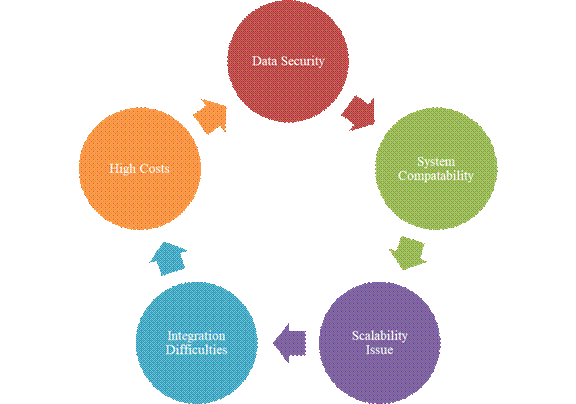
Fig. 3. Technical Challenges in Integrating
ChatGPT and Metaverse for SCM
Source: Author’s work
Figure 4 shows the security and
privacy concerns in integrating ChatGPT and Metaverse.
6.3. Adoption Barriers and Resistance to Change
Several parties may oppose ChatGPT
and the Metaverse in supply chain management. Resistance to change within and
outside organizations is a key hurdle [73]. Management and workers may be wary
of new technology since it may disrupt processes, procedures, and
responsibilities. Change management strategies may overcome this resistance,
including training, communication, and demonstrating the new technology's
benefits. The hefty cost of implementation also hinders acceptability.
Infrastructure, software development, and ongoing maintenance may be costly
when merging Metaverse and ChatGPT technologies [74]. Initial investment and
apparent ROI may deter many organizations, especially smaller ones, from
implementing these technologies. The
following are examples of resistance to change to adopt new technologies, i.e.:
§ Employee Resistance: A logistics company's employees
resisted Metaverse-based training, requiring additional change management and
training to succeed [75].
§ Cost Concerns: A medium-sized corporation was
reluctant to adopt ChatGPT technology due to high costs and uncertainty about
ROI [76].
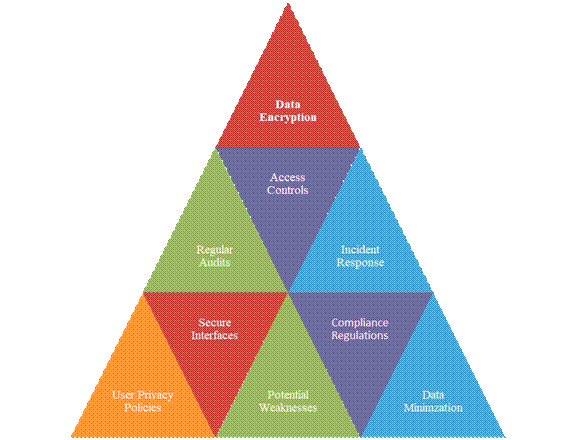
Fig. 4. Security and Privacy Concerns in
ChatGPT and Metaverse Integration
Source: Author’s work
Metaverse
and ChatGPT technology greatly benefit supply chain management. However, to
achieve this integration,
security, acceptance, and technological challenges must be addressed. These
technologies may enhance supply chain operations and help organizations achieve
their strategic goals, provided they recognize and address these concerns.
7.
FUTURE DIRECTIONS
7.1. Potential
Advancements in Metaverse and ChatGPT
Future development of Metaverse and ChatGPT might revolutionize supply chain management. As virtual and augmented reality improve, Metaverse users may expect increasingly vivid and participatory virtual environments. Technology like haptic feedback, which adds a physical aspect to online settings, may enable more realistic and participatory supply chain simulations. Metaverse settings might benefit from AI-powered virtual assistant upgrades that make virtual simulation interactions more natural and responsive. Natural language processing and comprehension improvements should help ChatGPT understand complex questions. Future ChatGPT versions may include more complicated reasoning and contextual understanding for more accurate and valuable responses. Integrating ChatGPT with computer vision and machine learning may increase its ability to handle and comprehend multimodal data – videos, photos, and text. Metaverse technology may enable more realistic virtual supply chain networks with real-time environmental changes and dynamic interactions. Due to its extensive natural language processing capabilities, ChatGPT may be able to handle more complex supply chain circumstances and provide more accurate and contextually relevant decision-making insights. Figure 5 shows potential advancements in AI Technologies.
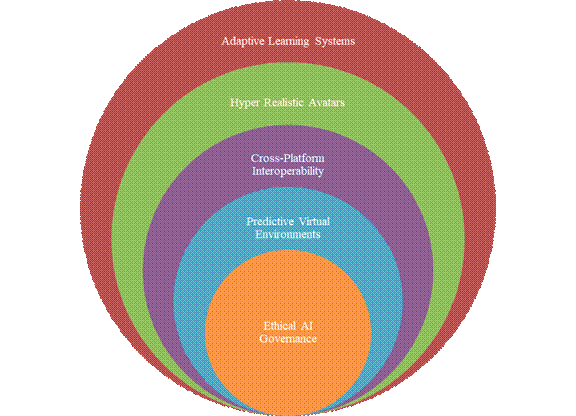
Fig. 5. Advancements in Metaverse and ChatGPT
Source: Author’s work
7.2. Prospects for Further Integration in
Supply Chain Management
Metaverse and ChatGPT are being
added to additional supply chain management systems, enabling greater
optimization and innovation. As Metaverse technology advances, supply chain
design and simulation tools will become more participatory. This development
may allow organizations to replicate and test whole supply chain systems before
going into production using virtual supply chain twins. With increased
real-time data analysis and decision-support, ChatGPT will become more
significant in supply chain management. ERP and advanced analytics platforms
are two supply chain management systems that might be integrated with this
technology to regulate supply chain operations. Increased usage of ChatGPT for
scenario planning and predictive analytics may help organizations anticipate
and resolve issues. Supply chain network virtual twins may be Metaverse
technology's next great usage. This would enable supply chain strategy
improvement and testing. ChatGPT integration with ERP and advanced analytics
platforms might provide a unified supply chain management solution with
real-time data and recommendations. Figure 6 shows the integrated SCM solutions
through different crucial factors.
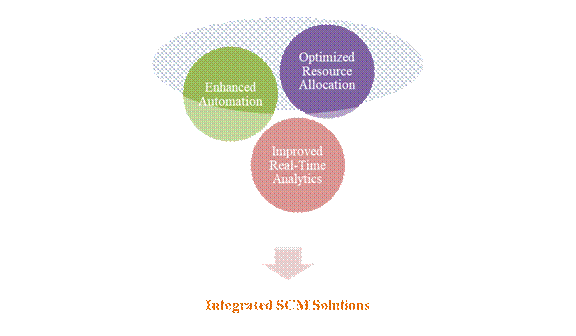
Fig. 6. Prospects for Assimilation in SCM
Source: Author’s work
7.3. Research Gaps and Opportunities
Metaverse and ChatGPT integration in
supply chain management offers research opportunities and constraints, despite
promising results. A significant study is required on the effectiveness and
practical usage of these technologies in supply chains. Even with a lot of
theoretical and experimental research, more case studies and data are needed to
prove the benefits and address the issues with these technologies. Another
problem is the regulatory and ethical implications of Metaverse and ChatGPT
supply chain applications. Data privacy, cybersecurity, and AI morality deserve
greater attention. Research in these domains is necessary to build ethical
technology usage policies. To verify these assertions, more case studies and
performance evaluations of Metaverse and ChatGPT technologies in supply chain
management are needed. The ethical and regulatory implications of adopting
these technologies into supply chain operations must be researched to ensure
their appropriate and safe use. Metaverse and ChatGPT technologies may increase
operational efficiency and decision-making, benefiting supply chain management
in the future. Addressing research gaps and exploring new opportunities will
ensure the proper integration of these technologies into supply chain
operations and their full benefits.
8.
CONCLUSIONS
Metaverse and ChatGPT technology may
revolutionize supply chain management by improving operational efficiency,
decision-making, and performance. This research addressed many key findings
concerning these technologies' consequences and potential. The study suggests
merging Metaverse and ChatGPT technologies into transportation logistics to
revolutionize smart, sustainable, and secure transportation systems.
Conversational AI and immersive simulation improve logistics network
situational awareness, decision-making, and communication reliability. Both
simulations and real-world transportation operations indicate that these
technologies improve efficiency, risk prediction, and safety compliance.
Successfully implementing AI-driven logistics solutions requires a solid data
infrastructure, digital governance procedures, and staff reskilling.
Policymakers, logistics managers, and tech developers should collaborate on
legal and technical norms for AI interoperability, cybersecurity, and ethics.
Metaverse and ChatGPT integration is a strategic enabler for intelligent
transport logistics in the AI-driven economy, not merely a technological
development. Metaverse technology can replicate and display the supply chain in
real-time. Immersive 3D modeling and dynamic environment interaction allow
supply chain operations, design research, and optimization in the Metaverse. It
increases risk management, product monitoring, and virtual training by
simulating and evaluating several supply chain scenarios. ChatGPT's natural language
processing transforms supply chain data analysis and communication. It analyzes
textual material, provides insights and ideas, and automates client requests
and report creation. ChatGPT allows quicker and more accurate processing of
enormous volumes of data, improving supply chain management decision-making.
Integration of these technologies
has significant implications for supply chain management. Supply chain managers
may utilize the Metaverse through virtual simulations to make better decisions
and operate more efficiently. It improves logistics, inventory management,
stakeholder participation, and commodity monitoring. ChatGPT automates data
analysis and transfers to boost supply chain insight. Real-time data and ideas
may help strategic planning, risk management, and predictive analytics. This
makes supply chain operations more agile and responsive, helping organizations
handle disruptions and enhance performance. Future Metaverse and ChatGPT
technologies will greatly impact SCM. As these technologies advance, better
modeling, analysis, and decision-making tools will become accessible. ChatGPT
improves language processing and AI interaction, while the Metaverse creates
more immersive virtual environments. To fully achieve these technologies'
potential, we must tackle their technical, security, and acceptability issues.
Responsible and effective Metaverse and ChatGPT use in supply chain management
requires continual study, empirical validation, and best practices to overcome
these challenges. Finally, Metaverse and ChatGPT technologies have
revolutionized supply chain management, enabling optimization and innovation.
By using these technologies, companies can improve supply chain resilience and
efficiency.
References
1.
Dong C., A. Akram, D. Andersson, P. O.
Arnäs, G. Stefansson. 2021. „The Impact
of Emerging and Disruptive Technologies on Freight Transportation in the
Digital Era: Current State and Future Trends.”
The International Journal of Logistics Management 32(2): 386–412.
2.
Sadeghi K., D. Ojha, P. Kaur, R. V. Mahto,
A. Dhir. 2025. „Metaverse
Technology in Sustainable Supply Chain Management: Experimental Findings.” Decision Support Systems 191: 114423.
3.
Jebbor I., Z. Benmamoun, H. Hachimi. 2025.
„Leveraging Digital Twins and Metaverse
Technologies for Sustainable Circular Operations: A Comprehensive Literature
Review.” Circular Economy and Sustainability. DOI: https://doi.org/10.1007/s43615-025-00615-2.
4.
Bansal G., V. Chamola, A. Hussain, M.
Guizani, D. Niyato. 2024. „Transforming
Conversations with AI—A Comprehensive Study of ChatGPT.”
Cognitive Computation 16(5): 2487–2510.
5.
Allioui H., A. Allioui, Y. Mourdi. 2024. „Maintaining Effective Logistics Management
During and After COVID-19 Pandemic: Survey on the Importance of Artificial
Intelligence to Enhance Recovery Strategies.”
Opsearch 61(2): 918–962.
6.
Tsolakis N., R. Schumacher, M. Dora, M.
Kumar. 2023. “Artificial Intelligence and Blockchain Implementation in Supply
Chains: A Pathway to Sustainability and Data Monetisation?” Annals of
Operations Research 327(1): 157–210.
7.
Alabi M. O., O. Ngwenyama. 2023. “Food
Security and Disruptions of the Global Food Supply Chains During COVID-19:
Building Smarter Food Supply Chains for Post COVID-19 Era.” British Food
Journal 125(1): 167–185.
8.
Wamba S. F., M. M. Queiroz, C. J. C.
Jabbour, C. V. Shi. 2023. “Are Both Generative AI and ChatGPT Game Changers for
21st-Century Operations and Supply Chain Excellence?” International Journal
of Production Economics 265: 109015.
9.
Yaqoob I., K. Salah, R. Jayaraman, M.
Omar. 2023. “Metaverse Applications in Smart Cities: Enabling Technologies,
Opportunities, Challenges, and Future Directions.” Internet of Things
23: 100884.
10.
Yenduri G., M. Ramalingam, G. C. Selvi, Y.
Supriya, G. Srivastava, P. K. R. Maddikunta, T. R. Gadekallu. 2024. “GPT
(Generative Pre-Trained Transformer) – A Comprehensive Review on Enabling
Technologies, Potential Applications, Emerging Challenges, and Future
Directions.” IEEE Access 12: 54608–54649.
11.
Khokhar R. H., W. Rankothge, L. Rashidi,
H. Mohammadian, B. Frei, S. Ellis, A. Ghorbani. 2024. “A Survey on Supply Chain
Management: Exploring Physical and Cyber Security Challenges, Threats, Critical
Applications, and Innovative Technologies.” International Journal of Supply
and Operations Management 11(3): 250–283.
12.
Mooney J. G., M. L. Williams. 2024.
“Enabling Technologies of the Fourth Industrial Revolution.” In Handbook of Research on
Strategic Leadership in the Fourth Industrial Revolution: 35–61. Edward
Elgar Publishing.
13.
Ud Din
I., K. A. Awan, A. Almogren, J. J. Rodrigues. 2023. “Integration of IoT and
Blockchain for Decentralized Management and Ownership in the Metaverse.” International
Journal of Communication Systems 36(18): e5612.
14.
Haddud A.
2024. “ChatGPT in Supply Chains: Exploring Potential Applications, Benefits and
Challenges.” Journal of Manufacturing Technology Management. DOI: https://doi.org/10.1108/JMTM-02-2024-0075
15.
Calzada
I. 2023. “Disruptive Technologies for E-Diasporas: Blockchain, DAOs, Data
Cooperatives, Metaverse, and ChatGPT.” Futures 154: 103258.
16.
Huang K.,
Y. Wang, B. Goertzel, T. Saliba. 2023. “ChatGPT and Web3 Applications.” In Beyond
AI, edited by K. Huang, Y. Wang, F. Zhu, X. Chen, C. Xing. Future of
Business and Finance. Springer, Cham. DOI: https://doi.org/10.1007/978-3-031-45282-6_3.
17.
Frederico
G. F. 2023. “ChatGPT in Supply Chains: Initial Evidence of Applications and
Potential Research Agenda.” Logistics 7(2): 26.
18.
Kılıçaslan
E., C. A. Zengi, D. Yücel. 2023. “Consumption Culture in the Metaverse Economy
as New Communication Technologies (ChatGPT Analysing).” İnsan ve
Toplum Bilimleri Araştırmaları Dergisi 12(5): 2480–2498.
19.
Hundekari
S., T. Mittal, A. Dutt, M. Bhavana, R. Kumar, G. Nijhawan. 2025. “AI-Driven
Solutions for Predictive Maintenance in Smart Transportation Systems.” 2025
International Conference on Computational, Communication and Information
Technology (ICCCIT): 572–577. IEEE.
20.
Cuchý M., M. Jakob, J.
Mrkos. 2025. “Route and Charging Planning for
Electric Vehicles: A Multi-Objective Approach.” Transportation Letters
17(1): 1–21.
21.
Sanjeev
A., R. Sharma. 2025. “Advancements and Challenges in Conversational AI:
Navigating the Frontiers of Innovation and Complexity.” The ChatGPT
Revolution: 107–128. Emerald Publishing Limited.
22.
Alsamh M.
H., A. Hawbani, S. Kumar, S. H. Alsamhi. 2024. “Multisensory Metaverse-6G: A
New Paradigm of Commerce and Education.” IEEE Access 12: 75657–75677.
23.
Rathor K.
2023. “Impact of Using Artificial Intelligence-Based ChatGPT Technology for
Achieving Sustainable Supply Chain Management Practices in Selected
Industries.” International Journal of Computer Trends and Technology
71(3): 34–40.
24.
George A.
S., A. H. George. 2023. “A Review of ChatGPT AI's Impact on Several Business
Sectors.” Partners Universal International Innovation Journal 1(1):
9–23.
25.
Shobhana
N. 2024. “AI-Powered Supply Chains Towards Greater Efficiency.” In Complex
AI Dynamics and Interactions in Management: 229–249. IGI Global.
26.
Dwivedi
Y. K., N. Kshetri, L. Hughes, E. L. Slade, A. Jeyaraj, A. K. Kar, R. Wright.
2023. “Opinion Paper: ‘So What if ChatGPT Wrote It?’ Multidisciplinary
Perspectives on Opportunities, Challenges and Implications of Generative
Conversational AI for Research, Practice and Policy.” International Journal
of Information Management 71: 102642.
27.
Büyüközkan
G. 2023. “Metaverse and Supply Chain Management Applications.” In Metaverse,
edited by F. S. Esen, H. Tinmaz, M. Singh. Studies in Big Data, vol.
133. Springer, Singapore. DOI: https://doi.org/10.1007/978-981-99-4641-9_26.
28.
De
Giovanni P. 2023. “Sustainability of the Metaverse: A Transition to Industry
5.0.” Sustainability 15(7): 6079.
29.
Lin J.,
Q. Li, C. Wang, Z. Hu. 2024. “Product Development and Design Framework Based on
Interactive Innovation in the Metaverse Perspective.” Applied System
Innovation 7(4): 58.
30.
Amaizu G. C., J. N.
Njoku, J. M. Lee, D. S. Kim. 2024. “Metaverse
in Advanced Manufacturing: Background, Applications, Limitations, Open Issues
& Future Directions.” ICT Express 10: 233–255.
31.
Basak R.,
P. Chatterjee, I. H. Molla, P. Paul, S. Kar. 2024. “Integrating AR and VR with
New Technologies Like AI, IoT, and Blockchain for Engineering Application.” In Navigating
the Augmented and Virtual Frontiers in Engineering: 131–157. IGI Global.
32.
Alizadehsalehi
S., I. Yitmen. 2023. “Digital Twin-Based Progress Monitoring Management Model
Through Reality Capture to Extended Reality Technologies (DRX).” Smart and
Sustainable Built Environment 12(1): 200–236.
33.
Kabir M.
R., S. Ray. 2023. “Virtual Prototyping for Modern Internet-of-Things
Applications: A Survey.” IEEE Access 11: 31384–31398.
34.
Myers D.,
R. Mohawesh, V. I. Chellaboina, A. L. Sathvik, P. Venkatesh, Y. H. Ho, Y.
Jararweh. 2024. “Foundation and Large Language Models: Fundamentals,
Challenges, Opportunities, and Social Impacts.” Cluster Computing
27(1): 1–26.
35.
Krishnamoorthy A., K. S.
Karthika, S. Arunkumar, N. Prabakaran. 2023.
“An AI-Driven Clinical Text-Based Decision Support System for Pancreatic Cancer
Diagnosis.” Migration Letters 20(S13): 460–467.
36.
Chow J.
C., V. Wong, K. Li. 2024. “Generative Pre-Trained Transformer-Empowered
Healthcare Conversations: Current Trends, Challenges, and Future Directions in
Large Language Model-Enabled Medical Chatbots.” BioMedInformatics
4(1): 837–852.
37.
Nleya S.
M., M. Velempini. 2024. “Industrial Metaverse: A Comprehensive Review,
Environmental Impact, and Challenges.” Applied Sciences 14(13): 5736.
38.
Fosso
Wamba S., C. Guthrie, M. M. Queiroz, S. Minner. 2023. “ChatGPT and Generative
Artificial Intelligence: An Exploratory Study of Key Benefits and Challenges in
Operations and Supply Chain Management.” International Journal of
Production Research 62(16): 5676–5696.
39.
Subagja
A. D., A. M. A. Ausat, A. R. Sari, M. I. Wanof, S. Suherlan. 2023. “Improving
Customer Service Quality in MSMEs Through the Use of ChatGPT.” Jurnal Minfo
Polgan 12(1): 380–386.
40.
Kmiecik
M. 2023. “ChatGPT in Third-Party Logistics – The Game-Changer or a Step into
the Unknown?” Journal of Open Innovation: Technology, Market, and
Complexity 9(4): 100174.
41.
Singh N.,
D. Adhikari. 2023. “Blockchain and AI in Reducing Inventory Fraud and Errors.” International
Journal for Research in Applied Science and Engineering Technology 11(12):
1023–1028.
42.
Choudhury
A., S. Elkefi, A. Tounsi. 2024. “Exploring Factors Influencing User Perspective
of ChatGPT as a Technology That Assists in Healthcare Decision Making: A
Cross-Sectional Survey Study.” PLoS One 19(3): e0296151.
43.
Dolgui
A., D. Ivanov. 2023. “Metaverse Supply Chain and Operations Management.” International
Journal of Production Research 61(23): 8179–8191.
44.
Chen P.
K., X. Huang. 2024. “Enhancing Supply Chain Resilience and Realizing Green
Sustainable Development Through the Virtual Environment of the Metaverse.” Sustainable
Development 32(1): 438–454.
45.
Lin J.,
Q. Li, C. Wang, Z. Hu. 2024. “Product Development and Design Framework Based on
Interactive Innovation in the Metaverse Perspective.” Applied System
Innovation 7(4): 58.
46.
Koohang
A., J. H. Nord, K. B. Ooi, G. W. H. Tan, M. Al-Emran, E. C. X. Aw, L. W. Wong.
2023. “Shaping the Metaverse into Reality: A Holistic Multidisciplinary
Understanding of Opportunities, Challenges, and Avenues for Future
Investigation.” Journal of Computer Information Systems 63(3):
735–765.
47.
Aladağ
H. 2023. “Assessing the Accuracy of ChatGPT Use for Risk Management in
Construction Projects.” Sustainability 15(22): 16071.
48. Sadeghi K., D. Ojha, P. Kaur, R. V. Mahto, A. Dhir. 2025.
“Metaverse Technology in Sustainable Supply Chain Management: Experimental
Findings.” Decision Support Systems 191: 114423.
49.
Luo W.,
K. Huang, X. Liang, H. Ren, N. Zhou, C. Zhang, W. Gui. 2024. “Process
Manufacturing Intelligence Empowered by Industrial Metaverse: A Survey.” IEEE
Transactions on Cybernetics. DOI: https://doi.org/10.1109/TCYB.2024.3420958.
50.
Kuo H. T., T. M. Choi.
2024. “Metaverse in Transportation and Logistics
Operations: An AI-Supported Digital Technological Framework.” Transportation
Research Part E: Logistics and Transportation Review 185: 103496.
51.
Nassif J., J. Tekli, M.
Kamradt. 2024. “Background and Technologies.” In Synthetic
Data. Springer, Cham. DOI: https://doi.org/10.1007/978-3-031-47560-3_3.
52.
Rezapour
M. M., A. Fatemi, M. A. Nematbakhsh. 2024. “A Methodology for Using Players’
Chat Content for Dynamic Difficulty Adjustment in Metaverse Multiplayer Games.”
Applied Soft Computing 156: 111497.
53.
Dahake P.
S., R. V. Mohare, N. S. Dahake. 2024. “Enhancing Management Education Through
ChatGPT: A Novel Method for Ease and Efficacy.” In Entrepreneurship and
Creativity in the Metaverse: 161–178. IGI Global.
54.
Meng Z.,
K. Chen, Y. Diao, C. She, G. Zhao, M. A. Imran, B. Vucetic. 2024.
“Task-Oriented Cross-System Design for Timely and Accurate Modeling in the
Metaverse.” IEEE Journal on Selected Areas in Communications 42(3):
752–766.
55.
Van Slyke
C., R. D. Johnson, J. Sarabadani. 2023. “Generative Artificial Intelligence in
Information Systems Education: Challenges, Consequences, and Responses.” Communications
of the Association for Information Systems 53(1): 1–21.
56.
Drissi
Elbouzidi A., A. Ait El Cadi, R. Pellerin, S. Lamouri, E. Tobon Valencia, M. J.
Bélanger. 2023. “The Role of AI in Warehouse Digital Twins: Literature Review.”
Applied Sciences 13(11): 6746.
57.
Hu X., Y. F. Chuang. 2023. “E-Commerce Warehouse Layout Optimization:
Systematic Layout Planning Using a Genetic Algorithm.” Electronic Commerce
Research 23(1): 97–114.
58.
Aljohani
A. 2023. “Predictive Analytics and Machine Learning for Real-Time Supply Chain
Risk Mitigation and Agility.” Sustainability 15(20): 15088.
59.
Zhou L., X. Shi, Z.
Wang, C. Ma, L. Gao. 2025. “Exploration
of Applications with ChatGPT for Green Supply Chain Management.” Annals of
Operations Research. DOI: https://doi.org/10.1007/s10479-025-06713-6.
60.
Can O.,
A. Turkmen. 2023. “Digital Twin and Manufacturing.” In Digital Twin Driven
Intelligent Systems and Emerging Metaverse. Springer, Singapore. DOI: https://doi.org/10.1007/978-981-99-0252-1_8.
61.
Raj R.,
A. Singh, V. Kumar, P. Verma. 2023. “Analyzing the Potential Benefits and Use
Cases of ChatGPT as a Tool for Improving the Efficiency and Effectiveness of
Business Operations.” BenchCouncil Transactions on Benchmarks, Standards
and Evaluations 3(3): 100140.
62.
El
Jaouhari A., J. Arif, A. Samadhiya, A. Kumar, V. Jain, R. Agrawal. 2024. “Are
Metaverse Applications in Quality 4.0 Enablers of Manufacturing Resiliency? An
Exploratory Review Under Disruption Impressions and Future Research.” The
TQM Journal 36(6): 1486–1525.
63.
Atiyah A.
G., N. N. Faris, G. Rexhepi, A. J. Qasim. 2023. “Integrating Ideal
Characteristics of Chat-GPT Mechanisms Into the Metaverse: Knowledge,
Transparency, and Ethics.” In Beyond Reality: Navigating the Power of
Metaverse and Its Applications, edited by M. Al-Emran, J. H. Ali, M.
Valeri, A. Alnoor, Z. A. Hussien. Lecture Notes in Networks and Systems,
vol. 895. Springer, Cham. DOI: https://doi.org/10.1007/978-3-031-51716-7_9.
64.
Gleim M.,
H. McCullough, O. C. Ferrell, C. Gabler. 2024. “Metaverse: Shifting the Reality
of Services.” Journal of Services Marketing 38(1): 13–27.
65.
Wan X.,
G. Zhang, Y. Yuan, S. Chai. 2023. “How to Drive the Participation Willingness
of Supply Chain Members in Metaverse Technology Adoption?” Applied Soft
Computing 145: 110611.
66.
Yazdi M., E. Zarei, S.
Adumene, A. Beheshti. 2024. “Navigating the
Power of Artificial Intelligence in Risk Management: A Comparative Analysis.” Safety
10(2): 42.
67.
Voß S.
2023. “Successfully Using ChatGPT in Logistics: Are We There Yet?” In Computational
Logistics, edited by J. R. Daduna, G. Liedtke, X. Shi, S. Voß. Lecture
Notes in Computer Science, vol. 14239. Springer, Cham. DOI: https://doi.org/10.1007/978-3-031-43612-3_1.
68.
Önden A.,
K. Kara, İ. Önden, G. C. Yalçın, V. Simic, D. Pamucar. 2024.
“Exploring the Adoption of the Metaverse and Chat Generative Pre-Trained
Transformer: A Single-Valued Neutrosophic Dombi Bonferroni-Based Method for the
Selection of Software Development Strategies.” Engineering Applications of
Artificial Intelligence 133: 108378.
69.
Alawida
M., S. Mejri, A. Mehmood, B. Chikhaoui, O. I. Abiodun. 2023. “A Comprehensive
Study of ChatGPT: Advancements, Limitations, and Ethical Considerations in
Natural Language Processing and Cybersecurity.” Information 14(8):
462.
70.
Fui-Hoon
Nah F., R. Zheng, J. Cai, K. Siau, L. Chen. 2023. “Generative AI and ChatGPT:
Applications, Challenges, and AI-Human Collaboration.” Journal of
Information Technology Case and Application Research 25(3): 277–304.
71.
Sami H.,
A. Hammoud, M. Arafeh, M. Wazzeh, S. Arisdakessian, M. Chahoud, M. Guizani.
2024. “The Metaverse: Survey, Trends, Novel Pipeline Ecosystem & Future
Directions.” IEEE Communications Surveys & Tutorials. DOI: https://doi.org/10.1109/COMST.2024.3392642.
72.
Wu X., R. Duan, J. Ni.
2024. “Unveiling Security, Privacy, and Ethical
Concerns of ChatGPT.” Journal of Information and Intelligence 2(2):
102–115.
73.
Huawei
H., Z. Qinnan, L. Taotao, Y. Qinglin, Y. Zhaokang, W. Junhao, Z. Zheng. 2023.
“Economic Systems in the Metaverse: Basics, State of the Art, and Challenges.” ACM
Computing Surveys 56(4): 1–33.
74.
Lv Z.
2023. “Generative Artificial Intelligence in the Metaverse Era.” Cognitive
Robotics 3: 208–217.
75.
Saini G.,
S. Gupta, M. M. Baba. 2025. “How Leadership Fosters Sustainable Organizational
Agility Through Metaverse Adoption.” International Journal of
Organizational Analysis. DOI: https://doi.org/10.1108/IJOA-08-2024-4776.
76.
Chen C.
T., S. C. Chen, A. Khan, M. K. Lim, M. L. Tseng. 2024. “Antecedents of Big Data
Analytics and Artificial Intelligence Adoption on Operational Performance: The
ChatGPT Platform.” Industrial Management & Data Systems 124(7):
2388–2413.
Received 07.12.2025; accepted in revised form 14.02.2026

Scientific Journal of Silesian
University of Technology. Series Transport is licensed under a Creative
Commons Attribution 4.0 International License