Article
citation information:
Nitsenko,
V., Lyshenko, M., Velychko, O., Vitkovskyi, Y., Darushyn,
O., Mazur, Y., Pokhlebina, T., Zhuk, R. Management of the
logistics and sales system of the agricultural industry in the crisis
conditions of the economy. Scientific
Journal of Silesian University of Technology. Series Transport. 2026, 130, 141-157. ISSN: 0209-3324. DOI: https://doi.org/10.20858/sjsutst.2026.130.9
Vitalii NITSENKO[1], Marharyta LYSHENKO[2], Oleksandr VELYCHKO[3], Yurii VITKOVSKYI[4], Oleksandr DARUSHYN[5], Yuliia MAZUR[6], Taisiia POKHLEBINA[7], Ruslan ZHUK[8]
MANAGEMENT OF THE
LOGISTICS AND SALES SYSTEM OF THE AGRICULTURAL INDUSTRY IN THE CRISIS
CONDITIONS OF THE ECONOMY
Summary. The article examines
the tasks and directions of transformation of logistics and sales management in
the agricultural sector caused by the crisis. Quantitative statistical analysis
of the Trade Policy Uncertainty Index proves that the level of challenges of
the current crisis and the dynamics of changes in their impacts are
significantly higher than during the crisis caused by the pandemic. The
significance of these indicators demonstrates the presence of a threat not only
to the sustainability of the activities of all business components of the
logistics and sales system, but even to their survival in crisis conditions. At
the same time, the significant pace of change in the challenges of the crisis
complicates the process of management adaptation to them. To assess the level
of management adaptation, a mathematical model of the dynamics of the logistics
and sales process was developed, which allows determining the adequacy of the
pace of change in management measures. The use of a systems approach made it possible
to establish that important areas of logistics and sales process management
also include supporting the resilience of not only the company, but also all
components of the specified system - from the manufacturer to the sales
markets. This necessitates the introduction of multi-purpose management and its
construction on the principles of a hierarchy of management decisions. It is
noted that this requires the interpretation of the logistics and sales chain as
a system cycle, which in the process of optimizing sales logistics requires
considering the set of risks as a mutually agreed system. The systems approach
also necessitated the study of the components of the management of the
logistics and sales system of the agricultural industry, including its
institutional component. A comparative analysis of the components of the
Logistics Efficiency Index by agricultural exporting countries indicated areas
for improving Ukrainian institutional management. It is indicated that the
dynamic reorientation of the directions of Ukraine's export logistics and sales
activities leads to the formation of much longer logistics and sales chains,
which reduces the possibility of participation in them not only of small but
also of medium-sized agricultural producers, which radically changes the
logistics and sales system of the country. In particular, this causes the need
to involve logistics and sales companies on the principles of outsourcing or
the formation of cooperatives specializing in logistics and sales of agricultural
products.
Keywords: logistics and distribution, systemic approach, multi-purpose
management, threat dynamics, adaptation to the crisis
1. INTRODUCTION
Managing logistics and sales
activities in the agricultural sector is a rather difficult task for
management, even in conditions of sustainable economic development. The
difficulties are primarily due to the peculiarities of agricultural products:
the seasonal nature of production, the ability to quickly lose their qualities
and even the inclusion of live animals in the product range, the logistics and
sales of which require specific skills and equipment. The difficulties are
exacerbated by the insufficient development of the transport system and
logistics infrastructure in developing countries, which can belong to both the
category of suppliers and the category of consumers of agricultural products.
At the same time, under conditions of sustainable development, the management
of the logistics and sales system of agricultural enterprises gains experience
and adapts to the specifics of the industry.
Crises not only radically affect all
links of the logistics and sales chains, all relevant areas of activity, but
they also require a transformation of management to neutralize the challenges
that have arisen. Another significant problem is the dynamism of the emergence
and action of threats generated by the crisis. The pace of change in threats
requires not only the introduction of operational management measures, it
requires a dynamic nature of management transformation, which will ensure the
appropriate level of adaptation of the logistics and sales process both to the
challenges of the crisis and to the new landscape of sales markets formed by
the crisis (Bazaluk, 2017; Kotenko et al., 2021; Bazaluk et al., 2022).
The comprehensive nature of the
impacts of the crisis also requires a broadening of the view of the logistics
and sales system of the agricultural industry, and, accordingly, to the
structure of its management (Ociepa-Kicińska et al.,
2025). In the context of the crisis, it is worth including institutional
management in the specified system, the actions of which determine the level of
success of agricultural logistics in the supplying countries and the efficiency
of the sales process in the consuming countries of agricultural products. A
systemic view of the logistics and sales process also allows for the
identification of the mutual influence of both crisis factors and managerial
reactions to them, which helps to identify both positive and negative synergistic
effects. The study of these aspects will contribute to both the effective
transformation of logistics and sales management, as well as its adaptation to
the conditions of the crisis and, accordingly, ensuring sustainable development
for all components of the logistics and sales system.
2. LITERATURE REVIEW
Scientific research on the
management of logistics and sales activities of agricultural enterprises is
complicated by the involvement of various areas of activity in this issue, for
example, such as distribution (Korniietskyi et al.,
2025), transport (Spaskyi, 2022), integrated
(Voloshchuk et al., 2020), logistics and the significant fragmentation of this
system by functional areas, for example, agro-logistical
hubs (Kustrich, 2022), logistics centers
(Danylenko, 2020), by nomenclature: grain products (Zakharchuk et al., 2025),
wine materials (Marchuk et al., 2025), volume of commodity batches (Malik et
al., 2023), etc. Also, researchers are often limited to one of the functions of
the logistics and sales activities of agricultural enterprises, in particular,
marketing management of supply chains (Balanovska et
al., 2025; Makarenko et al., 2025), digital management (Lagodiienko
et al., 2023; Klius et al., 2023; Perevozova
et al., 2024; Kwilinski et al., 2025), green
(ecological) logistics (Chukurna et al., 2022; Sklavos et al., 2024), etc.
The fragmentation of the problem
sometimes hides the systemic nature of logistics and sales activities. At the
same time, there are studies devoted to the need to build a logistics system in
the agricultural sector as a way to overcome the crisis (Radchenko, 2023;
Kotenko et al., 2021). Moreover, scientists point out the need to highlight a
separate category of logistics systems, which are proposed to be called the “agrologistics system” (Vinichenko
et al., 2023). There are also works that indicate the importance of forming a
logistics and marketing system for a separate cluster (Deineha
et al., 2022) or even an enterprise (Gumenyuk et al., 2020). In view of the
issues raised in the presented article the emphasis of the study by Gumenyuk et
al. (2020) on the importance of forming specialized logistics and marketing
enterprises primarily for agricultural products that quickly lose their
consumer qualities, such as vegetables, is essential.
The systemic impact of the logistics
and sales process in the agricultural industry is not directly confirmed in the
article by Li et al. (2022), which states that the formation of stable and
resilient supply chains ensured the viability of agricultural household
suppliers during the pandemic crisis. However, the systemic approach is
supported mainly by qualitative rather than quantitative research into the
process.
Also, the generalization of
scientific conclusions is significantly complicated by different views on the
nature of the current crisis, its causes, the directions of influence on the
management of logistics and sales activities of agricultural products, the need
for changes in management approaches, etc. Thus, in the articles by Stonozhenko et al. (2023) and Potwora et al. (2024), it is
indicated that one of the main negative factors of the crisis is the
uncertainty of its impacts. Mazur et al. (2025) focus on the threats of the
crisis to the level of competitiveness of supplies to foreign markets, which,
in their opinion, requires improving the logistics management strategy of
agricultural enterprises. Lykholat et al. (2022) note
that the crisis has led to the destruction of traditional logistics chains. The
articles by Radchenko (2023) and Voronina et al. (2024) point out the threat of
an increase in the cost of logistics services in Ukraine at a rate of 2-3 times
per year, which destabilizes not only the national but also the global
agricultural market.
Scientists also point out that the
crisis requires a radical transformation of the logistics and sales activities
of agricultural enterprises, in particular, given the need for logistical
support for food security at both the national and global levels (Pavlyshyn,
2023). In the article by Maievska (2022), the main
task of transforming the logistics and sales management of agricultural
enterprises in times of crisis is to manage logistics chains in such a way that
will provide maximum added value to each of the participants in these chains.
In our opinion, such a statement of the management task is insufficiently
substantiated.
Scientific studies rightly point out
the significant difference in the importance of crisis factors on logistics and
sales entities. Even the impact of the war is uneven for different regions of
Ukraine, on whose territory the war is taking place. As noted in the articles
by Shalyhina et al. (2025) and Mykolaichuk
et al. (2025), frontline farms are characterized by significant fluctuations in
crop yields and production volumes, which leads to a significant level of
instability of the logistics and sales process for the domestic and,
especially, for the foreign market where consumers are attentive to the fulfillment of contract terms. At the same time, Shalyhina et al. (2025) indicate that even under extremely
harsh crisis conditions, there are signs of adaptation of both production and
logistics and sales processes to existing threats. But this thesis is not
supported by quantitative analysis.
Scientists use different methods to
assess the impact of the crisis and optimize various aspects of logistics and
sales activities. Thus, Kovalenko (2025) relies on a SWOT analysis of Ukrainian
agricultural logistics, which is a qualitative method of analysis, reducing the
relevance of scientific conclusions. When setting the tasks of optimizing the
logistics and sales process of agricultural enterprises, scientists often limit
themselves to improving resource provision (Aulin et al., 2018; Andriushchenko et al., 2021), minimizing costs (Dramaretska et al., 2018), improving the management of
logistics of material flows (Rzhepishevska et al.,
2017), offering either qualitative approaches (Panchenko, 2024) or quantitative
approaches, where, even in times of crisis, exclusively economic and financial
functions are chosen as goals (Vinichenko et al.,
2023).
At the same time, the cardinal
changes due to the crisis in all components of the logistics and sales system
of the agricultural industry require a comprehensive, systemic view of
management in this area, the conditions and directions of its transformation.
The importance of such a view is enhanced by the decrease in the share of
self-organization of some links of logistics and sales chains, inherent in a
stable period of economic development, in the conditions of crisis, which leads
to an increase in the level of integrated management. An extended study is
also required by a problem that has remained unnoticed by many scientists - the
speed of change of crisis challenges, which determine not only the need for
operational management responses to threats, but also pose the task of
dynamically adapting to them the logistics and marketing system of agricultural
production at all levels of its management - from the enterprise and cluster to
the state level. This is not only a question of ensuring the proper level of
sustainability of logistics and marketing of agricultural products, but it is
also a question of the survival of all business links of the logistics and
marketing chain and, in general, the issue of food security, both at the local
and global levels.
3. MATERIALS AND METHODS
The study used
mathematical methods of statistical analysis and group theory.
For quantitative
statistical analysis of the impact of the crisis, the Trade Policy Uncertainty
(TPU) Index was used, since it has been proven that changes in this indicator
are closely related to changes in other global financial indicators: Dow Jones,
STOXX 600 index, Hang Seng, Nikkei 225 and Shanghai Composite, etc. (Kantemyr et al., 2025). The TPU Index was introduced by the
US Federal Reserve Board to numerically measure the level of
trade policy uncertainty. The higher the numerical value of this indicator, the
greater the risks for investment and trade. That is, a high TPU-Index value
indicates a higher level of crisis. In the time interval presented in Fig. 1,
there are signs of two crises: COVID-2019 and the current one, which, in terms
of risks for trade, according to the comparison of TPU-Index values, exceeds
the previous one by almost two times.
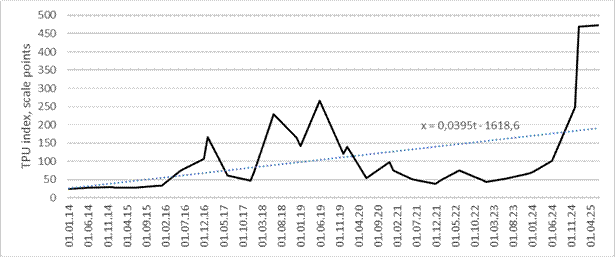
Fig. 1. Dynamics of Trade Policy Uncertainty
Index for
the period 01.2014 – 04.2025, scale points
Source: developed by the author
based on data from the National Bank of Ukraine (2025)
The increase in TPU-Index values is not only an indirect indication of
the level of challenges of the crisis to the logistics and supply chain in the
agricultural sector, but also directly indicates a threat. Thus, the increase
in the unpredictability of agricultural logistics in terms of delivery times,
uncertainty in the cost of logistics operations in regions of hostilities, led
to an increase in the risks of financial transactions with agricultural
products on forward markets. Therefore, Ukrainian grain traders switched to the
spot market. As it is known, selling prices on the spot market are lower than
on forward markets. This reduced the profitability of grain production, which,
due to the increase in the cost of logistics operations, led to a crisis of all
components of the logistics and marketing system of grain crops. The
instability of demand satisfaction also increased due to the decrease in the
flexibility of logistics and marketing chains due to the increase in threats to
warehouses and elevators, and, accordingly, the reduction in opportunities for
the formation of reserves.
This has increased the impact of the crisis on the world market and,
accordingly, created threats to global food security.
Therefore, this necessitates the need for statistical assessment and
mathematical formalization of the analysis of changes in the TPU Index.
The average deviation of
the TPU Index in the time interval 01.2014 - 04.2025 is:
 (1)
(1)
where  is the number of years,
  is the TPU Index value for the year
  ,
,  is the average TPU Index value for years.
At the same time, the deviation from
the average value for the period as of 04.2025 is 54.3% more than this
indicator, which is a significant confirmation of the crisis at this time. This
increases the risks for investors and, as indicated, complicates forward
trading, which is important for the agricultural sector.
Also, the rate of change of its
indicators is significant for the logistics and sales process. This is due to
the fact that the dynamic impact of the crisis does not allow companies to
adapt their logistics and sales to it. This is especially important for
agricultural products, which are characterized by a long production cycle and
for a significant part of the product range, there are no possibilities for its
storage without losing not only its qualities but, in some cases, even its
suitability for consumption.
This allows for formulating the
first prerequisite for effective management of the logistics and sales system
of agricultural enterprises in crisis management conditions - not only a high
level of adaptation to the challenges of the crisis, but also a high efficiency
of the adaptation process.
The mathematical formalization of
the rate of change is the first derivative of the indicator, or the slope ratio
of its trend line. According to the trend equation established by the analysis:
 (2)
(2)
first derivative TPU Index for the
period 2014-2025:
 =
= (3)
(3)
This value is integral, and for the
COVID-19 crisis, the assessment period narrows to 2018-2019, and the first
derivative of the TPU Index in this period is 3.63. At the same time, for the
period 06.2024-04.2025, the first derivative of the TPU Index is 4.66. This
indicates that the impact of the crisis 06.2024-06.2025 is more significant
than during the pandemic.
The impacts of the crisis are
characterized by the presence of many negative factors of different
orientations. For each crisis factor j, there may be its own rate of change.
This raises the question of determining the sufficiency of the rate of individual
management measures to neutralize threats and the proper adaptation of
management to them.
The condition for proper
adaptability of management is such a rate of change of management action  (where
  s the index of management action), aimed at
neutralizing the integral impact of the crisis, which is not less than the
maximum value of the rate of change of the crisis factor
s the index of management action), aimed at
neutralizing the integral impact of the crisis, which is not less than the
maximum value of the rate of change of the crisis factor . This approach allows us to form
two sets that do not intersect - the set of rates of change of crisis factors
. This approach allows us to form
two sets that do not intersect - the set of rates of change of crisis factors  and the set of rates of change of management actions, regarding the
neutralization of crisis factors
and the set of rates of change of management actions, regarding the
neutralization of crisis factors  . Then, according to the theory of
groups, the left and right adjacent classes are formalized as the result of
multiplying
. Then, according to the theory of
groups, the left and right adjacent classes are formalized as the result of
multiplying  by each element of the set respectively, from the left and right:
 (4)
(4)
 (5)
(5)
Such conditions provide grounds to
form a normal subgroup for the mathematically formalized requirement of
ensuring the proper pace of managerial actions:
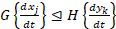 (6)
(6)
The above not only
simplifies the mathematical formalization of the dynamics of the logistics and
sales process in the conditions of multifactorial impacts of the crisis, but
also formally indicates the sufficiency or insufficiency of the pace of change in
management measures for proper adaptation to the challenges of the crisis.
4. RESULTS
Logistics and sales
activities are an integral part of the Agricultural and Food Supply Chains
(AFSC) system, which, according to established scientific views, covers all
logistics chains of agricultural product distribution from marketing,
warehousing, to product delivery to the consumer, which determines the special
importance of such activities as an integrating factor of the spheres of
production and consumption.
The operational tasks of
the logistics and sales process in scientific works indicate the formation and
satisfaction of solvent consumer demand, but, first of all, the organization of
distribution channels and logistics flows of agricultural products. This may
include the trade and intermediary activities of companies that specialize in
the logistics and sales process.
Logistics and sales
activities in agricultural production are complicated by the peculiarities of
the nomenclature of goods in this sector, since both products or raw materials
with a short shelf life and live animals can be intended for sale, the overtime
extension of which in the transportation process requires special
organizational solutions, which significantly increase the cost of logistics
services. This places additional demands on the logistics of the agricultural
sector. Over a certain period of time, both producers, logisticians, and
consumers adapt to these requirements and features. But the period of crisis is
characterized by the fact that it forces the change of established procedures
and business models, since the efficiency of the logistics and sales system is
the key to the survival of the enterprise during this period. Thus, the
beginning of large-scale hostilities in 2022 caused not only a disruption in
the supply of agricultural products but also a permanent instability of
agricultural logistics, which led to indirect losses for Ukrainian producers in
the amount of 18.5 billion dollars.
The blocking of sea
logistics routes for Ukrainian grain resulted not only in a temporary reduction
in the supply of Ukrainian grain to the world market. This also led to drastic
changes in the structure of crops, a decrease in the yield of subsequent periods
due to violations of agricultural technologies, which increased the long-term
negative impact on all participants in the logistics and sales chain of
Ukrainian food.
This resulted in a
shortage of supply in sales markets and an increase in prices not only for
grains and products made from them, but also for other agricultural products.
This, as well as an increase in risks for transport vessels even in the period
after the opening of Ukrainian ports, led to a significant increase in
logistics costs. These rising costs and declining profitability of grain
production have resulted in a reduction in the area under grain cultivation in
Ukraine, which has led to global changes in the global logistics of grain
products. This has disrupted global logistics and supply chains and,
accordingly, created threats to global food security.
This has forced consumer
countries to diversify supplies and even introduce emergency measures, in
particular, to limit or prohibit the export of their own agricultural products.
The obstacle for food consumers in developing countries has become the high
share of internal logistics costs and the inefficiency of the national
transport system. Also, since the institutional measures of consumer countries
in the face of increasing risks to external food supplies are mainly aimed at
containing prices, this deepens the food crisis not only locally but also at
the global level.
Therefore, important
areas of management of the logistics and sales process of agricultural products
in crisis conditions are also supporting the resilience of one's own company
during the extension of the crisis period in time and adhering to the principle
of complexity and systematicity. This requires changing the management goals
and prioritizing them by introducing multi-purpose management of logistics and
sales activities. In particular, it requires not focusing only on profit, but
forming an appropriate level of sustainability of the entire logistics and
sales system.
The priority of goals
for the formation of logistics and sales supply chains necessitates changes in
management and its reconstruction by introducing the principles of the
hierarchy of management decisions. The logistics and sales chain in such
circumstances should be considered as a systemic cycle of transforming
available resources, not only material and financial, but also time resources,
into the final result.
This systemic cycle must
meet the requirements for optimizing both logistics and sales processes in real
time, including minimizing the entire set of risks. The set of risks for this
should also be considered as a mutually agreed system. This mutual agreement,
in particular, consists in the fact that minimizing the risks of military
damage to cargo requires operators to choose not the shortest, but the safest
logistics route. At the same time, extending the transportation time of
agricultural products, which have the property of quickly deteriorating, can
lead to a deterioration in consumer quality and, as a result, loss of the sales
market.
A systematic approach to
the logistics and sales process also requires compliance with the conditions of
the emergence of activities in the general logistics and sales system. The
effect of the emergence of the system, as it is known, is provided by the synergy
of the coordinated interaction of its components. This means that the
management of logistics and sales activities in times of crisis should
contribute to the resilience of both the manufacturer and the consumer to
ensure not only the efficiency of their own business and its sustainability,
but also the formation of the prerequisites for the survival of all
participants in the logistics and sales chain.
For example,
a rational reduction in prices for logistics services will allow reducing
prices of agricultural products for the consumer, which can contribute to an
increase in sales volumes, and, thereby, help to level the impact of the crisis
on the agricultural products market. It should be noted that the cost of
logistics expenses for Ukrainian companies, in
some cases, even in relatively safe periods of time, amounted to more than 30%
of the total cost of agricultural production (Rzhepishevska
et al., 2018). This indicator tends to grow in times of crisis, which puts
agricultural production on the verge of survival. An example of this is the
reduction in the area of grain crops in Ukraine, which, accordingly, reduces
the volume of logistics services (Agriculture Logistics Market Size & Share
Analysis - Growth Trends & Forecasts, 2025).
Also, the principle of
complexity and systematicity in logistics and sales activities indicates that
the requirements should apply not only to the management of logistics companies
or specialized units of the agricultural business, but also to the management
of the producer and even to public administration in this area.
Regarding the
requirements for producer management, it is first of all worth noting that a
certain problem is their adherence to the traditions of agricultural
production, typical for developing countries, in particular Ukraine, which
results in a mix of emphasis on the production of what is in demand and
attempts to sell the products that agricultural enterprises are used to
producing. This reduces adaptation to the challenges of the crisis, especially
in conditions of dynamic changes not only in volumes but also in the range of
products on local markets due to significant fluctuations in price ratios for
the main product groups, which, in particular, significantly complicates the
logistics and sales process. This requires a change in the psychology of management
in traditional agricultural production. At the same time, the separation of
logistics and sales from production activities allows, to some extent, to level
the negative impact of traditional approaches to management, in particular by
implementing process and project approaches and involving specialists in
monitoring demand in local markets, managing material and financial flows in
real time, organizing sales, etc.
The presence of
shortcomings in institutional management that affect logistics and sales
activities is indicated by a comparison of the components of the Logistics
Efficiency Index of European agricultural exporting countries (see Table 1).
Tab. 1
Components of the Logistics Efficiency Index by
country, scores in the range of 1-5
|
Components |
Country |
||||||
|
Bulgaria |
Romania |
Poland |
France |
Spain |
Ukraine |
Ukraine 2023 to 2018, % |
|
|
Customs |
3.1 |
2.7 |
3.4 |
3.7 |
3.6 |
2.4 |
3.8 |
|
Infrastructure |
3.1 |
2.9 |
3.5 |
3.8 |
3.8 |
2.4 |
9.1 |
|
International shipments |
3.0 |
3.4 |
3.3 |
3.7 |
3.7 |
2.8 |
10.3 |
|
Logistics competence |
3.3 |
3.3 |
3.6 |
3.8 |
3.9 |
2.6 |
-9.2 |
|
Timeliness |
3.5 |
3.6 |
3.9 |
4.1 |
4.2 |
3.1 |
-10.3 |
|
Tracing |
3.2 |
3.5 |
3.8 |
4.0 |
4.1 |
2.6 |
-19.6 |
Source: developed by the author using data from
the World Population Review (2025)
As can be seen from Table 1, Eastern
European countries, both members of the European Union and Ukraine, are
significantly inferior to Western European countries, in particular, France and
Spain, in terms of the level of components of the Logistics Efficiency Index.
A comparison of Ukraine's indicators
before and after the start of large-scale aggression also confirms the
significant impact of the crisis caused by the war on the components of the
Logistics Efficiency Index. Thus, the shortage of personnel for logistics and
sales activities due to emigration and personnel mobilization led to a
significant decrease in the "Logistics Competence" indicator, and the
bombing increased the risks for transportation, forcing maneuvering
in real time along the routes of transportation of agricultural products. The
challenges of war also lead to the inefficiency of digital means of managing
the logistics process and, accordingly, excessive delays in the supply of
agricultural products, which resulted in the decrease in the value of the
"Timeliness" and "Tracking" delivery indicators.
It is also worth noting that the
inconsistency of Ukraine's institutional management of agricultural product
logistics in some cases even exacerbates the effects of the crisis. Thus, in
2023, citing the increase in losses for the transport industry in war
conditions, the Ministry of Infrastructure increased railway tariffs by 70%,
later reducing them to 30%, which put certain areas of agricultural product
logistics on the verge of survival.
At the same time, the
data in Table 1 confirm that, despite the impact of war risks on logistics
processes, Ukraine is able to improve its performance in some components of the
Logistics Efficiency Index compared to the period before the start of intensive
hostilities. In general, the data in Table 1 indicate key problems in the
logistics and sales process that should be immediately addressed by the
institutional management of agricultural exporting countries.
A peculiarity
of the logistics and sales system of the agricultural sector is that in times
of crisis, farmers, unlike most other industries, cannot always change the
target function of logistics. The crisis encourages logistics services, for
example, of industrial enterprises, to ensure the reliability of supplies,
minimizing risks on logistics routes. At the same time, the logistics of
agricultural enterprises often have to rely on the implementation of the “short
run” principle, which ensures the speed of
delivery, since agricultural products tend to deteriorate and quickly lose
their consumer qualities, which increases the risks for carriers. Therefore, in
the conditions of the crisis caused by the war, Ukrainian farmers will choose
the tactic of centralizing distribution, forming large batches, as a means of
minimizing transportation costs and speeding up the logistics process. But this
increases the vulnerability of transport to air attacks, which is primarily
inherent in logistics, mostly maritime logistics,
of grain crops during the harvest period. Also, this approach does not always
allow for a prompt response to dynamic changes in demand, especially in foreign
markets.
At the same time, there
is a tendency for a dynamic integrated reorientation of export logistics and
sales activities for
Ukrainian farmers (see Fig. 2).
As can be seen from Fig.
2, even in a relatively short period of time, one year, there is a significant
reduction in the volumes of the logistics and sales process for Ukrainian
agricultural products towards EU countries and an increase in these volumes for
the countries of the Asian continent.
Thus, when comparing
this indicator in 2024 to its values in 2023, there was a reduction in volumes
for Slovakia - by 14.53%, for Poland - by 7.16% and for Romania - by 54.42%. At
the same time, the volumes of supplies to the Chinese market have almost not
changed, but for Kyrgyzstan they have increased by 2.4%, for Kazakhstan they
have increased by 9.37%, for Azerbaijan they have increased by 10.52%.
Reorientation of export
logistics and sales activities leads to the formation of much longer logistics
and sales chains. This, in turn, leads to the formation of business models that
cannot be supported not only by farming households, small agricultural
producers, but even by medium-sized farms. This process is negatively
contributed to by the increase in costs for transport services, the reduction
in the efficiency of transport networks, in particular due to the increase
in military risks of damage to transport hubs, the increase in the share of
coastal voyages for sea transportation of grain, etc.
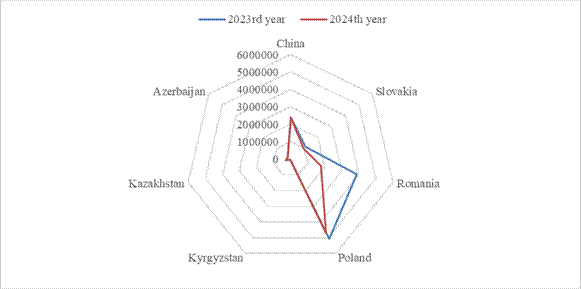
Fig. 2. Volumes of the export-oriented
logistics and sales process for
Ukrainian agricultural products, thousand USD
Source: developed by the author based on data
from
the State Statistics Service of Ukraine (2025)
Thus, the
differentiation of threats to the logistics and sales process requires the
concentration of logistics and sales services, which leads to the displacement
of small businesses from this process, radically changing the logistics and
sales system of the country.
The increase in the
number of participants in the logistics and sales process as a result of the
extension of transport routes due to the effects of the crisis, also results in
an increase in formal and informal relations, which reduces the level of partnership
and trust between participants. This also leads to an increase in the final
price of agricultural products by 2.5-3.5 times the producer price. This
affects the reduction in sales volumes and, accordingly, a decrease in
production volumes. This necessitates the involvement of logistics and sales
companies on the principles of outsourcing or the formation of
cooperatives specializing in the logistics and sales of agricultural products.
Companies specializing
in the logistics and sales process are able to provide a systematic approach to
the movement of agricultural product flows at all stages of the logistics
process at the modern level, organize effective risk control on each of the logistics
routes and, in accordance with the level of risks, coordinate changes in
transport flows, establish not only accounting for logistics costs but also
optimize them even in conditions of dynamic changes in threats. This allows for
the optimal organization of the interaction of functional links of the
logistics and sales process and, thus, ensures effective
management of agricultural product flows.
The dynamics of military
threats to logistics routes in Ukraine reduce, as noted above, the use of
standard digital business process automation (BPA) systems. A possible solution
in the context of military risks is the diversification of transport management.
An example of this is the introduction by the Ukrainian company Kernel of the
digital network platform Transithub, with real-time establishment of risks on each route and placing responsibility for the
transportation of agricultural cargo directly on drivers or forwarders, who are
given the right not only to plan transportation but also to change routes at
their own discretion in real time. Route geotags remain in the transportation
history on the digital platform, which allows for post-facto assessment of the
carrier's actions. This simplifies logistics management in conditions of
threats.
The direction of
management activities to accelerate the adaptation of the logistics and sales
process in the agricultural sector to crisis conditions is the operational
change of logistics flows in the event of dynamic variability of demand between
sales markets. Therefore, permanent marketing of all types of markets - consumer, agricultural and
production, intermediary, national, local and global ones - becomes important.
This is necessary for
both logistics and sales activities in the field of agricultural raw materials
(including grain and legume crops, dairy and livestock products, both sugar
beets and sugar, etc.) for its processing, logistics and sales activities in the
field of finished agricultural products (honey, vegetables, fruits, berries,
etc.) and for logistics and sales activities in the field of agricultural
products with a higher level of added value (flour, cereals, oil, etc.). Such
permanent marketing will ensure, if necessary, the appropriate level of
management response to dynamic changes in both production and consumption of
agricultural products in each type of market.
This also increases the
need for dynamic customization of finished agricultural products and
agricultural products with a higher level of added value, especially in foreign
markets.
The formation of
distributed sales networks also becomes important, possibly involving several
logistics operators in the supply of products. This can, in times of crisis, in
particular with a dynamic change in the level of military threats to both transport
routes and individual links of logistics chains, ensure the reliability of
supply, avoid losing the local sales market, and even contribute to increasing
the level of food security.
5. CONCLUSIONS
Analysis of the dynamics
of the TPU index quantitatively confirmed the extraordinary magnitude of the
threats of the current crisis for the logistics and sales system of
agricultural enterprises. It was established that the level of threats of the
current crisis is almost twice as high as during the crisis caused by the
pandemic. It was also established that the dynamics of the challenges of the
current crisis is more than during the COVID-19 period by a third. Accordingly,
this poses a threat to the sustainability and even survival of all business
components of the logistics and sales system. This determines the importance of
adapting the management of the logistics and sales process in the agricultural
sector to the dynamic challenges of the crisis. Effective adaptation of
logistics to the conditions of the crisis can reduce the costs of logistics and
sales activities, thereby reducing the prices of agricultural products for the
consumer, which can contribute to increasing sales volumes, and, thereby, help to
level the impact of the crisis on the agricultural products market. Therefore,
a mathematical formalization of the dynamics of the logistics and sales process
is proposed, which allows determining the sufficiency of the pace of change in
management measures for proper adaptation to the challenges of the crisis.
The versatility of the
negative impacts of the crisis on the logistics and sales system of
agricultural enterprises and the formation of threats to global food security
are studied. It is indicated that important areas of management of the
logistics and sales process of agricultural products in crisis conditions also
support the resilience of one's own company during the extension of the crisis
period in time and adhere to the principle of complexity and systematicity.
This requires a change in management goals or their priority for the
introduction of multi-objective management, and requires not to focus only on
financial results, but to form an appropriate level of sustainability of the
entire logistics and sales system. The priority of the goals of the logistics
and sales system also requires a change in management and its reconstruction
for the introduction of the principles of the hierarchy of management
decisions. The logistics and sales chain in such conditions should be
considered as a system cycle that must meet the requirements of optimizing both
logistics and sales processes in real time, including minimizing the entire set
of risks. It is proposed to consider the set of risks as a mutually agreed
system.
It is indicated that the
use of a systems approach necessitates the observance of the condition of the
emergence of activities in the general logistics and sales system. This means
that the management of logistics and sales activities in times of crisis should
contribute to the resilience of both the producer and the consumer to ensure
not only the efficiency of their own business and its sustainability, but also
the formation of prerequisites for the survival of all business components of
the system. The non-resilience and fragmentation of the logistics system lead
to an increase in prices for agricultural products, which reduces the
resilience of producers and consumers.
Also, the principle of
complexity and systematicity in logistics and sales activities indicates that
the requirements should apply not only to the management of logistics companies
or specialized units of the agricultural business, but also to the management
of the producer and, even, to public administration in this area. In
particular, a factor in ensuring the efficiency of logistics and sales
activities in foreign markets is the proper use of institutional potential for
cross-border trade. An indicator of this is the Logistics Efficiency Index.
Therefore, a comparative analysis of the components of the specified Index was
performed by agricultural export countries. This allowed to identify both the
adaptation of Ukraine's institutional management to the challenges and the gaps
in this management activity.
A trend of dynamic
reorientation of the directions of export logistics and sales activities of
Ukraine has been established. It is indicated that this reorientation causes
the formation of much longer logistics and sales chains, which reduces the
possibility of participation in them not only small but even medium-sized
agricultural producers. This reduction is also facilitated by the
differentiation of threats to the logistics and sales process, which results in
the concentration of logistics and sales services, causing the need to involve
logistics and sales companies on the principles of outsourcing or the
formation of cooperatives specializing in the logistics and sales of
agricultural products.
Acknowledgement
This publication was
supported by the Ministry of Education and Science of Ukraine 12/27/2023 No.
1572 within the project No. 0124U000632: Neuromodeling
of the anti-entropy of the agro-trading logistics
system of Ukraine.
References
1.
Agriculture Logistics Market Size & Share Analysis
- Growth Trends & Forecasts. 2025. Available at: https://www.mordorintelligence.com/industryreports/agriculture-logistics-market.
2.
Andriushchenko Kateryna, Oleksandr Datsii, Oksana Lavruk, Ruslan Dmytrenko, Igor Kutashev,
Vіnіchenko Igor, Dmytro
Mishchenko, Yulia Kakhovych, Konstantin Pivovarov, Ganna Ortina. 2021.
«Development of а matrix of food industry capacity
for making management decisions in the formation of sustainable development of
agroecosystems.» Eastern-European Journal
of Enterprise Technologies 2(13(110)): 16-27. ISSN: 1729-3774. DOI: https://doi.org/10.15587/1729-4061.2021.227805 .
3.
Aulin Victor, Denis Velikodnyi, Victoria Dуachenko. 2018. “Optimization
and management of resources in the transport and logistics system of agrarian
and industrial complex.” Scientific Notes
62: 8-11. ISSN: 0204-3599. Available at: http://nbuv.gov.ua/UJRN/Nn_2018_62_3.
4.
Balanovska Tetiana, Olga
Gogulya, Krystyna Dramaretska, Volodymyr Voskolupov, and Viktoriia Holik. 2021.
“Using Marketing Management to Ensure Competitiveness of Agricultural
Enterprises.” Agricultural and Resource
Economics: International Scientific E-Journal 7(3): 142-161. ISSN:
2414-584X. DOI: https://doi.org/10.51599/are.2021.07.03.09.
5.
Bazaluk Oleg, Valerii Havrysh, Vitalii Nitsenko. 2021. “Energy
Efficiency of Inland Waterways Transport for Agriculture: The Ukraine Case
Study.” Applied Sciences 11(19):
8937. ISSN: 2076-3417. DOI: https://doi.org/10.3390/app11198937.
6.
Bazaluk Oleg. 2017. The Theory of War and Peace: The Geophilosophy of Europe. Cambridge Scholars Publishing.
ISBN: 978-1-4438-4876-3. Available at:
https://www.researchgate.net/publication/319644721_the_theory_of_war_and_peace_geophilosophy_of_europe.
7.
Chukurna O., V. Nitsenko, N.
Tyukhtenko, O. Lomonosova, Z. Zhartay, V. Dobrovolskyi. 2022. Substantiation of the green approach in
the formation of a sustainable system of ecological logistics. Naukovyi Visnyk Natsionalnoho Hirnychoho Universytetu 1: 76-82. ISSN: 2071-2227. DOI: https://doi.org/10.33271/nvngu/2022-1/076.
8.
Danylenko Valerii. 2020. “Characteristics
and establishment prospects of logistics centers for
agricultural products in Ukraine.” Young Scientist
2(2):330-334. ISSN: 2313-2167. DOI:
https://doi.org/10.32839/2304-5809/2020-2-78-70.
9.
Deineha Oleksandr, Kateryna
Chymosh, Tetiana Kobylynska, Oleksii Nazarov, Mykola Liapa,
Nataliia Sapotnitska. 2022. “Adaptive management of
transport logistics in agricultural enterprises.” Journal of Agriculture and Crop 8(1): 20-26. ISSN: 2413-886X. DOI:
https://doi.org/10.32861/jac.81.20.26.
10.
Dramaretska
Krystyna, Alona Zorhach. 2023. “Logistics management of agricultural
enterprises.” Ukrainian Journal of
Applied Economics and Technology 8(1): 248-253. ISSN: 2415-8453. DOI:
https://doi.org/10.36887/2415-8453-2023-1-36.
11.
Gumenyuk Alla, Olena Garmatiuk. 2020. “Formation and
organization of logistics and sales systems for agricultural enterprises.” Azov Economic Bulletin 3(20): 99-103. ISSN: 2522-4263. DOI: https://doi.org/10.32840/2522-4263/2020-3-17.
12.
Kantemyr Kateryna, Maryna
Shubaa. 2025. “US trade policy as a trigger for financial markets volatility.” Acta Academiae Beregsasiensis. Economics 9(9):175-188. ISSN: 2786-6734. DOI: 10.58423/2786-6742/2025-9-175-188.
13.
Klius I., M. Prodanchuk, O. Gololobova, G. Oliynik, M. Varhatiuk. 2023. “Evaluation and control of
data relevance in information systems of the transport industry management.” Naukovyi Visnyk Natsionalnoho Hirnychoho Universytetu 3: 137-143. ISSN: 2071-2227. DOI: https://doi.org/10.33271/nvngu/20233/137.
14.
Korniietskyi Oleksandr, Volodymyr
Orel, Anna Orel. 2025. “The role of distribution logistics in ensuring the
sustainable development of livestock farms in the deoccupied
territories.” Agrosvit
10: 17-24. ISSN: 2306-6792. DOI: 10.32702/2306-6792.2025.10.17.
15.
Kotenko S., S. Mashkantseva,
I. Hanzhurenko, M. Vasylyuk, Y. Lavrushchenko, I. Kucher.
2021. “The Economic Crisis as a Factor in Changing the Structure of Multimodal
Transportation Routes.” Financial and
Credit Activity: Problems of Theory and Practice 6(41): 277-284. ISSN:
2306-4994. DOI: https://doi.org/10.18371/fcaptp.v6i41.251454.
16.
Kotenko Sergiy, Svitlana Ilchenko, Valeriia Kasianova,
Vitalii Diakov, Svitlana Mashkantseva, Vitalii Nitsenko. 2022. “Determination
of the Expected Value of Losses Caused by the Cargo Transportation Insurance
Risks by Water Transport.” Inventions
7(3): 81. ISSN: 2411-5134. DOI: https://doi.org/10.3390/inventions7030081.
17.
Kovalenko Andrii. 2025. “Methodology of scientific
research of agrarian logistics in the period of instability.> Agrosvìt
7: 105-111. ISSN: 2306-6792. DOI:10.32702/2306-6792.2025.7.105.
18.
Kustrich Liliіa. 2022. “Agro-logistical
hubs as an integral part of the
development of Ukraine's agricultural sector.” Economy and Society 39: 1-7. ISSN: 2524-0072. DOI: https://doi.org/10.32782/2524-0072/2022-39-14.
19.
Kwilinski Aleksy, Liudmyla Hnatyshyn, Oksana Prokopyshyn, Nataliia Trushkina. 2022. “Managing the
logistic activities of agricultural enterprises under conditions of digital
economy.” Virtual Economics 5(2):
43-70. ISSN: 2657-4047. DOI: https://doi.org/10.34021/ve.2022.05.02(3).
20.
Lagodiienko Volodymyr, Iryna
Perevozova, Liudmila Bakhchivanzhi, Kateryna Ozarko, Viktoriia Milcheva, Olena
Orlova. 2023. “The Role of Digital Technologies in Optimizing the Functioning
of the Marketing and Logistics System of the Enterprise.” Review of Economics and Finance 21: 2019-2026. ISSN: 1923-8401.
DOI: https://doi.org/10.55365/1923.x2023.21.217.
21.
Li Nan, Muzi Chen, Difang
Huang. 2022. “How do logistics disruptions affect rural households? Evidence
from COVID-19 in China.” Sustainability 15(1):
465. ISSN: 2071-1050. DOI: https://doi.org/10.3390/su15010465.
22.
Lykholat Svitlana, Oleksandr Myskiv. 2022. “The essence of agrologistics
and its current state in Ukraine.” Academic
visions 14. ISSN: 2786-586X. DOI: http://dx.doi.org/10.5281/zenodo.10122569.
23.
Maievska Nataliia. 2022. “Agro-food chains transformation in the context of war in
Ukraine.” Market infrastructure 69:
91-98. ISSN: 2519-2868. DOI: https://doi.org/10.32782/infrastruct69-16.
24.
Makarenko Nataliia, Tetiana Hutsal.
2025. “Features of the use of information marketing systems in the sales
activities of agricultural enterprises.” Podilian Bulletin Agriculture Engineering Economics 46:155-159. ISSN:
2706-9052. DOI: https://doi.org/10.37406/2706-9052-2025-1.22.
25.
Malik Mykola, Svitlana Kravchenko, Anna Diuk, Larisa Malik, Maryna Nechyporenko. 2023. “Development of micro-entrepreneurs in
agriculture in wartime conditions.” Ekonomika APK 30(2):10-23.
ISSN: 2221-1055. DOI: https://doi.org/10.32317/2221-1055.202302010.
26.
Marchuk Uliana, Liubov Gutsalenko, Svitlana
Rybalchenko, Serhiy Zabolotnyy. 2025. “Accounting and control in the system of
marketing and logistics support for Ukrainian wineries.” Accounting and Financial Control 6(1): 25. ISSN: 2543-5485. DOI:
https://doi.org/10.21511/afc.06(1).2025.03.
27.
Mazur Julia, Iryna Kalina, Lіubov Karbovska.
2025. „Strategies of
Logistics Management of Foreign Economic Activity of Agricultural Enterprises.”
Economic Achievements: Prospects and Innovations
17. ISSN: 2786-9431. DOI https://doi.org/10.5281/zenodo.15321534.
28.
Mykolaichuk Mykola, Nina
Petrukha, Liudmyla Akimova, Nataliia Pozniakovska, Bohdan Hudenko, Oleksandr Akimov. 2025. “Conceptual
principles of analysis and forecasting threats to national security in modern
conditions.” Sapienza: International Journal of Interdisciplinary Studies
6(2): e25029-e25029. DOI: https://doi.org/10.51798/sijis.v6i2.985
29.
National Bank of Ukraine. 2025. Inflation Report, July
2025. Available at: https://bank.gov.ua/admin_uploads/article/IR_2025-Q3.pdf?v=14.
30.
Ociepa-Kicińska
Elżbieta, Karolina Palimąka, Persefoni
Polychronidou, Małgorzata Porada-Rochoń.
2025. “AI, Academic
Expectations, and the Making of Intellectual Capital: Evidence from Polish and
Greek Universities.” Intellectual Economics 19(2): 171-188. DOI: https://doi.org/10.13165/IE-25-19-2-07.
31.
Panchenko Volodymyr. 2024. “Optimization of
agro-industrial logistics of Ukraine in conditions of supply chain disruption
due to war.” Herald of Lviv University of
Trade and Economics. Economic Sciences 77: 57-61. ISSN: 2522-1205.
DOI: https://doi.org/10.32782/2522-1205-2024-77-08.
32.
Pavlyshyn Marianna. 2023. “The role of transformational logistics processes in wartime food
supply: challenges for Ukraine.”
Formation of market economy in Ukraine 50: 54-65. ISSN: 2078-5860. DOI: http://dx.doi.org/10.30970/meu.2023.50.0.5005.
33.
Perevozova Iryna, Taras
Gubernat, Lukian Hontar, Vitaliy Shayban, Nadiia
Bocharova. 2024. “Using Big Data Analytics to Improve Logistics Processes and
Forecast Demand.” Pacific Business Review
(International) 17(4): 30-39. ISSN: 0974-438X. DOI: https://doi.org/10.5281/zenodo.14756955.
34.
Potwora Maciej, Olha Vdovichena, Dmytrii
Semchuk, Liubov Lipych, Volodymyr Saienko. 2024. “The use of artificial
intelligence in marketing strategies: Automation, personalization and
forecasting.” Journal of Management World 2: 41-49. DOI: https://doi.org/10.53935/jomw.v2024i2.275.
35.
Radchenko Alexander. 2023. “Problems and perspectives
of the functioning of national logistics systems on agricultural product
markets”. Market Economy: Modern
Management Theory and Practice 2(51): 126-136. ISSN: 2413-9998. DOI: https://doi.org/10.18524/2413-9998.2022.2(51).274369.
36.
Rzhepishevska Vita, Nataliia
Klochko. 2018. “Logistic fundamentals of assuring competitiveness of
agricultural companies.” Financial Space
2(30): 101-111. ISSN: 2304-1692. Available at:
http://www.irbis-nbuv.gov.ua/cgi-bin/irbis_nbuv/cgiirbis_64.exe?C21COM=2&I21DBN=UJRN&P21DBN=UJRN&IMAGE_FILE_DOWNLOAD=1&Image_file_name=PDF/Fin_pr_2018_2_12.pdf.
37.
Shalyhina Iryna, Tetiana
Basenkova. 2025. “Conducting and restoring agribusiness in the frontline
territories of Ukraine in war conditions.” Sustainable
Economic Development 3(54): 54-63. ISSN: 2308-1988. DOI: https://doi.org/10.32782/2308-1988/2025-54-63.
38.
Sklavos George, George
Theodossiou, Zacharias Papanikolaou, Christos Karelakis,
Themistokles Lazarides. 2024. ”Investing the impact and the challenges of
Digital Transformation and Green Entrepreneurship in Greek Food Industry.” Intellectual
Economics 18(2): 360-383. DOI: https://doi.org/10.13165/IE-24-18-2-06.
39.
Spaskyi Habriiel,
2022. “Development of transport logistics in agricultural enterprises of the
western regions of Ukraine.” Ekonomika APK 11:
65-74. ISSN: 2221-1055. DOI: https://doi.org/10.32317/2221-1055.201811065.
40.
State Statistics Service of Ukraine. 2025. Foreign
trade in goods by partner countries. Available at: https://www.ukrstat.gov.ua/.
41.
Stonozhenko Roman, Ilona Androshchu. 2023. “Peculiarities of Management of
Agricultural Enterprises of Ukraine in the Conditions of Uncertainty and Crisis
Situation.” Central Ukrainian Scientific
Bulletin. Economic Sciences 9(42): 252-259. ISSN: 2663-1636. DOI: https://doi.org/10.32515/2663-1636.2023.9(42).252-259.
42.
Vinichenko Igor, Sergiy
Vasil'ev, Lina Pomazan. 2023. “Features and optimization of agricultural
enterprises logistics systems.” Economy
and Society 48. ISSN: 2524-0072. DOI: https://doi.org/10.32782/2524-0072/2023-48-72.
43.
Voloshchuk Vitaliy, Sergiy Bohachyk, Oleksandr
Ivanyshyn. 2020. “Formation of resource supply chains in the innovative system
of agricultural logistics.” Entrepreneurship
and Innovation 13: 19-23. ISSN: 2707-6237. DOI: https://doi.org/10.37320/2415-3583/13.3.
44.
Voronina Yuliia, Ivan Lopushynskyi, Bogdan Grechanyk,
Oleksandra Vahonova, Andrii Kondur, Oleksandr Akimov.
2024. “Economic and environmental component in the field of sustainable
development management.” Calitatea 25(201):
7-14. DOI: https://doi.org/10.47750/QAS/25.201.02.
45.
World Population Review. 2025. Logistics Performance
Index. Available at:
https://worldpopulationreview.com/country-rankings/logistics-performance-index-by-country.
46.
Zakharchuk Oleksandr, Veronika Nechytailo,
Yaroslav Navrotskyi, Andrii Kovalenko. 2025. “Development of grain logistics in
Ukraine.” Ekonomika
APK 32(3): 21-30. ISSN: 2221-1055. DOI: 10.32317/ekon.apk/3.2025.21.
Received 31.10.2025; accepted in revised form 14.02.2026

Scientific Journal of Silesian
University of Technology. Series Transport is licensed under a Creative
Commons Attribution 4.0 International License