Article
citation information:
Kuzior, A., Arefieva, O.,
Poberezhna, Z., Arefiev, S. Digitalization of
business processes in the integrated concept of “Industry 5.0” in ensuring
investment and security management of transport enterprises. Scientific Journal of Silesian University of
Technology. Series Transport. 2026, 130, 125-140. ISSN: 0209-3324. DOI: https://doi.org/10.20858/sjsutst.2026.130.8
DIGITALIZATION OF
BUSINESS PROCESSES IN THE INTEGRATED CONCEPT OF “INDUSTRY 5.0” IN ENSURING
INVESTMENT AND SECURITY MANAGEMENT OF TRANSPORT ENTERPRISES
Summary. The article considers
the possibilities of integrating the basic principles of Industry 5.0 into the
business processes of transport enterprises. Particular attention is paid to
the general issues of the essence of Industry 5.0 and determining its genesis.
It is established that the digitalization of business processes of transport
enterprises on the principles of Industry 5.0 contributes to the formation of
new goals, objectives and helps to meet customer needs and expand the
capabilities of enterprises through the introduction of digital products. In
this context, the main principles of Industry 5.0 include additive
manufacturing, transparent production process, hyper-customization and
cyber-physical cognitive systems, etc. The author outlines a number of
characteristic features inherent in Industry 5.0, namely: customer focus,
social responsibility, integration of advanced technologies, creation of
innovative solutions in the field of flexible production systems, human capital
development, and widespread use of digital technologies, which allow the
creation of lean, sustainable and innovative production systems. The
possibilities of integrating the basic principles of this concept of Industry
5.0 into the business processes of transport enterprises to ensure investment
and security management are considered, and a number of advantages that
enterprises will receive are identified, namely: improving the level of safety
and maintenance; optimization of routes and flights; improving customer
service; and reducing emissions into the atmosphere. It is proven that solving
the tasks of resource management in the business processes of transport
enterprises on the principles of Industry 5.0 in real time is ensured by the
use of multi-agent systems, which are built on the basis of a network of small
agents and parallel operations. A model for determining the level of
implementation of digital technologies in the business processes of transport
enterprises is proposed, and the coefficient of return on investment in digitalization
is determined, which allows for establishing the level of net income and gross
profit received by transport enterprises from increasing the use of digital
technologies in their business processes.
Keywords: transport enterprise, Industry 4.0, Industry 5.0, business processes,
digitalization of services, digitalization, investment and security management
1. INTRODUCTION
The new technological revolution, Industry 5.0,
is based on the combination of virtual and material states in cyber-physical
complexes, on the basis of which a single digital ecosystem is created. The
development of the concept of informatization of business processes of
transport enterprises in conditions of complexity, dynamics and uncertainty
should be based on the prospects for the introduction of elements and tools of
Industry 5.0. The factors that drive technological transformation are primarily
consumer requirements, the need to increase efficiency, and competitive
pressure [1].
In the current conditions of economic
transformations taking place at the macroeconomic level and covering the
microeconomic level, it is appropriate to focus on creating the basis for the
sustainable development of transport enterprises. In view of this, the
investment and security aspects are becoming increasingly important,
contributing to the stability of business activities of business entities, as
well as the effective management of the economic security of the enterprise as
a whole. One of the basic components of
the investment and security management of transport enterprises in the context
of Industry 5.0 is the process of preventing losses from negative internal and
external influences on economic activity, efficient use of resources, and
ensuring the automation of business processes, which is achieved through the
introduction of digital technologies.
The application of the general principles of
this concept will make it possible to ensure an open, decentralized, digital
functioning of business processes of transport enterprises, which will allow
making prompt and accurate decisions in the event of unforeseen situations with
a quick revision of work plans, solving resource and other problems, which in
turn emphasizes the relevance of the study.
The needs of the changing labor
market, the prospects for the development of Industry 4.0, and the demand for
new competencies required to work with modern technologies allow us to be quite
optimistic about the future [2]. In practice, only a few SMEs are still
interested in truly implementing Industry 4.0 technologies. Although the vast
majority of large enterprises started using Industry 4.0 technologies almost
immediately, most SMEs have optimized, but without a coherent strategy [3, 4].
Clusters can be characterized as a useful tool for Industry 4.0 implementation
policy. It can be noted that the attributes of clusters are ideally suited to
the tasks of Industry 4.0, and the properties of clusters can become drivers of
Industry 5.0 development.
New business models characteristic of Industry
5.0, such as connected organizations with disappearing boundaries and the
emergence of digital business ecosystems, can be seen in cluster-related
mechanisms. Clusters can provide a favorable
environment for the creation and dissemination of knowledge, for the
implementation of advanced projects, and for the architecture of platforms or
networks in general [5, 6].
2. LITERATURE REVIEW
Although
the concept of Industry 5.0 is quite new and was not widespread until 2020,
there are currently a number of scientific works on this issue, among which it
is worth highlighting in the paper [7], whose research draws a parallel between
Industries 4.0 and 5.0 and identifies the general principles of the transition
to a sustainable and human-centered industry. In
paper [8] analyzed the dominance of Industry 5.0
values in the progressive business models of our time was analyzed.
The prerequisites for the emergence of Industry 5.0 are highlighted in paper
[9], and the conditions for the implementation of Industry 5.0 in terms of
financial support, management and security aspects, as well as approaches to
performance evaluation are analyzed the authors in
paper [10]. Thus, Industry 5.0 pays attention to the human aspects of
production and aims to create human-centered
production systems that would ensure the sustainability of the working
environment and contribute to the harmonious development of society, it is not
only a challenge but also a reasonable continuation of Industry 4.0, which,
according to papers [11, 12], although it ensured mass production and
accessibility, did not pay attention to the development of human capital in the
economy, which in turn led to the outflow of human capital to intangible
sectors of the economy.
Despite
the fact that there is already a large number of scientific developments in the
field of Industry 5.0, the issues of integrating its conceptual foundations
into the business processes of transport enterprises require further
clarification.
The
purpose of the study is to determine the general principles of digitalization
of business processes in the integrated concept of Industry 5.0 in ensuring
investment and security management of transport enterprises. This contributes
to improving the efficiency of transport enterprises with a focus on
sustainable development, environmentalization,
human-centeredness and resource efficiency.
3. MATERIALS AND METHODS
Today,
Industry 5.0 covers more and more areas of society, production, and products.
The development of the Internet, robotics, artificial intelligence, and large
databases will determine the development of Industry 5.0. Let's consider the
evolution of Industry 4.0 through its complement and the development of digital
technologies into Industry 5.0:
1. Additive manufacturing using lean elements is an
approach in which the production of products is a step-by-step production
algorithm. This makes it possible to produce lighter but stronger parts using
3D and 5D printing technology. Such production involves energy savings and
rational use of material resources, which increases the environmental
friendliness of various industries [13].
2. Transparent production service, with the help of
which enterprises can identify and assess uncertainties in the implementation
of production plans and equipment operation. The use of the Internet of Things
(IoT) enables the use of smart technologies and indicators. The basis of
transparent service technologies is an intelligent computing mechanism that
provides preventive modeling and management of
business processes based on software [14].
3. Hypercustomization is a
production system that uses advanced technologies (artificial intelligence
(AI), e-learning, cognitive systems, virtual reality (VR)) to train
professional consumers who are actively involved in supplementing and improving
the final product of the enterprise. This makes it possible to move to more
flexible business processes and value chains [15].
4. Cyber-physical cognitive systems, the development
of which occurs through the joint cognition of laws, patterns and certain
phenomena by people in combination with computers through the implementation of
a sequence of actions defined by digital decision-making platforms. The result
of the combination of technology and people is modeled
in real time
While
noting that the general principles of Industry 5.0 development are a logical
continuation of Industry 4.0, to understand its essence, identify the root
causes and peculiarities of its formation, it is worth considering the entire
chain of genesis of Industry 5.0 in the context of the evolution of industry,
which has gone through a number of the following stages, Fig. 1.
It
is worth noting that this is the difference between Industry 5.0 and Industry
4.0, which moves further and develops digitalization, turning it into a
collaboration of human creativity with technology, which makes it possible to
create unique products that are as close as possible to the tastes and
financial capabilities of consumers. The use of digital technologies allows a
company to maintain centralized control at all stages of the life cycle of a
product (or service). These include digital design and modeling,
digital manufacturing, digital supply chain, logistics, and digital adaptation
for the consumer after delivery [16].
Thus,
let us outline a number of characteristic features inherent in Industry 5.0:
- customer focus is a
key feature that involves the cooperation of human labor
with technology, where control over business processes is carried out that are
consumer-oriented;
- social
responsibility, which aims to achieve sustainable development by reducing the
negative impact on the environment, ensuring social justice, and directing
business processes to reduce resource use and recycling;
- integration of
advanced technologies, such as artificial intelligence, augmented reality,
blockchain, and the Internet of Things, to create intelligent and flexible
production systems;
- creation of
innovative solutions in the development of flexible production systems that
quickly adapt to changes in the internal and external environment;
- development of human
capital, which means that everyone should use their own unique capabilities in
the process of achieving common goals, applying a creative approach to the
enterprise, etc.;
- widespread use of
digital technologies to optimize existing business processes and create new
ones.
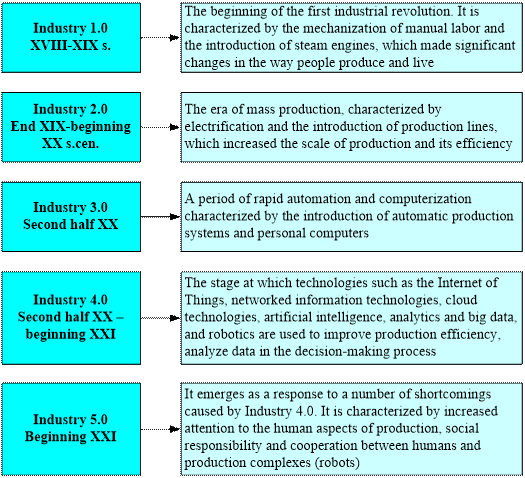
Fig. 1.
Genesis of Industry 5.0 in the context of industrial evolution
It
is also advisable to highlight the trends in the development of technologies
within Industry 4.0, which is increasingly relevant to the problem of creating
the prerequisites for maintaining economic security when using high-tech
processes [17].
These
features make it possible to define Industry 5.0 as a development direction
aimed at creating lean, sustainable and innovative production systems. Given
the essence and main characteristics of Industry 5.0, we consider it expedient
to consider the possibilities of digitalizing business processes in the
integrated concept of Industry 5.0 in ensuring investment-secure management of
transport enterprises. In our opinion, this can be useful in terms of improving
both production business processes and customer interaction.
It
is worth noting the main hypotheses of the study:
Н0 -
insignificant relationship of the indicator investments in digitization of
business process  indicator (t) with the volumes of gross profit (GP) and net income (NI) of enterprises;
Н1 -
significant relationship of the indicator investments in digitization of
business process indicator (t) with the volumes of gross profit (GP) and net income (NI) of enterprises.
Digitalization
of business processes of transport enterprises in ensuring financial and
information security should be defined as a set of results of turnover with
general economic benefits. This implies the active functioning and positioning
of enterprises in the market niche, taking into account material and intangible
costs [18].
The
need to integrate the concept of Industry 5.0 into the business processes of
transport enterprises is due to the following shortcomings in their
organization and management, including: planning the labor
intensity of operations in business processes at enterprises is actually
carried out once a year; existing methods and management tools do not allow
management to see real progress in individual business processes or operations;
the principles of “cost economy” make it impossible to plan and evaluate real
profits for individual business projects, management approaches used by the
management do not provide the necessary transparency, controllability,
efficiency and flexibility in the use of resources; lack of information systems
that would provide real-time support for forecasting possible bottlenecks in
business processes, which leads to delays in decision-making; corporate systems
data are not systematized, so they cannot fully reflect a correct, reliable and
accurate picture of business processes.
At
the same time, the introduction of innovations in the enterprise should be
continuous. In addition, when developing and commercializing new products, it
is necessary to focus on the needs of the market, investors and the needs of
buyers of goods and services [19]. Enterprises that constantly use innovations
and are actively engaged in investment activities have great advantages in the
market compared to competitors. This is manifested in increasing the efficiency
of activities and helps to successfully withstand all the challenges of the
external environment faced by the enterprise [20, 21].
The
main advantages and ways to integrate the Industry 5.0 concept into the
business processes of transport enterprises in ensuring financial and
information security include:
- improving the level
of safety and maintenance through the use of intelligent monitoring and
forecasting systems will make it possible to identify problems with equipment
in advance, which will help avoid accidents and improve safety;
- comprehensive use of
data analytics and artificial intelligence in route and flight optimization,
planning and resource utilization will help reduce fuel costs and increase
efficiency;
- the introduction of
innovative technologies, chatbots, automated booking systems and personalized
services will help improve customer (passenger) service and ensure greater
satisfaction with the use of transport services;
- the development of
artificial intelligence systems and analytical tools for decision-making will
enable the management of enterprises to make effective strategic and
operational decisions;
- introduction of
environmentally friendly technologies, reduction of harmful emissions into the
atmosphere and optimization of fuel use will ensure environmental
sustainability of transport enterprises and help to respond to challenges
related to environmental protection, etc.
This
necessitates a rethinking of classical approaches to strategic enterprise
management, where financial indicators are no longer a key success factor.
Within the framework of the Industry 5.0 concept, the business model of a
transport enterprise is transformed into a complex ecosystem, where
digitalization is not an end in itself, but a foundation for building
sustainable and strategic business processes. The central element of such
transformation is the creation of conditions for increasing the investment
attractiveness of enterprises. Digitalization of business processes in this
context allows for the automation of activities, which ensures full
transparency of financial and operational flows for potential investors.
Digitalization of business processes is designed in such a way that digital
tools free employees from routine operations, allowing them to focus on solving
non-standard tasks. Therefore, the integration of digital technologies within
Industry 5.0 creates a unique synergistic effect. It allows transport companies
not only to achieve technological advantage, but also to create a safe,
environmentally responsible and investment-attractive environment.
In
this context, the main components of the Industry 5.0 concept in the investment
and security management system of transport enterprises can be identified, Fig.
2.
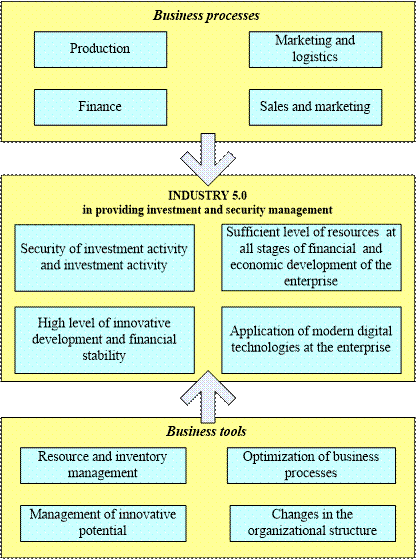
Fig. 2. The
concept of “Industry 5.0” in the system of
investment and security management of transport enterprises
That
is why the development of business models of transport enterprises should take
into account the social, environmental and economic aspects of Industry 5.0,
which encourages the introduction of digital technologies and automation of
business processes, which in turn contributes to their digitalization while
ensuring investment and security management. The basic principles of
integrating the Industry 5.0 concept into a single outline of the architecture
of digitalization of business processes of transport enterprises, Fig. 3.
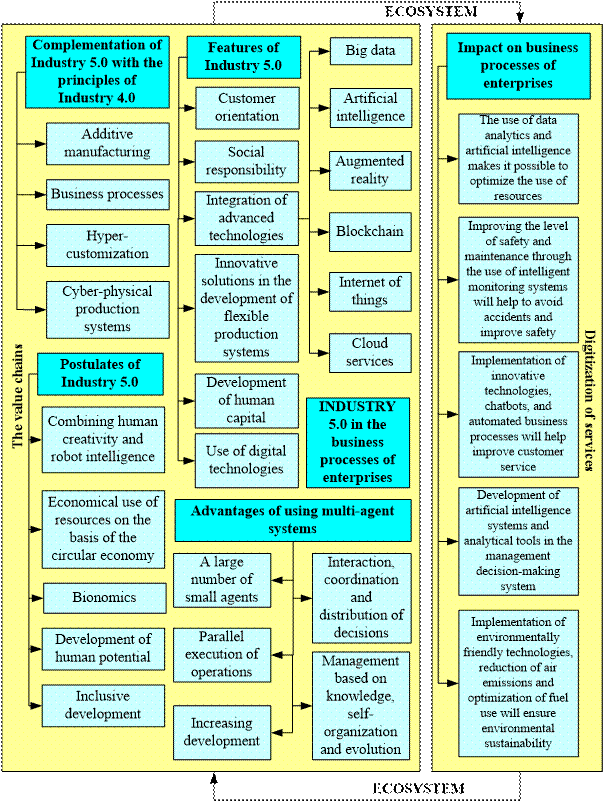
Fig. 3.
Principles of integrating the Industry 5.0 concept into a single architecture
contour for the digitalization of business processes of transport enterprises
Thus,
the main postulates on which the digitalization of business processes of
transport enterprises within the framework of Industry 5.0 should be based in
ensuring investment and security management include:
1. Combining the creative approach of human labor and robots to create a customized product that best
meets consumer demand in terms of price and value for consumers.
2. Comprehensive and maximum use of biological
resources in the business processes of an enterprise to achieve a balance
between the economy, environment, production, and society, which is ultimately
described by the science of bionomics. Bionomics involves solving humanity's
problems, such as reducing waste, increasing productivity and ensuring
sustainable development through adaptation to change, optimizing efficiency,
using renewable resources, recycling, interacting with the environment and
using natural models to develop new technologies and innovations.
3. Economical use of resources on the basis of the
circular economy, which aims to reduce waste and maximize the use of resources
by creating a closed cycle of production, consumption and recovery of
resources. The main idea is to produce, use and recycle resources in such a way
that they remain in the economy as long as possible, which contributes to
sustainable development, reducing environmental impact and conserving natural
resources.
4. Developing human potential by investing in human
capital, which is aimed at expanding opportunities and improving the quality of
life of people by maximizing the use of their abilities, skills, knowledge and
creativity. Human potential development is a key factor for sustainable social,
economic and cultural development of the society, as it contributes to
increased productivity, innovation and quality of life for all people.
5. Ensure inclusive development aimed at creating a
just, equal and democratic society in which everyone has the opportunity to
realize their potential and contribute to the common good. Inclusive
development aims to ensure the participation of all population groups in the
development process and equal access to opportunities and resources.
The
author proposes a mathematical model for determining the level of
digitalization of business processes of transport enterprises, which allows
determining the profitability of investments in digitalization and shows a
direct relationship with such indicators as net profit and gross profit. The
model allows testing the hypotheses proposed by the author: H0 and the alternative H1.
To evaluate
and forecast the efficiency of using digital business tools, the rate of return
on investments in digitization was calculated:
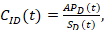 (1)
(1)
where  - digitization
costs, t – year,
- digitization
costs, t – year,
 - additional profit from the introduction of
digital tools.
- additional profit from the introduction of
digital tools.
The relationship of the indicator (t) with the volumes of gross profit (GP) and net income (NI) of enterprises was analyzed.
Pearson's correlation coefficient  :
:
 (2)
(2)
where E(...) is the operation of finding the mathematical expectation.
Let the hypothesis H0 be an insignificant connection, and the
alternative H1 be a significant connection. To solve the problem
of hypothesis testing, we calculate the decisive statistics:
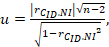 (3)
(3)
where n is the sample size.
For the significance level α = 1-р, we find the critical value  .
.
If  , then H0 is accepted, otherwise the alternative H1 is accepted. On the other hand, if
  is accepted, then the
probability of the significance of the statistical relationship p can be found using the corresponding χ2
distribution table.
is accepted, then the
probability of the significance of the statistical relationship p can be found using the corresponding χ2
distribution table.
We will use regression analysis to model the
relationship. To build the model, we will use a linear regression relationship.
At the same time,  :
:
where
 - linear and free coefficients that need to be
estimated. In the case of the assumption of a normal density of the error
distribution, you can use the mean square regression, for which:
- linear and free coefficients that need to be
estimated. In the case of the assumption of a normal density of the error
distribution, you can use the mean square regression, for which:
 (4)
(4)
From:
 (5)
(5)
Then:

 (6)
(6)
 (7)
(7)
Given that:  , we get:
 (8)
(8)
The
results of correlation and regression analysis indicate that the development of
transport enterprises should be based on the use of innovations and
digitalization of business processes. The model confirmed the validity of
hypothesis H1 about the significant relationship between the
indicator of investments in digitalization of the business process indicator (t)
with the volumes of gross profit (GP) and net
income (NI) of
enterprises.
There are certain limitations of the proposed model, which consist of the
availability of financial data of enterprises, especially regarding the amount
of investment and indicators of gross profit and net income. The
scientific novelty lies in substantiating the importance of using digital
technologies in business processes of enterprises in order to ensure financial
and information security. Digitalization has a positive effect on updating the
organizational structure, applying end-to-end investment and security
management methods, modularity of business processes and relevant business
tools, rationalization of energy and material support of business processes by
complying with regulatory requirements, and applying digital technologies in
business processes of enterprises.
4. RESULTS AND
DISCUSSION
Businesses
that invest in digital technologies can differentiate themselves from their
competitors, leading to increased market share and increased profits [22, 23].
To
test the proposed proposals regarding the effectiveness of using digital
technologies in the business processes of airline companies, we analyzed 5 airline companies: PE "TRANS
LOGISTICS", PJSC "DHL INTERNATIONAL UKRAINE", LLC "MERSK
UKRAINE LTD", LLC "GOOD LOGISTICS", LLC "SIVA"
LOGISTICS UKRAINE" based on data characterizing their activities during
2021-2024 [24-28].
The results of the calculations are given in Tab. 1.
Tab. 1
Results of the correlation analysis of the indicator of return on
investment in digitization and net and gross profit
|
Enterprise |
Correlation between |
Correlation between |
||
|
The value of the Pearson correlation
coefficient |
|
The value of the Pearson correlation coefficient |
|
|
|
PE
"TRANS LOGISTICS" |
0,9093 |
0,9940 |
0,9215 |
0,9955 |
|
PJSC
"DHL INTERNATIONAL UKRAINE" |
0,2611 |
0,6914 |
0,4265 |
0,8005 |
|
LLC
"MERSK Ukraine LTD" |
0,5915 |
0,8919 |
0,5625 |
0,8774 |
|
GOOD
LOGISTICS LLC |
0,6723 |
0,9283 |
0,4911 |
0,8387 |
|
LLC
"SIVA LOGISTICS UKRAINE" |
0,8976 |
0,9924 |
0,8544 |
0,9849 |


So,
we can conclude that for all 5 enterprises there is a relationship between the
profitability index of digitization costs and the main performance indicators -
net income and gross profit.
Tab. 2 shows
the results of the regression equation for each type of connection, as well as
the value of the coefficient of determination R2.
Tab.2
Results of the
regression analysis of the dependence of net income  and gross profit
  on the indicator of return on investment in
digitization
on the indicator of return on investment in
digitization 
|
Enterprise |
Relationship between |
Relationship between |
|
PE
"TRANS LOGISTICS" |
|
|
|
PJSC
"DHL INTERNATIONAL UKRAINE" |
|
|
|
LLC
"MERSK Ukraine LTD" |
|
|
|
GOOD
LOGISTICS LLC |
|
|
|
LLC
"SIVA LOGISTICS UKRAINE" |
|
|




















For a visual display of the presented calculations, they are shown in
Fig. 4-5.
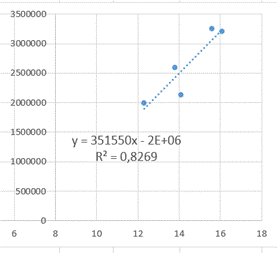
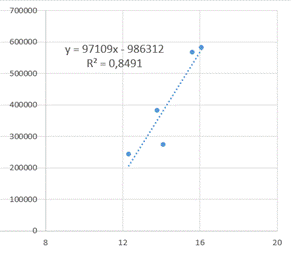
Fig. 4. Modeling the dependence of net income  and gross profit on
the indicator of return on investment in digitization for PE "TRANS LOGISTICS"
Based on the
simulation results (Fig.4-5), the following conclusions can be drawn:
1. For all enterprises, the value of the indicator of
return on investment in digitization has
a significant direct relationship with such indicators as net income and gross profit ,
which speaks of the potential effectiveness of digitalization of business
processes at aviation enterprises.
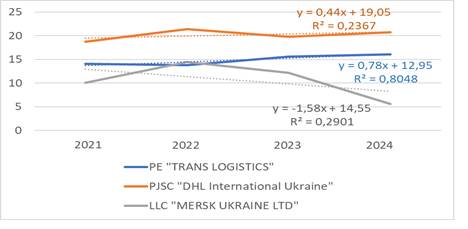
Fig.5. Modeling the dynamics
of the indicator for enterprises: PE
"TRANS LOGISTICS", PJSC "DHL INTERNATIONAL UKRAINE", LLC
"MERSK Ukraine LTD"
2. Based on the results of modeling
the dependence of net income and gross profit on the indicator of return on investment in
digitization  it can be concluded that with an increase in by 1%, the expected increase in net income and gross profit with 95% reliability for each of the
enterprises will lie within (forecasting income and profit), Tab.3.
it can be concluded that with an increase in by 1%, the expected increase in net income and gross profit with 95% reliability for each of the
enterprises will lie within (forecasting income and profit), Tab.3.
Tab.3
Results of modeling
|
Enterprises |
Net income |
Gross profit |
|
PE "TRANS LOGISTICS" |
From 3216785 to 3814315 |
From 88344 to 105874 |
|
PJSC "DHL INTERNATIONAL UKRAINE" |
From 10658 to 48610 |
From 868,3 to 4838,3 |
|
LLC
"MERSK Ukraine LTD" |
From 33149 to 81101 |
From 22320 to 28250 |
|
GOOD
LOGISTICS LLC |
From 41479 to 59431 |
From 16998 to 22972 |
|
LLC
"SIVA LOGISTICS UKRAINE" |
From 324779 to 372731 |
From 18247 to 23997 |
3. The indicator has
an upward trend during 2021-2024 for two of the five enterprises: PE
"TRANS LOGISTICS" and PJSC "DHL INTERNATIONAL UKRAINE", for
which positive dynamics of financial and economic activity indicators are also
observed.
5. CONCLUSIONS
Taking
into account the above, it can be concluded that new types of business models
will be formed in the global economic system of the future, the business
processes of which will take into account the conceptual principles of Industry
5.0, and accordingly, will be based on knowledge, innovations and information
aimed at the values determined by the principles of sustainable development.
Those transport enterprises that can quickly adapt their business model to the
imperatives of Industry 5.0 and the implementation of digital technologies will
win the competition. That is why the primary task facing enterprises is the
digitization of business processes, in which human intelligence and cybernetic
systems combined with the comprehensive capabilities of artificial intelligence
will be successfully combined. This will make it possible to receive effective
and individual investment-security management solutions aimed at saving
resources and sustainable development.
Digitization
of business processes in the integrated concept of Industry 5.0 while ensuring
investment and security management of transport enterprises will allow to
increase the efficiency of activities, production and provision of services due
to the implementation of real-time economic principles in decision-making,
adaptive planning of resources at all stages of the product life cycle,
intelligent systems for resource management based on multi-agent technologies,
enterprise knowledge bases for making security decisions by intelligent systems
and performers, restructuring of management principles in order to reduce costs
in project management, implementation of the Internet of Things and the
constant process of training employees. At the same time, there should be a
transition to a network enterprise based on the decentralization of business
process functions using multi-agent networks and knowledge bases.
Prospects
for further research include the issue of ensuring sustainable competitive
advantages of transport enterprises due to the formation of modern business
models, taking into account the principles of sustainable development, greening
and thrift based on the use of Industry 5.0 tools.
References
1.
Bilan Y., P. Rubanov, T. Vasylieva, S. Lyeonov. 2019. “The
influence of Industry 4.0 on financial services: Determinants of alternative
finance development”. Polish Journal of Management Studies 19(1): 70-93. DOI: https://doi.org/10.17512/pjms.2019.19.1.06.
2.
Prokhorova
V., M. Budanov, P. Budanov, A. Zaitseva,
A.Slastianykova. 2025. „Devising a comprehensive methodology for
estimating the economic efficiency of implementing an investment project for
ensuring energy security of enterprises: organizational-economic aspect”.
Eastern-European Journal of Enterprise Technologies 13(133): 59-68. DOI: https://doi.org/10.15587/1729-4061.2025.321965.
3.
Birkel
H.S., J.W. Veile, J.M. Müller, E. Hartmann, K.I. Voigt. 2019. “Development of a
risk framework for Industry 4.0 in the context of sustainability for
established manufacturers”. Sustainability 11(384): 27. DOI:
https://doi.org/10.3390/su11020384.
4.
Grenсikova A., M. Kordos, J. Sokol. 2019.
“The approach to Industry 4.0 within the Slovak business environment”. Social
Sciences 8(4): 104. DOI: https://doi.org/10.3390/socsci8040104.
5.
Haseeb
M., H.I. Hussain, S. Kot, A. Androniceanu, K. Jermsittiparsert. 2019. “Role of
social and technological challenges in achieving a sustainable competitive
advantage and sustainable business performance”. Sustainability 11(14):
3811. DOI: https://doi.org/10.3390/su11143811.
6.
Tupa J.,
J. Simota, F. Steiner. 2017. “Aspects of risk management implementation for
Industry 4.0”. Procedia Manufacturing 11: 1223–1230. DOI: https://doi.org/10.1016/j.promfg.2017.07.248.
7.
Ривак
Н.О. 2022.
„Індустрія 5.0:
перехід до
стійкої та
орієнтованої
на людину
промисловості”.
[In Ukrainian: “Industry 5.0: Transition to sustainable and
human-centered industry”]. Соціально-економічні
проблеми
сучасного
періоду
України 155(3): 41-46. DOI: https://doi.org/10.36818/2071-4653-2022-3-7.
8.
Нагара М.
2022. „Прогресивні
бізнес-моделі:
домінування
цінностей
Індустрії 5.0”. [In Ukrainian: “Progressive business models: the dominance of the values
of Industry 5.0”]. Економіка
та
суспільство:
45. DOI: https://doi.org/10.32782/2524-0072/2022-45-38.
9.
Momenta.
2022. “Industry 5.0. Purpose-Driven Technology Adoption for People and the
Planet”. Available at: https://www.momenta.one/hubfs/Resources/Reports-and-Surveys/Momenta-Industry%205.0-Report-2022.pdf.
10. Publications Office of the European Union. 2022.
”Industry 5.0 roundtable. Meeting report”. Available at: https://op.europa.eu/en/publication-detail/-/publication/053bf2aa-f1d7-11ec-a534-01aa75ed71a1/language-en.
11. Nahavandi S. 2019. “Industry 5.0 – A Human-centric
Solution”. Sustainability 11 (16): 371-385. DOI: https://doi.org/10.3390/su11164371.
12. Longo F., A. Padovano, S. Umbrello. 2020. “Value-oriented
and Ethical Technology Engineering in Industry 5.0: a Human-centric Perspective
for the Design of the Factory of the Future”. Applied Sciences 10(12):
182-200. DOI: https://doi.org/10.3390/app10124182.
13. Thakur P., V.K. Sehgal. 2021. “Emerging Architecture for
Heterogeneous Smart Cyber-Physical Systems for Industry 5.0”. Computers
Industrial Engineering 11: 201-224. DOI: https://doi.org/10.1016/j.cie.2021.107750.
14. Schwab K. 2021. The Fifth Industrial Revolution.
Geneva: World Economic Forum. 205 p. ISBN: 9780241300756.
15. Leong Y.K., J.H Tan, K.W. Chew, P.L. Show. 2020. Significance
of Industry 5.0. The Prospect of Industry 5.0 in Biomanufacturing. New
York: CRC Press. 320 p. ISBN: 9781003080671.
16.
Munteanu
I., L. Ionescu- Feleagă, B.S. Ionescu. 2024. “Financial Strategies for
Sustainability: Examining the Circular Economy Perspective”. Sustainability 16:
8942. DOI: https://doi.org/10.3390/su16208942.
17.
Deng T.
2013. „Impacts of Transport Infrastructure on Productivity and Economic Growth:
Recent Advances and Research Challenges”. Transport Reviews 33: 686-699.
DOI: https://doi.org/10.1080/01441647.2013.851745.
18.
Jovic M.,
E. Tijan, Hadzic A. Peric, P. Karanikic. 2020. „Economic aspects of automation
innovations in electronic transportation management systems”. Pomorstvo
34(2): 417-427. DOI: https://doi.org/10.31217/p.34.2.22.
19. Prokhorova V., N. Reznik, O. Bozhanova, K. Slastianykova.
2019. “Technology Transfer as a Prerequisite of Innovative Development of
Enterprises”. SHS Web of Conferences 67: 01011. DOI: https://doi.org/10.1051/shsconf/20196701011.
20.
Prokhorova
V., O. Shkurenko, O. Kravchenko, I. Miahkykh, V. Dalyk, O. Kostiuk, O. Makovoz. 2024. „Building a model for evaluating the
efficiency of circular transformations in the context of technology transfer”. Eastern-European
Journal of Enterprise Technologies 13(129): 100-112. DOI: https://doi.org/10.15587/1729-4061.2024.303992.
21.
Al-Azzeh J., A. Mesleh, M. Zaliskyi, R. Odarchenko, V. Kuzmin. 2022. „A Method of Accuracy Increment
Using Segmented Regression”. Algorithms 15(10) 378: 1-24. DOI: https://doi.org/10.3390/a15100378.
22.
Maslak
O., M. Maslak, N. Grishko, Y. Yakovenko, A. Savielova. 2023. “Formation of
Metallurgy Industry Development Scenarios Based on Energy Efficiency and
Digitalization of Production”. 2023 IEEE 4th KhPI Week on Advanced
Technology (KhPIWeek). DOI: https://doi.org/10.1109/khpiweek61412.2023.10312839.
23.
Ivannikova V., M. Zaliskyi, O. Solomentsev, I. Ostroumov, N. Kuzmenko. 2025. „Statistical data processing
technologies for sustainable aviation: A case study of Ukraine”. Sustainability
17(13)5781: 1-33. DOI: 10.3390/su17135781.
24.
The
financial statements for 2021-2024 of PJSC DHL International Ukraine. Available at: http://clarity-project.info/edr/22925230/finances?current_year=2024.
25.
The financial statements for 2021-2024 of LLC
MERSK UKRAINE LTD. Available at: https://clarity-project.info/edr/19351630/finances?current_year=2024.
26.
The
financial statements for 2021-2024 of PE TRANS LOGISTICS. Available at: https://clarity-project.info/edr/34307753/finances?current_year=2024.
27.
The
financial statements for 2021-2024 of HUD LOGISTICS LLC. Available at: https://clarity-project.info/edr/39353364/finances?current_year=2024.
28.
The
financial statements for 2021-2024 of LLC SIVA LOGISTICS UKRAINE. Available at:
https://clarity-project.info/edr/35894081/finances?current_year=2024.
Received 20.09.2025; accepted in revised form 24.02.2026

Scientific Journal of Silesian
University of Technology. Series Transport is licensed under a Creative
Commons Attribution 4.0 International License