Article
citation information:
Beqaj, B., Gjipalaj, J., Marko,
O., Shkurta, E. Environmental considerations of
road infrastructure construction in a coastal city. Scientific Journal of Silesian University of Technology. Series
Transport. 2026, 130, 53-64. ISSN:
0209-3324. DOI: https://doi.org/10.20858/sjsutst.2026.130.3
Blerina BEQAJ[1],
Joana GJIPALAJ[2],
Oltion MARKO[3],
Enkeleda SHKURTA[4]
ENVIRONMENTAL
CONSIDERATIONS OF ROAD INFRASTRUCTURE CONSTRUCTION IN A COASTAL CITY
Summary. Cities near the
coastline are the most important coastal tourism cities in Albania, which are
experiencing a fourfold increase in population in the summer season, with an
ever-increasing trend. Such a high tourist frequency in the summer season
brings an extremely heavy traffic situation, especially at city entrances and
exits. Environmental impact assessment represents the importance of
implementing infrastructure projects, starting this analysis at the study and
design stage of roads. The environmental impact assessment procedure focuses on
describing the project, identifying the main negative impacts on the
environment, and designing mitigation measures to minimize these negative
impacts as much as possible, with the aim of maintaining the balance between
them to achieve sustainable development of the area. Studies on environmental
issues present the implementation of infrastructure development projects and
the economic benefit from their implementation, always protecting the
environment and taking into account the "Principle of Sustainable
Development". This study shows the importance of developing road
infrastructure projects well-focused on environmental protection. Road
construction projects usually cause environmental pollution, impacts on
habitats, changes in water flow patterns, and these projects must be developed
taking into account environmental, social and economic impacts.
Keywords: environmental consideration, road infrastructure, road construction,
environmental concerns, environmental protection
1. INTRODUCTION
A natural and untouched environment is an
essential basis for daily life and, consequently, the health, well-being, and
economy of a country. Due to the need to ensure human comfort, it often becomes
necessary to protect natural resources with the aim of using them sustainably;
to protect viable ecosystems and maintain a high degree of biological
diversity; to protect the climate as much as possible, and finally, to adapt to
its changes to an acceptable extent. Road construction infrastructure produces significant
adverse effects on the environment and human health due to the discharge into
the atmosphere of pollutants during the accomplishment of the various
construction processes and the operation of diesel-powered equipment [1-4].
Road construction significantly impacts the environment, being one of the most
energy-intensive sectors and a major contributor to CO2 emissions
[5].
The process of road construction heavily relies
on natural resources, including soil, stone, lime, cement, and asphalt, to meet
material requirements. Previous studies have shown that the use of conventional
asphalt methods for road construction can result in large carbon emissions and
high energy consumption, which is incompatible with the principles of
sustainable development and environmental protection at the construction site
[6], [7]. Such projects cannot be separated from various environmental and social
impacts as they often result in significant changes to ecosystems, including
habitat reduction, pollution, and impacts on water flows [8].
The assessment of environmental impact presents
the importance of implementing infrastructure projects, starting this analysis
at the study and design stage of roads. The environmental impact assessment
procedure focuses on describing the project, identifying the main negative
impacts on the environment, and designing mitigation measures to minimize these
negative impacts as much as possible, with the aim of maintaining the balance
between them to achieve sustainable development of the area. Although road construction
is an essential aspect in the development of an area, there is limited
awareness of the environmental impacts resulting from the implementation of
these projects [9].
The impacts of road infrastructure development
on ecosystems can be numerous, including habitat destruction, disruption of
aquatic ecosystems, and increased pollution. Road construction often has a
direct impact on habitat fragmentation and changes in wildlife migration
patterns [10]. More importantly, these changes can disrupt the balance of
ecosystems that have existed for centuries, affecting not only flora and fauna
but also water and soil resources. Road infrastructure development from a
social perspective has significant impacts on local communities, as its
construction can trigger socio-economic changes, including changes in
employment structures and community dynamics. These developments can bring new
economic opportunities but often also have negative consequences, such as
community displacement and increased cost of living [11].
Environmental sustainability is considered an
important issue that should be included in the planning and implementation
process of road infrastructure projects [12].
Various studies emphasize the importance of an
approach to sustainable development that takes into account environmental and
social impacts from the beginning of an infrastructure project; and this step
not only protects ecosystems but also ensures the well-being of local
communities [13]. Mitigation measures are necessary to reduce the negative
impacts of such projects, which include the development of green
infrastructure, empowerment of local communities, and environmental
sustainability.
Cities near the coastline are the most important
coastal tourist cities in Albania, which are experiencing a fourfold increase
in population during the summer season. High tourist frequency in the summer
season brings an extremely heavy traffic situation, especially at the city
entrances and exits [14]. The existing road systems, both within and around the
city, are insufficient to accommodate this flow. Heavy traffic, especially at
the entrance of the coastal city, has become common during the tourist season.
2. MATERIALS
AND METHODS
To predict environmental impacts, the following steps should be taken
into consideration:
−
analysis of the
project implementation, project location, and road length;
−
the existing
environmental and social conditions of the area expected to be affected by the
development project;
−
information and
consultation with other interested parties.
The methodology for drafting the environmental impact assessment is based
on the recognition of:
−
full compliance of
the project with relevant laws and regulations;
−
assessment of the
socio-economic impacts on the community and the health of the residents
themselves;
−
assessment of
long-term or permanent impacts on ecological systems, local natural resources,
as well as those representing national or regional interest;
−
assessment
regarding the negative social impacts on a part of the local community directly
affected by the development of the road infrastructure construction project.
The impact assessment methodology also takes into account the analysis of
the implementation of the proposed project in relation to: equipment,
machinery, auxiliary materials, the method of project implementation, time,
deadlines, and the team necessary for its implementation.
The purpose of the study is to draft a conceptual and implementation
project for the construction of a new road segment connecting Qafe-Gjashta with
the national road, leaving open the possibility of further development towards
the connection with the Kardhiq-Delvine-Saranda road and the Coastal road
(Figure 1). Study aims:
−
designing a traffic
flow scheme that would enable easy vehicle circulation in the area;
−
designing the road
axis to enable the most suitable traffic scheme for users;
−
designing
connections with the capillary infrastructure of other city roads to guarantee
traffic flow towards the city;
−
creating a
comfortable infrastructure for the movement of vehicles in this tourist area;
−
creating a modern
infrastructure for the movement and safety of pedestrians.
From repeated observations of the main entrances to the city, especially
in the summer season, it has been found that almost all the main entrances have
significant difficulties in traffic.
In order to eliminate this congestion, the solution is to create a new
entry point towards the coastal city. The new entrance is proposed to be
located in the northern part of the city and directly connected to the road
axis [8].
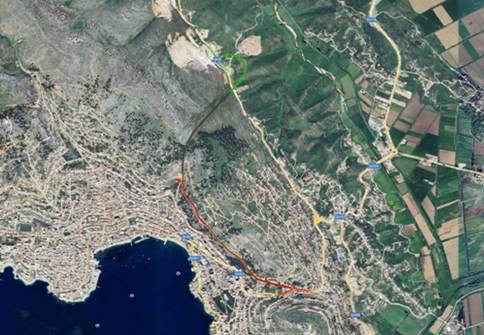
Fig. 1.
Proposed road route of the project
3. RESULTS AND
DISCUSSIONS
The road axis to be built is approximately 3.0 km long, and 750 m is
represented by a tunnel. The road will pass through difficult terrain, with
steep slopes, and with geometric limitations due to the presence of buildings
on both sides of the road. During field inspections, sporadic underground and
aboveground infrastructure elements have been identified, which will be treated
with care in later phases. The cross-section will consist of two 3.5 m wide
roadways, 2 m of parking pathway and 2 m wide ditch, as well as sidewalks
on both sides of the road, each 2 m wide. Project environmental impacts have
been assessed in relation to the state of the environment in the project
implementation site, with reference to the technical road construction project.
Technological processes are those of the construction phase, carried out by
construction firms, and generally consist of the following:
−
demolition of
concrete structures;
−
cleaning the site
and removing all inert waste;
−
selecting the area
where the machinery will be located;
−
elevation of the
construction site;
−
excavating and
filling the caisson;
−
construction of the
road layers (body);
−
construction of
asphalt layers;
−
construction of
sidewalks;
−
hydro technical
works (hydrants, sewage, etc.);
−
works for the
electrical network;
−
application of
paint;
−
road signs and
protection.
The raw materials used are mainly concrete mortar, monolithic concrete
structures, stabilizers for the road body, sand, gravel, bitumen for asphalt
layers, and two-component paint. The following potential negative impacts on
the environment will be highlighted:
−
social impact,
−
impact on waste
generation,
−
impact on road
traffic,
−
impact on air
quality,
−
impact on noise,
−
impact on
biodiversity,
−
impact on water
resources,
−
impact on working
environments and human health,
−
visual impact,
−
impact on land,
−
impact on cultural
and archaeological heritage.
Each impact has been assessed using the criteria in the table below. To
provide a relative illustration of the magnitude of the impact, it is useful to
assign numerical or relative descriptors of the intensity of the impact and the
sensitivity of the receptor for each potential impact. Each criterion has been
assessed according to a numerical scale (Table 1).
Tab. 1
Environmental impact assessment criteria
|
|
Classification |
Description |
|
1 |
The extension |
Assessment of the area of
occurrence/influence of the impact on the environment. If the impact occurs
locally, in a limited area (within a radius of 2 km from the project area);
at the local level (within a radius of 5 km); regional (at the district, national
or international level). |
|
2 |
Continuity/duration |
Assessment of the duration of the impact on
the environment, if the impact will be temporary (<1 year); short-term
(1-5 years); medium-term (5-10 years); long-term (>10 years); or
permanent. |
|
3 |
Social
context/sensitivity or potential for conflict between actors |
Assessment of impacts for
sensitive receptors in terms of ecological, social sensitivity and aspects
such as rare and endangered species, sensitive ecological and endangered
environments, architecture, social or cultural environment, high potential
for conflicts of interest and different stakeholders. The sensitivity
classification is presented as follows: High
sensitivity: Displacement of entire communities,
destruction of world heritage or important cultural sites, large-scale
conflict of interest groups, etc. Average sensitivity: Displacement of several
families, moderate level of concern to stakeholders. Low sensitivity: No relocations are necessary;
there is no potential for stakeholder conflict. |
|
4 |
Compliance with legal
requirements and regulatory framework |
Impact assessment on national and
international legal requirements. High: Major
violations of regulatory requirements that could result in criminal
prosecution or significant delays in project approval. Medium: Potential
violations of specific regulatory framework boundaries that could result in
non-compliance. Low:
No violations of specific regulatory framework boundaries are anticipated. |
|
5 |
Overall impact assessment (Significance) |
Using a combination of
the above criteria, the overall significance of the impact is categorized as:
very large, substantial, moderate, small and negligible. |
3.1. Environmental impacts
Social
impacts
Positive social impacts:
−
Improvement of
existing roads and infrastructure for residential areas and residents;
−
Traffic relief due
to the improvement of existing roads and infrastructure;
−
Noise reduction and
stress reduction as a result of traffic improvement.
Negative social impacts: During the construction phase:
−
Temporary blockage
of various road segments;
−
Increased traffic
during works in various segments;
Waste
generation
The construction phase is accompanied by excavation processes. This
project will generate around 70150 m3 of soil, part of which will be
reused for filling, while the rest will be removed. Inert waste from excavation
processes will be removed to their disposal areas, previously approved by the
Municipality of Saranda. Meanwhile, during the construction phase, inert waste
as well as urban waste will be generated from the human activity of workers
working on the road construction. Contractors must separate, at source, inert
waste from other waste generated from the construction phase (excavations,
soil). Determining the route and timing of heavy trucks transporting waste is
important, with the aim of avoiding residential areas or other sensitive human
receptors as much as possible. All waste must be disposed of in approved
landfills under agreements with the waste disposal site manager, approved by
the municipality. Hazardous waste, such as paints, adhesives, and various
chemicals, should be managed by a contractor certified by the National
Environmental Agency. Supervising engineers should ensure that contractors do
not illegally dump waste in areas other than those approved for waste disposal.
Impact
on road traffic
During the construction phase, due to the narrowing of
roads during the works, there is expected to be an impact on road traffic.
During the operational phase, no impacts on road traffic are expected as the
works are carried out precisely with the aim of improving infrastructure and
easing traffic.
Impact
on air quality
Air pollution resulting from construction works, such as
dust emissions, will increase especially when working with equipment in
processes with "dry" materials. This impact will be local and only
during the construction phase. There will potentially be a moderate increase in
the level of PM10 and PM2.5 in the air. This amount of
dust will mainly affect the air quality in the vicinity of the construction
site. There may be emissions of gases from fuel combustion by machinery and
equipment operating on the construction site (CO2, SO2,
NOx, VOC gases emitted from the combustion of fuels).
Noise
impact
The noise impact during the construction phase is
temporary and local. Noise sources can be numerous and can be caused by
construction works from equipment, such as generators, and machinery, such as
excavators, transport trucks, etc. The noise impact will be felt in the area
where the works are carried out and in the vicinity of the nearby facilities,
especially on roads that may be located near various institutions or near
citizens' homes.
Impact
on biodiversity
Vegetation cover near the project area consists mainly of
ornamental trees and shrubs, typical of urban areas. These species are planted
by the local administration for ornamental purposes. During the implementation
of the project, vegetation cover will not be affected by the works. The impact
may come through the rise of dust in various possible cases during the work.
Impact
on water resources
During the construction phase, there will be no direct
pollution of water sources. There may be a potential increase in solids in
areas where rainwater is discharged and consequently in surface waters, as a
result of the leaching of excavated soil surfaces (during periods of rainfall).
There is no negative impact during the operational phase of the roads.
Impact
on working environments and human health
In order to prevent the negative impacts of construction
activities on health and the environment, from the failure to implement
occupational safety regulations, and from the failure to take safety
precautions, the construction company must implement an occupational health and
safety management system. This system is defined for construction activities
according to the relevant legislation. No negative impact is expected after the
completion of the construction processes.
Visual
impact and landscape
During the construction phase of this project, there are
expected to be both temporary and permanent changes to the landscape. Some
general negative impacts are:
−
visual changes to
the location where the works will be carried out;
−
visual changes from
the installation of construction equipment and machinery, which will be used
and installed temporarily during the construction phase.
During the construction phase, temporary damage will
negatively affect the landscape (e.g., the presence of piles of soil,
aggregates or construction materials).
The visual impact will be temporary, and after the
completion of each segment, the area will be rehabilitated immediately. At the
end of the road construction activity, the impact on the landscape will be
positive and permanent.
Impact
on the soil surface
There may be contamination of the soil surface due to
leaks, accidental spills of hydrocarbons, lubricants from equipment, and
machinery operating on site during the construction phase. No impact on soil
quality is expected after completion of construction processes.
Impact
on cultural and archaeological heritage
The areas through which the project passes and where the
works will be carried out are close to two archaeological sites. Construction
works will be carried out with the utmost care to ensure that these areas of
known archaeological value are not affected.
3.2. Discharges of wastewater, gases, dust,
noise, vibrations and waste generated
During the 3-year construction period, emissions to the
environment are of a temporary and relatively short-term nature. Expected
emissions to the environment are estimated as follows:
−
soil from the
excavation process;
−
generation of
polluted water from the employee’s activity operating on the site;
−
gas emissions from
the combustion of fuel from vehicles operating on the site;
−
inert waste from
the road construction process;
−
urban waste from
the human activity of the company operating on the site;
−
PM10, PM2.5, TS PM
emissions;
−
noise emissions.
3.2.1. Soil and inert materials generated from
excavations
Inert waste from excavation processes / soils will be
deposited in the landfill and then reused for various fillings. It has been
estimated that insignificant amounts of inert will be generated, as well as
soil will be generated from excavation processes.
3.3. Discharges of urban wastewater and urban waste
from employees’ activity involved in the project
Many workers will be hired to build the road. Under these
conditions, there will be discharges into the environment from the human
activity of the employees involved in the project. Urban waste generated by the
employees will be collected and managed by the company that manages the
collection and transport of urban waste in the Municipality of Saranda,
according to the relevant contractual agreements. Wastes will be removed within
the day, so as not to hinder further work and not pollute the environment. Urban
wastewater will be managed through licensed subcontractors for the collection
and treatment of urban wastewater (mini portable toilets). The amount of waste
generated by human activity is considered insignificant in reference to the
urban waste generated by the residents of Saranda. Since the employees involved
in the project will be mainly residents of the area, urban waste is part of the
same matrix, location, waste dump and disposal site as if they were carrying
out another activity within the Saranda area.
3.4. Assessment of the significance of negative
environmental impacts
The nature of impacts can be categorized in terms of:
Direction - Positive or negative
Duration - Long-term or short-term
Location - Direct or indirect
Magnitude - Large or small
Extent - Widespread or local
Significance - Large or small
Tab. 2
Methodology
for assessing the significance of potential negative impacts on the environment
|
Category |
Description |
|
Low |
The impact
is temporary, slightly damaging natural values, both in quality and quantity
(volume). Once the action that causes it is completed, it no longer has any
effects on the environment. |
|
Medium |
The impact is temporary, but in the
absence of control and management measures, it may cause long-term impacts on
natural values. The alienated area is not restored to its original state, but
occupies an acceptable ratio with the total area of the project, and only the
construction area of the facility is alienated. The impact does not represent
discharges of pollutants into the environment. |
|
Considerable |
The impact
is permanent and extends beyond the affected area (displacement, pollution,
noise, and air emissions). The impact compromises the rates of emissions into
the environment and the rates of environmental use. |
|
Reversible |
The effect ends when the cause is
stopped and the affected environment regains its natural state. |
|
Partially Reversible |
The effect
continues partially even after the cessation of the cause that causes it.
(Continues the negative effect on the environment partially) |
|
Irreversible |
The consequences of the impact are
irreversible (continue to have a negative effect on the environment) even
after the action causing the impact ends. |
To identify the impacts associated with the construction
of the proposed road infrastructure, an impact matrix has been raised, which
presents the main project activities against relevant environmental factors.
This matrix is presented in Table 3.
4. CONCLUSIONS
AND RECOMMENDATIONS
From the review of all environmental impacts for the road
infrastructure construction project, the following was concluded.
The identified potential environmental impacts have been
assessed and addressed according to the required legal standards, methodology
and recommendations.
Project implementation with the foreseen mitigation
measures guarantees not only the achievement of the objectives but also
environmental performance in full compliance with the laws in force, regarding
the level of emissions into the environment and its protection.
Tab. 3
Environmental
impact matrix in the construction phase
|
|
Activity/ Impact |
Direction |
Duration |
Magnitude |
Extension |
Importance |
||||||||
|
Positive |
Negative |
Long term |
Medium
term |
Short term |
High |
Medium |
Small |
Wide |
Local |
High |
Medium |
Small |
||
|
A |
Transport of materials to the
facility |
|||||||||||||
|
Dust emissions during loading,
transportation of materials |
|
x |
|
|
x |
|
x |
|
|
x |
x |
|
|
|
|
Emissions from material transport vehicles |
|
x |
|
|
x |
|
x |
|
|
x |
x |
|
|
|
|
Traffic congestion from vehicle
traffic |
|
x |
|
|
x |
|
x |
|
|
x |
x |
|
|
|
|
B |
Road construction works |
|||||||||||||
|
Noise, vibrations |
|
x |
|
|
x |
|
x |
|
|
x |
x |
|
|
|
|
Dust |
|
x |
|
|
x |
|
x |
|
|
x |
x |
|
|
|
|
Gas emissions from machinery
operating in the facility |
|
x |
|
|
x |
|
|
x |
|
x |
|
x |
|
|
|
Visual appearance |
|
x |
|
|
x |
|
|
x |
|
x |
|
x |
|
|
|
Soil generation
from excavations |
|
x |
|
|
x |
|
|
x |
|
x |
|
|
x |
|
|
Urban waste generation from the company's human
activity |
|
x |
|
|
x |
|
|
x |
|
x |
|
|
x |
|
|
Generation of inert waste from
construction (construction waste) |
|
x |
|
|
x |
|
|
x |
|
x |
|
|
x |
|
|
Generation of urban wastewater from the company's
human activity |
|
x |
|
|
x |
|
|
x |
|
x |
|
|
x |
|
|
|
Soil contamination due to
mechanical failures in the project area |
|
x |
|
|
x |
|
|
x |
|
x |
|
|
x |
|
Impact on existing vegetation
during the construction phase |
|
x |
|
|
x |
|
|
x |
|
x |
|
|
x
|
|
|
Job creation |
x |
|
|
|
x |
|
|
x |
|
x |
|
x |
|
|
|
Urban area development |
x |
|
x |
|
|
x |
|
|
x |
|
x |
|
|
|
|
Visual appearance of the area after improvement
and/or construction |
x |
|
x |
|
|
|
x |
|
|
x |
|
x |
|
No significant impacts are identified that would affect
the quality of the environment from the implementation of the project.
From the analysis of the content of this study, the
implementation of this project will not have significant negative impacts on
the environment surrounding the project areas during its construction phase,
while after the construction phase, there will be an improvement in road
standards, consequently reducing traffic.
During the construction phase, it is recommended to fence
off temporary areas where work is being carried out and to place warning signs
regarding the risks to passersby and workers; to carry out occasional wetting
of surfaces where there is the presence of materials that cause dust on the
city streets.
As a result of the implementation of the project, no
significant environmental, social and human health impacts will be incurred.
It is recommended to maintain green areas and to plant
native decorative plants in artificial conditions, to increase in every case
that is possible the green coefficient.
The use of generators must be avoided as much as
possible, and noise must be reduced in the late hours.
The impact on archaeological areas near the project
should be avoided as much as possible during construction works.
Awareness-raising advertisements should be placed for
employees and citizens for a clean environment.
The construction company must take into account the legal
framework for the environment and its changes.
By placing special containers for the collection of urban
waste and including them in the existing scheme for the collection and disposal
of urban waste, the problem of evacuating waste to the location settled by the
municipality, as well as to other areas of the municipality's territory, is
solved.
The cleanliness of the area's environment will be
constantly maintained to guarantee a cultured environment within the project
area.
It is recommended to build green areas where necessary,
with decorative trees and shrubs, and to landscape the spaces around roads.
References
1.
Faber P., F. Drewnick, S.
Borrmann. 2015. “Aerosol particle and trace gas emissions from earthworks, road
construction, and asphalt paving in Germany: Emission factors and influence on
local air quality”. Atmospheric
Environment 122: 662-671. ISSN: 1352-2310. DOI: 10.1016/j.atmosenv.2015.10.036.
2.
Font A., et al. 2014. “Degradation in urban air
quality from construction activity and increased traffic arising from a road
widening scheme”. Science of the Total
Environment 497-498: 123-132. ISSN: 0048-9697. DOI: 10.1016/j.scitotenv.2014.07.060.
3.
Fu M., et al. 2012. “Characteristics of typical
non-road machinery emissions in China by using portable emission measurement
system”. Science of The Total Environment
437: 255-261. ISSN: 0048-9697. DOI: 10.1016/j.scitotenv.2012.07.095.
4.
Torén K., B. Järvholm. 2014. “Effect of occupational exposure to vapors, gases, dusts, and fumes on COPD mortality risk
among Swedish construction workers: a longitudinal cohort study”. Chest 145(5): 992-997. DOI: 10.1378/chest.13-1429. PMID: 24264472.
5.
Giunta M. 2020. “Assessment of the environmental
impact of road construction: Modelling and prediction of fine particulate
matter emissions”. Build. Environ
176: 106865.
6.
Zheng Z., X. Gao, J. Wang, X. Ji. 2019. “Prediction
Model for Energy Consumption and Carbon Emission of Asphalt Surface
Construction”. International Conference
on Advances in Civil Engineering, Energy Resources and Environment Engineering
330: 1-9.
7.
Plati C. 2019. “Sustainability factors in pavement
materials, design, and preservation strategies: A literature review”. Construction
and Building Materials 211: 539-55.
8.
Jones R., J. Llewellyn. 2019. “Improving
infrastructure”. National Institute
Economic Review 250(1): R61-R68. DOI: 10.1177/002795011925000119.
9.
Aryan Y., D.A. Kumar, Sh.A.
Mohan. 2024. “Assessment of environmental impacts and reduction opportunities
for road infrastructures in India”. Transportation Research Part D:
Transport and Environment 128: 104106.
10. Chen Z., Y. Li, Y.
Liu, X. Liu. 2021. “Does rural residential land expansion pattern lead to
different impacts on the eco-environment? A case study of loess hilly and gully
region, China”. Habitat International 117: 102436. DOI: 10.1016/j.habitatint.2021.102436.
11. Fernandez L., R.
Acheampong. 2019. “Social impacts of road infrastructure development”. Journal
of Social Change 31(4): 210-229.
12. Kuncoro E., R.N. Wurarah, I.E. Erari. 2024. “The
impact of road infrastructure development on ecosystems and communities”. Social, Ecology, Economy for Sustainable
Development Goals Journal 1(2): 78-90. DOI: 10.61511/seesdgj.v1i2.2024.336.
13. Ruggerio C.A. 2021.
“Sustainability and sustainable development: A review of principles and
definitions”. Science of the Total
Environment 786: 147481. DOI: 10.1016/j.scitotenv.2021.147481.
14. Report on Strategic
Environmental Assessment for the Local General Plan of Saranda Municipality. 2017.
Received 07.10.2025; accepted in revised form 14.02.2026

Scientific Journal of Silesian
University of Technology. Series Transport is licensed under a Creative
Commons Attribution 4.0 International License