Article
citation information:
Batko,
W., Bąkowski, A., Radziszewski, L. Diagnostic of exceedances of permissible noise levels
in the environment. Scientific Journal of
Silesian University of Technology. Series Transport. 2026, 130, 41-52. ISSN: 0209-3324. DOI: https://doi.org/10.20858/sjsutst.2026.130.2
Wojciech BATKO[1], Andrzej BĄKOWSKI[2], Leszek RADZISZEWSKI[3]
DIAGNOSTIC OF
EXCEEDANCES OF PERMISSIBLE NOISE LEVELS IN THE ENVIRONMENT
Summary. The article analyses
the calculation rules for assessing the exceedance of permissible noise levels
generated by road transport vehicles, their interpretation and application.
Possible limitations and interpretation errors associated with the currently used
rules for quantifying exceedances of permissible noise levels in the
environment are highlighted. The related application consequences were
discussed. Attention was drawn to the advisability of searching for a different
methodology for classifying the results of exceedances of permissible noise
levels, in relation to the acoustic protection of the environment applicable in
practice. It was proposed that the methodology of modeling
should be linked to the choice of a metric appropriate for comparisons of
decibel numbers in the space of modeling the
conditions of their reception by humans. Examples of metrics meeting the new
criteria for the analysis of exceedances of permissible noise levels in the
environment are provided. The authors, using the example of the analysis of
noise monitoring results on one of the main communication arteries of the city
of Kielce, presented the functioning of the new idea of classifying exceedances
of permissible noise levels. The article presents a verification of the noise threat
assessment using the Euclidean measure of exceedances of permissible noise
levels, and using a measure that meets the requirements of the metric for
the decibel space of human perception of acoustic phenomena. Statistical
characteristics of the analyzed measures of
exceedances of permissible noise levels are presented.
Keywords: noise, regulations, traffic
1. INTRODUCTION
The
current criteria for assessing exceedances of permissible noise levels in the
environment defined by national regulations [6], acoustic standards and World Health Organization (WHO)
[4,5] guidelines - are based on the Euclidean measure [1] of the difference
between the measured (or calculated) level of the analyzed
noise indicator and the permissible value for it.
In
the practice of environmental research, such assessments are used for the
analysis of exceedances of various noise indicators, e.g., daytime and evening
noise level  , equivalent
sound level, tonal or impulse noise, or peak exceedances [12]. In the article,
the authors raised the problem of the correctness of the quantification of
acoustic hazards based on the Euclidean value of the difference [10] between
the control result and the permissible value for it. They paid the attention to
the fact that in the control assessments there may be exceedances described by
numbers from the lower range of the decibel scale, i.e. values less than 30 dB.
The interpretation of such results, in relation to
the guidelines defining permissible noise levels in the context of their
perception and potential harmfulness to human health, developed by WHO - raises
questions about the correctness of the assessment of acoustic hazards. The
procedures for assessing exceedances of permissible noise levels are
inconsistent (in the interpretation of their results) with the guidelines
intended to protect public health by minimizing the negative effects of noise
[13], such as sleep disturbances, concentration problems, hearing damage and
other health problems.
, equivalent
sound level, tonal or impulse noise, or peak exceedances [12]. In the article,
the authors raised the problem of the correctness of the quantification of
acoustic hazards based on the Euclidean value of the difference [10] between
the control result and the permissible value for it. They paid the attention to
the fact that in the control assessments there may be exceedances described by
numbers from the lower range of the decibel scale, i.e. values less than 30 dB.
The interpretation of such results, in relation to
the guidelines defining permissible noise levels in the context of their
perception and potential harmfulness to human health, developed by WHO - raises
questions about the correctness of the assessment of acoustic hazards. The
procedures for assessing exceedances of permissible noise levels are
inconsistent (in the interpretation of their results) with the guidelines
intended to protect public health by minimizing the negative effects of noise
[13], such as sleep disturbances, concentration problems, hearing damage and
other health problems.
It
is therefore reasonable to ask the question, to what extent are such
assessments correct? The authors verified them based on analyses of their
compliance with:
·
laws
describing human perception of acoustic hazards and the resulting nuisance and
health risks;
·
interpretation
of exceedances in the context of the sensitivity of the decibel scale
·
requirements that apply to the measurement
result comparison measures specified in the identification process methodology
·
the logic
of evaluating the result of calculations of exceedances of permissible noise
levels in relation to the calculation, inverse to the analysis of exceedances
of controlled noise indicators, consistent with the relations of decibel
algebra
·
relating
the results of the estimation of the uncertainty of control measurements of
acoustic hazards to the calculated exceedances of permissible noise levels.
It
should be noted that the problem of assessing the correctness of the current
rules for classifying acoustic hazards discussed in the article applies not
only to the assessment of the risk of nuisance resulting from exceeding the
permissible noise levels in the environment and the negative health effects
caused by them, but it also influences the answer to what extent current
regulations and legal provisions take into account the perception of noise
hazards and whether they provide an effective and adequate system of
instruments for the protection of the acoustic climate.
The
analysis results obtained in this work should be treated as a starting point
for the construction of new rules for the assessment of acoustic hazards to the
environment and an incentive for a broader discussion on the advisability of
changing the current rules for the quantification of acoustic hazards to the
environment.
2.
INFORMATIONAL CONTENT OF CURRENT MEASURES OF EXCEEDING PERMISSIBLE NOISE LEVELS
IN THE CONTROL OF ACOUSTIC ENVIRONMENTAL HAZARD
In
scientific research and its applications concerning the
“object-environment-human” system, an anthropocentric approach is necessary,
where the human is the most important part of the system. The results of
research on acoustic hazards must generate results that determine the solution
of many technical and decision-making problems related to human functioning in
the surrounding environment. Relating this requirement to the currently used
Euclidean measure of exceedances of permissible noise levels in the processes
of quantifying acoustic hazards, it should be stated that it is not selected
correctly. This measure does not properly relate to the conditions of human
perception of acoustic hazards and the resulting nuisance and health risks.
The decibel
classification of noise resulting from the Weber-Fechner psychoacoustic law
[9,14] is described by a nonlinear logarithmic relation. This relation takes into account the fact that
human hearing works non-linearly, which means that a 1 dB change in noise is
almost imperceptible to humans, a 3 dB change causes barely perceptible
differences, and only a 5 dB change causes clearly perceptible changes in the
noise level. Hence, not every formal exceedance of the standard resulting from
the current rules for assessing exceedances of permissible noise levels is felt
by people. This means that if the control measurement and its evaluation show,
for example, a formal exceedance of the standard by 2 dB, this may not be
noticeable for most people. In environmental acoustic studies, we usually deal
with exceedances described by numbers from the lower range of the decibel
scale, i.e. with values less than 20 dB. This range
of decibel numbers describing noise exceedances in the environment in the light
of the noise assessment criteria and their impact on humans proposed by WHO -
is classified as practically harmless values. Values in the range of 0 dB - 20
dB are considered comfortable sound levels, while noise levels in the range of
20-40 dB are classified as non-obtrusive, facilitating human concentration.
When analyzing the
information content of exceedances of permissible noise levels in the
environment, attention should be paid to the problem of the sensitivity of the
decibel scale, considered in the perception space of the obtained research
diagnosis in various ranges of the values of the analyzed
exceedances expressed in decibel numbers. In the range of [0 - 8] dB values,
significant deviations from the constancy of decibel numbers' representation of
the conditions of their perception by humans were found. From the results of
research analyses estimated by the dependence (1):
 (1)
(1)
it follows that for noise levels greater than 25 dB it can be assumed
that the sound level sensitivity coefficient has a constant value. In the range
of sound levels lower than 15 dB, significant deviations from the condition of
constancy of representation of acoustic disturbances perceived by humans from
noise levels were found, as illustrated in Fig. 1a.
a)
b)
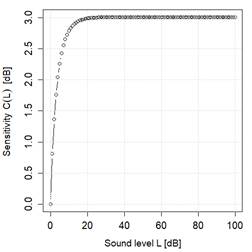
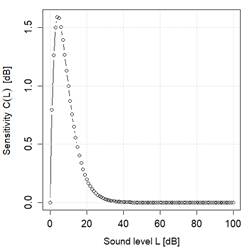
Fig. 1. The sensitivity of the
decibel scale C(L) describing the perception of acoustic phenomena
characteristic of calculations in the space of numbers: a) decibel, b)
Euclidean
In
particular, this problem raises doubts as to the validity of performing
identification calculations according to formulas assigned to Euclidean
numbers. The sensitivity of the decibel scale C(L) specific to calculations in
the Euclidean number space is given by the relation (2) and is presented in
Fig. 1b:
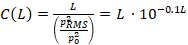 (2)
(2)
The
plot in Figure 1a for pressure levels in the range 0 dB to 15 dB is non-linear.
The sensitivity increases to approximately 3 dB and remains constant for higher
noise values, which is a desirable property of any electromechanical
transducer. Interpretation of the waveform from Fig. 1b in the decibel range
from 0 dB to 10 dB shows the presence of strong non-linearity and a maximum
sensitivity value. It is a strong message of detachment of acoustic
disturbances perceived by humans from the representing noise levels [8]. It follows from this that in the scope of
current administrative proceedings aimed at improving the acoustic climate in
the environment - based on the Euclidean measure of exceedances of permissible
noise levels, there may be significant errors of interpretation and
discrepancies in the correct connection of standard exceedances of noise levels
with the conditions of their perception by humans, and thus with their nuisance
and harmful effects on health. They refer to the non-linear sensitivity range
of the decibel scale. For noise levels greater than 30 dB, it can be assumed
that the value of the sensitivity coefficient of the equivalent sound level
does not change and has a constant and linear course. The maximum value of the
sensitivity is 1.6 dB, and the average value in the range [30 dB, 120 dB] is
0.0003 dB. The obtained results indicate the need to
depart from the Euclidean calculation of their identification, common in the
control of acoustic hazards to the environment, in the case of the analysis of
noise levels described by low decibel numbers.
Another interpretation problem concerning
exceedances of permissible noise levels in the environment is the issue of the
correctness of using the Euclidean measure to represent the conditions of their
perception by humans, analyzed through the prism of
the requirements placed on the metrics of decibel comparisons of measurement
results. The commonly used Euclidean measure  of comparisons of decibel values of noise
levels
of comparisons of decibel values of noise
levels  used in the process of identifying acoustic
hazards to the environment - determined by the results of the differences
used in the process of identifying acoustic
hazards to the environment - determined by the results of the differences  of noise levels - does not meet the
requirements of the metrics that specify conditions (a ÷ c). Consequently, this
measure is not appropriately chosen for comparisons of decibel measurement data
[15]. It is invalid for identification tasks performed in the metric
identification space appropriate for diagnostic tasks of the state of acoustic
hazards in the environment. The requirements of the measure (metric) for data
comparisons in the adopted space of modeling recognized states are determined
by the following conditions:
of noise levels - does not meet the
requirements of the metrics that specify conditions (a ÷ c). Consequently, this
measure is not appropriately chosen for comparisons of decibel measurement data
[15]. It is invalid for identification tasks performed in the metric
identification space appropriate for diagnostic tasks of the state of acoustic
hazards in the environment. The requirements of the measure (metric) for data
comparisons in the adopted space of modeling recognized states are determined
by the following conditions:
a)  ,
,
b)  (symmetry condition),
c)  (triangle condition).
In the decibel
database of measurement results – the implementation of the comparison of three
values  evaluated by their Euclidean differences – is
an improper process. These distances in the decibel space of human reception do
not meet condition (c).
evaluated by their Euclidean differences – is
an improper process. These distances in the decibel space of human reception do
not meet condition (c).
Example 1:
When we analyze the measurement results defined by the noise level
values: L1 =55 dB, L2 =50 dB, L3 =45 dB, their distances
calculated using the Euclidean measure are:
 ,
,  ,
,  .
.
They do not meet the
requirements that should be assigned to a measure correctly selected for their
comparisons in space consistent with the conditions of their reception by
humans. This is because condition (c) is not met:

This means that the
Euclidean measure of comparison of decibel scores in the acoustic hazard
identification process is inappropriate. This objection can be applied to tasks
related to the classification of acoustic hazard states. The current practice
of using the Euclidean measure in assessing exceedances of permissible noise
levels generates results with interpretational results that are difficult to
accept.
In the evaluation of the Euclidean metric of
exceedances of permissible noise levels, one can notice an inconsistency in the
perception of the result of exceedances given by the difference between the
control value and the permissible value in relation to the perception of its
inverse relationship, i.e. the perception of the result of the sum of
exceedances and the permissible value.
An example of the interpretational inconsistency of
exceedances of permissible noise levels calculated according to the current
Euclidean measure is the evaluation of the result of its reverse operation. The
result exceeding the permissible noise level added to the permissible noise
level value gives a result that does not match the measured noise level. This
means that such a result is separated from the calculation of decibel numbers.
It shows the lack of logic assigned to the interpretations assigned to the
description of the identification of acoustic hazards in the space of their
perception, i.e. their reception by humans. Such a situation is illustrated by
the data described in the example below.
Example 2
For
the Euclidean measure of exceedance  dB defined as the difference between the
measured noise
dB defined as the difference between the
measured noise  dB and the permissible value
  dB, the perception of the inverse relation,
i.e. the result of adding two noise sources given the permissible level value
of 45 dB and exceedances of 6 dB will take an almost unchanged value. This
results from the calculation of the addition operation: 45 dB
dB, the perception of the inverse relation,
i.e. the result of adding two noise sources given the permissible level value
of 45 dB and exceedances of 6 dB will take an almost unchanged value. This
results from the calculation of the addition operation: 45 dB  6 dB =
  45 dB. The
result of such an operation of 45 dB is different from the measured noise level
dB.
45 dB. The
result of such an operation of 45 dB is different from the measured noise level
dB.
When
considering the usefulness of the Euclidean measure of exceedances of
permissible noise levels, its usefulness should be considered in the context of
the uncertainty of acoustic environmental measurements. In control tests, a range of exceedances not exceeding 12 dB is often
found. Therefore, their references to the error tolerance field that may be
present in the processes of controlling acoustic hazards to the environment are
important. According to the work [3, 11], the type B uncertainty in the assessment
of environmental acoustic hazards is in the range of [0 - 5] dB. In control practice, there will often be situations in
which the uncertainty analyses of exceedances of acoustic environmental hazards
assessed using the Euclidean measure will be at a level comparable to the
control results. This fact may be a basis for questioning their credibility and
certain administrative and legal actions related to them. This situation is
well illustrated by the measurement data described in the example below.
Let the measured noise level in the environment as
a result of the control measurement be  dB, with the permissible noise
value dB. The basis for admiralty
actions, determining the requirements for the entity responsible for excessive
noise emission, will be the value of the Euclidean measure of exceedance ΔL = 3 dB, i.e. the difference between the measured
noise dB and the permissible value dB. Relating such a result - to
the uncertainty of type "B" encountered in environmental acoustic
studies [3] shaped at the level of [0, 5] dB - gives grounds to question the
validity of its recognition as a reliable basis for enforcing a decision based
on such a result.
dB, with the permissible noise
value dB. The basis for admiralty
actions, determining the requirements for the entity responsible for excessive
noise emission, will be the value of the Euclidean measure of exceedance ΔL = 3 dB, i.e. the difference between the measured
noise dB and the permissible value dB. Relating such a result - to
the uncertainty of type "B" encountered in environmental acoustic
studies [3] shaped at the level of [0, 5] dB - gives grounds to question the
validity of its recognition as a reliable basis for enforcing a decision based
on such a result.
The arguments presented above justify the need for
a broader verification of the usefulness of using the Euclidean measure to
assess exceedances of permissible noise levels and the search for new measures
of exceedances of permissible noise levels in the environment consistent with
their perception by humans. To more effectively assess the impact of
environmental noise on people, it is worth considering extending the current
methods with additional measures of exceedances of permissible noise levels. These
measures should be free from the interpretational limitations of Euclidean
measures of exceedances of permissible values of the analyzed
noise indicators, discussed in the previous point. An example of such a measure
is the operation of subtracting the levels of two noise sources in the decibel
number space, which determines the conditions for the perception of their
result:
 for
for  (3)
(3)
This measure meets the requirements in terms of the
exceedances it shows:
·
correct references to
the conditions of their perception by humans and the nuisances and health risks
resulting from them,
·
they are within the
fully acceptable sensitivity range of the decibel scale,
·
meet the metric
requirements for measuring comparisons of human perception of the difference in
noise levels between two sources,
·
the correctness of
the perception condition of the inverse relation to the operation of assessing
exceedances of the permissible noise level, i.e. the result of the sum of
adding two noise sources given the value of the permissible level and the value
of its exceedances,
·
acceptability of the interpretation in the
control process of uncertainty estimates of the result of exceedances of
permissible noise levels, conditioned by a significant difference in the noise
levels defining them.
3. RESULTS OF EXPERIMENTS VERIFYING PERCEPTUAL
MEASURES OF ACOUSTIC (NOISE) THREATS
The basis for the analyses were the results of the
equivalent sound level recorded by the noise monitoring station located in
Kielce at Popiełuszki Street [2]. The location of the
station in the urban layout of Kielce is shown in Figure 2.
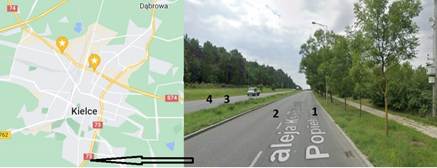
Fig. 2. Location of the monitoring station at Popiełuszki
Street in the urban layout of Kielce
Popiełuszki Avenue is part of the eastern bypass of Kielce and
national road no. 73 (Warsaw/Łódź – Kielce – Tarnów),
which is directly connected to the Trans-European Transport Network. Popiełuszki Av. is the main section of the exit route from
the center of Kielce towards Tarnów and serves both
urban, suburban and transit road traffic. All measurements were performed 24
hours a day. The equivalent sound level  (equation 4) was recorded for
three-time intervals: from 6:00 to 18:00, from 18:00 to 22:00 and from 22:00 to
6:00.
(equation 4) was recorded for
three-time intervals: from 6:00 to 18:00, from 18:00 to 22:00 and from 22:00 to
6:00.
 (4)
(4)
where: T - represents the overall measurement time, s;  - A-weighted sound pressure, Pa;
 - is the reference sound
pressure of 20 µPa;
- is the reference sound
pressure of 20 µPa;  - represents the effective sound
pressure. The results coming directly from the monitoring, i.e. the course of
the recorded values of the equivalent sound level for the times of the day:
day, evening and night are shown in Figure 3. These data were recorded in 2011.
It should be noted that for technical reasons, the station recorded data for
158 days.
- represents the effective sound
pressure. The results coming directly from the monitoring, i.e. the course of
the recorded values of the equivalent sound level for the times of the day:
day, evening and night are shown in Figure 3. These data were recorded in 2011.
It should be noted that for technical reasons, the station recorded data for
158 days.
The parameter used in environmental protection
programs against noise is the day-evening-night noise index  . For this reason, the authors analyzed exceedances of the permissible
values of this parameter. This index is a measure of the long-term or daily
average sound level, expressed in decibels (dB) [7] and determined according to
the relationships (5) and (6).
. For this reason, the authors analyzed exceedances of the permissible
values of this parameter. This index is a measure of the long-term or daily
average sound level, expressed in decibels (dB) [7] and determined according to
the relationships (5) and (6).
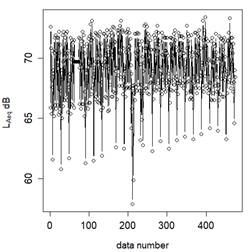
Fig. 3. Equivalent sound level values recorded by
the noise monitoring station
The daily noise index  is
determined according to the following relationship:
is
determined according to the following relationship:
 (5)
(5)
The long-term day-evening-night noise index is determined according to:
 (6)
(6)
where:  ,
,  ,
,  - equivalent sound level for three time periods: from 6:00 to 18:00,
from 18:00 to 22:00 and from 22:00 to 6:00, corresponding to the times of the
day, evening and night. The course of the noise index on the subsequent days is shown in Figure 4. For the analyzed data, the
value of the noise level index was
- equivalent sound level for three time periods: from 6:00 to 18:00,
from 18:00 to 22:00 and from 22:00 to 6:00, corresponding to the times of the
day, evening and night. The course of the noise index on the subsequent days is shown in Figure 4. For the analyzed data, the
value of the noise level index was  dB.
dB.
The basis for the assessment of acoustic
threats to the environment in the noise monitoring system was the Euclidean
measure of exceedances of the permissible value expressed by the following
relationship:
 (7)
(7)
Selected values of statistical parameters of this
quantity in relation to the permissible value of noise level  dB are presented in Table 1.
Tab.
1
Statistical
analysis of exceedances according to currently used Euclidean evaluation rules
|
Shapiro Wilk Test |
Quartile dB |
Logarithmic mean dB |
Median dB |
Quartile III dB |
Standard Deviation dB |
COV % |
Ua dB |
Skewness |
Kurtosis |
|
H0 Rejected |
3.93 |
4.46 |
4.64 |
5.25 |
1.45 |
34.14 |
0.12 |
-1.38 |
4.37 |
a)
b)
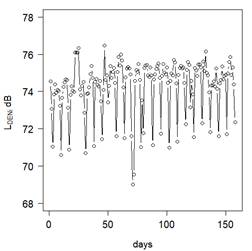
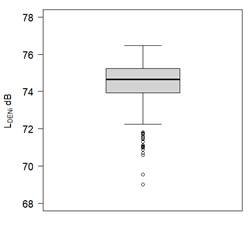
Fig. 4. Daily day-evening-night
noise index
a) course on subsequent days, b) box distribution of values
It includes parameters related to the distribution
and variability of the exceedance measure being studied. The compliance of the
distribution of the analyzed measure with the normal
distribution was also analyzed. The acceptability of
this hypothesis was verified using the Shapiro-Wilk test, the null hypothesis
of which H0 assumes that the analyzed variable
complies with the normal distribution. The average
value of the analyzed exceedances expressed in
decibel values was assumed to be their logarithmic mean according to the
following relationships: -  . Table 1 also shows the value coefficient of variation
 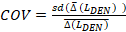 where sd denotes standard deviation and
  denotes type A standard uncertainty.
The next analyzed measure
is the exceedances assessed by the conditions of their reception by humans in
accordance with the Weber-Fechner law. This measure should be determined
according to the relationship (8):
 for (8)
 for
for 
Table 2 shows the values of the statistical
analysis of exceedances assessed by the conditions of their perception by
humans for the permissible noise level value dB.
Tab.
2
Selected
values of exceedances  of the
permissible noise level
of the
permissible noise level
 dB
assessed according to equation (8)
dB
assessed according to equation (8)
|
Shapiro Wilk Test |
Quartile dB |
Logarithmic mean dB |
Median dB |
Quartile III dB |
Standard Deviation dB |
COV % |
Ua dB |
Skewness |
Kurtosis |
|
H0 Rejected |
71.74 |
72.59 |
72.83 |
73.71 |
2.81 |
3.91 |
0.23 |
-1.82 |
5.6 |
The analysis of the statistical properties of the
solutions for assessing exceedances of permissible noise levels based on the
exceedance measure proposed by the authors (3) and the currently used Euclidean
measure (7) allows us to state that both measures generate results that do not
allow for the acceptance of the null hypothesis about the normality of the
statistics of exceedances of permissible noise values in the environment. It is
clearly seen that the density function of the normal distribution does not fit
the empirical distribution, as illustrated by the values of the skewness and
kurtosis parameters. This research result is often reported in environmental
noise studies. It forces the use of non-classical statistical methods in the
tasks of estimating the uncertainty of acoustic hazards in the environment [1].
Comparing the numerical data contained in Tables 1 and 2, it can be seen that
by using the exceedance measure consistent with the conditions of their
reception by humans, significantly higher numerical values of all parameters
characterizing the distribution of the tested variable were obtained in
comparison to the exceedances determined according to the currently used
Euclidean assessment rules. In the case of the logarithmic mean, its value determined
based on equation (8) was 72.6 dB in comparison to the value of 4.5 dB, which
was obtained for the currently used Euclidean exceedance measure. Such
representation means the correctness of the references of the results generated
by the measure proposed by the authors to the conditions of their perception by
humans and the associated nuisances and health hazards. A significant
difference in the comparison of the properties of both measures of exceedance
of permissible noise levels is the reference values of their coefficients COV.
In the case of using the proposed new measure of exceedances, the result of COV
obtained was over 11 times lower than the value assigned to the classical
assessments of exceedances of permissible levels. Exceedances assessed with
classical analysis rules are characterized by a median value of 4.6 dB and a
logarithmic mean of 4.5 dB. They are at a level fully
comparable to the B-type uncertainty occurring in environmental acoustic
measurements [3], which makes them unreliable in assessments of acoustic
hazards to the environment using the Euclidean measure of exceedances. When
using the new exceedance measure described by function (8a), the obtained
result is acceptable. The statistical evaluation of the results generated by it
is characterized by a standard deviation of 2.8 dB.
Compared to the exceedance estimates described by the median value of 72.3 dB
or the logarithmic mean of exceedances of 72.6 dB, it is at a level that
ensures the acceptability of the result of noise exceedance control, with an
appropriate level of its uncertainty. An important property of the proposed
measure for assessing exceedances of permissible noise levels is the compliance
of the results it shows with the conditions of their perception and harmfulness,
i.e. the criteria for assessing noise and its impact on humans proposed by WHO.
The results generated by it are in accordance with the decibel calculus inverse
to the analysis of exceedances of controlled noise indicators, which allows for
verification of the measurement result based on the calculated exceedances in
relation to the adopted permissible values. They also concern the range of the
constant sensitivity of the decibel scale, which is not ensured by using the
Euclidean measure of permissible noise levels. As a result of the presented
empirical analysis of exceedances of permissible noise levels, based on the
results of road noise monitoring in the city of Kielce, a need to change the
approach to diagnosing the state of acoustic threats to the environment was
identified. It is also advisable to introduce new measures of exceedances of
permissible noise levels into the practice of diagnosing the state of acoustic
threats to the environment.
4. CONCLUSIONS
The
analyses carried out have shown that the Euclidean measure of exceedances of
permissible noise levels present in the implementation standards of
environmental acoustic control has no reasonable references and interpretations
in relation to the conditions of their perception by humans. It is detached
from the conditions of decibel processing of measurement results appropriate to
the decibel algebra used in the processes of identifying acoustic hazards in
the environment. This conclusion results from the fact that the noise
exceedance levels are not consistent with the classification of noise levels in
the context of the conditions of their perception and potential harmfulness to
human health, developed by the WHO. The Euclidean exceedance measure used for
their estimation does not meet the conditions required for measures of
comparison of measurement results used in identification processes. The
exceedance results related to it do not allow for correct verification of the
measurement result by the reverse operation, i.e. the relation of adding the
exceedance values to the value considered permissible. An important premise in favor of rejecting the Euclidean measure of exceedances of
permissible noise levels in the control of acoustic hazards may be the
references of exceedances of permissible noise level standards to the value of
the control measurement uncertainty. In the case of small exceedances with
values not exceeding 5 dB, the estimated uncertainty of the control measurement
may be comparable to it or even smaller. Such a result will generate doubts as
to whether the standard has actually been breached. With higher, relatively
small values of exceedances calculated using the Euclidean metric, their
reference to the "type B" uncertainty (including those related to
errors in measurement instrumentation and measurement conditions) will always
generate doubts as to whether they are significant enough to enforce further
administrative or legal steps.
As
it results from the above reservations regarding the current - Euclidean
measure of exceedances of permissible noise levels in the environment - the
justification for its use should be verified. It is advisable to abandon it in favor of the presented measure appropriate to the process
of identifying the conditions of their perception by humans.
References
1.
Batko Wojciech, Paweł Pawlik,
Bartosz Stępień. 2015. Nieklasyczne metody statystyczne w ocenie niepewności
w badaniach i modelowaniu akustycznym. [In Polish: Non-classical
statistical methods for uncertainty assessment in acoustic research and modeling]. Wydawnictwo Naukowe Instytutu Technologii i
Eksploatacji-PIB, Radom.
2.
Bąkowski Andrzej,
Wojciech Batko, Leszek Radziszewski. 2024.
“Assessment of changes in environmental pollution by road noise using a scalar
measure”. Archives of Environmental
Protection 50(4): 31-42. DOI:
10.24425/aep.2024.152893.
3.
Craven
N.J., G. Kerry. 2007. A good practice guide on the sources and
magnitude of uncertainty arising in the practical measurement of environmental
noise. University of Salford School of Computing,
Science & Engineering Salford M5 4W T. ISBN: 0-9541649-0-3.
4.
Environmental
Noise Guidelines for the European Region. World Health Organization. 2018. ISBN:
978 92 890 5356 3. European Environment Agency.
5.
Environmental
noise in Europe. 2020. EEA Report No
22/2019. ISSN:
1977-8449. DOI: 10.2800/686249.
6.
ISO
1996-1:2016 - Acoustics Description,
measurement and assessment of environmental noise Part 1: Basic quantities and
assessment procedures.
7.
Khan
Diyar, Rafał Burdzik.
2023. “Measurement and analysis of transport noise and vibration: A review of
techniques, case studies, and future directions”. Measurement 220: 113354. DOI: 10.1016/j.measurement.2023.113354.
8.
Lenk
Claudia, et al. 2023. “Bio-inspired,
neuromorphic acoustic sensing”.
In: Bio-Inspired
Information Pathways: From Neuroscience to Neurotronics. Cham: Springer
International Publishing, p. 287-315. DOI: 10.1007/978-3-031-3670.
9.
Moore
Brian C.J. 2013. An
introduction to the psychology of hearing. Academic Press, 6th edition. ISBN: 0-12-398331-2.
10.
Moroe
Nomfundo, Mabaso Paballo. 2022. „Quantifying traffic noise
pollution levels: A cross-sectional survey in South Africa”. Scientific
Reports 121: 3454. DOI: 10.1038/s41598-022-07145-z.
11.
Peters
Robert. 2020. Uncertainty in acoustics:
measurement, prediction and assessment. CRC Press. DOI: 10.1201/9780429470622.
12.
Przysucha
Bartosz, et al. 2021. “Impact of the noise indicators components correlation
Ld, Le, Ln on the uncertainty of the long-term day–evening–night noise
indicator Lden”. Measurement 179:
109399. DOI: 10.1016/j.measurement.2021.109399.
13.
Sahu Alekh Kumar, et al. 2021. „Traffic noise and its impact on wellness of the residents in sambalpur city – A critical analysis”. Archives
of Acoustics 46(2): 353-363. DOI: 10.24425/aoa.2021.136588.
14.
Van Der
Helm Peter A. 2010. “Weber-Fechner behavior in symmetry perception?”. Attention, Perception, & Psychophysics
72: 1854-1864. DOI: 10.3758/APP.72.7.1854.
15.
Weidenfeld
Sarah, et al. 2021. “Short-term annoyance due to night-time road, railway, and
air traffic noise: Role of the noise source, the acoustical metric, and
non-acoustical factors”. International
Journal of Environmental Research and Public Health 18(9): 4647. DOI: 10.3390/ijerph18094647.
Received 21.10.2025; accepted in revised form 14.02.2026

Scientific Journal of Silesian
University of Technology. Series Transport is licensed under a Creative
Commons Attribution 4.0 International License